

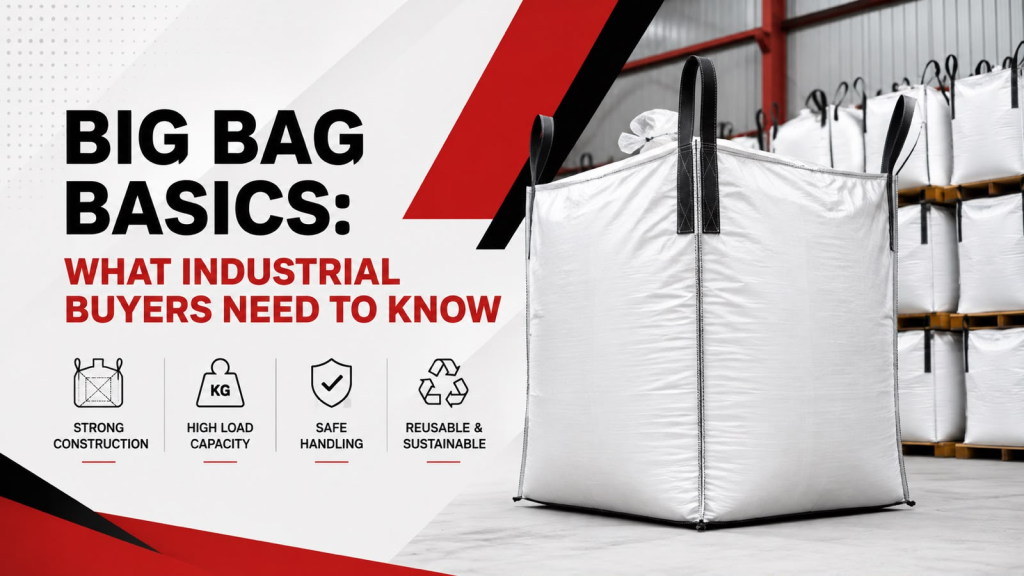
What is a big bag?
A big bag is a woven polypropylene container that moves dry bulk material in single units of 500 kg to 2,000 kg. The technical name is FIBC (Flexible Intermediate Bulk Container). ISO 21898 is the international standard covering FIBCs for non-dangerous goods. One unit combines the fabric body, lifting loops, a filling spout and a discharge spout into a single handling item.
Load rating is expressed as SWL (Safe Working Load) with a safety factor, the ratio between test load and working load. A 5:1 factor is the baseline for single-trip bags and 6:1 for multi-trip bags. Big bags occupy the middle ground between the small sack and the silo.
Why did bulk shipping move from small sacks to one-tonne units?
Bulk shipping moved to one-tonne units because handling cycles dominate operating cost. One 1,000 kg big bag replaces 20 sacks of 50 kg or 40 sacks of 25 kg. A single forklift movement then does the work of an entire pallet build. Labour hours, manual lifting risk and pallet wrapping consumption fall with it. Producers that weave their own fabric supply the format from integrated plants. Cesur started big bag production in 1985, after integrated sack manufacturing from 1981.
Freight economics reinforce the change. A one-tonne unit carries more payload per pallet footprint than stacked sacks, so a truck reaches its weight limit before its volume limit. Empty bags travel flat and stack in bales. Warehouse footprint follows: fewer, denser units mean fewer rack positions per tonne.
How does a big bag compare with other bulk formats?
Packaging format choice follows unit size, available equipment and flow rate. Small sacks, big bags and silo delivery each hold a distinct band of the supply chain. Volume per delivery and discharge method set the boundary between them.
| Format | Typical unit load | Handling | Storage | Typical use |
| Small sack | 25 to 50 kg | Manual lifting, hand stacking on pallets | Palletised racking | Retail-linked volumes, seed, specialty chemicals |
| Big bag (FIBC) | 500 to 2,000 kg | Forklift or crane, lifted by loops | Floor stacking or racking, flat when empty | Powders, granules, minerals, food ingredients |
| Silo or bulk tanker | 20 tonnes and above | Pneumatic or gravity transfer, no discrete unit | Fixed silo, permanent installation | Continuous single-material production, cement, flour |
Where do big bags fit in the supply chain?
Big bags start at the filler’s line and end at the customer’s discharge station. Filling runs over a weighing platform while product enters the top spout. The filled unit moves by forklift into block stacking, onto a pallet, or into a container.
Discharge decides many specification choices. A spout feeds a hopper, a mixer or a bag emptying frame, and a tie or valve controls flow. Sites without lifting height above head level need a low-headroom frame.
Which industries use big bags most?
Big bag users cluster in five sectors where material moves in tonnes rather than kilograms. Each sector brings its own hygiene, static and certification demands.
- Food: flour, sugar, starch and grain, needing hygienic production and a food-contact liner.
- Chemicals: resins, additives and fertiliser, where static behaviour and dangerous goods rules apply.
- Construction: cement, dry mortar, sand and aggregates, where abrasion and outdoor exposure matter.
- Agriculture: seed, feed and soil improvers, often shipped in ventilated bags that allow air exchange.
- Minerals and mining: ores, salt and silica, where high density pushes buyers toward smaller bags.
Food and pharmaceutical buyers add a further layer. Hygienic FIBC lines run in classified cleanrooms, and class 100,000 is the reference level. Schemes such as BRCGS (Brand Reputation Compliance Global Standards) and HACCP (Hazard Analysis and Critical Control Points) document the hygiene system behind those lines.
What do buyers specify when ordering big bags?
Specification starts with the material, not with the bag. A supplier quoting without bulk density and discharge method is guessing, and the result will either overfill or run half empty.
- Bulk density in kg per cubic metre, which converts target weight into bag volume.
- Target fill weight, required SWL, and single-trip or multi-trip service.
- Fill method: open top, duffle top, or a spout matched to the line head.
- Discharge method: flat bottom, spout, or full-opening bottom for sticky material.
- Handling equipment on both sides, including loop length and lifting headroom.
- Storage conditions: indoor or outdoor, stacking height, duration of UV exposure.
- Liner requirement: barrier, bottle-shaped or conductive, depending on moisture and static risk.
- Print and traceability: batch coding, language, number of printed panels.
- Certification scope: food contact, dangerous goods approval, or a defined static protection type.
Which safety ratings and certificates apply?
Static electricity classification separates FIBC types. Type A carries no static protection and Type B limits breakdown voltage. Type C uses conductive threads and must be grounded during filling and discharge. Type D dissipates charge without a ground connection. IEC 61340-4-4 defines the test methods behind these types.
Dangerous goods add a separate approval track. UN and ADR rules govern bags carrying hazardous material, and those units are tested and marked accordingly. Management system certificates sit alongside product standards: ISO 9001 for quality, ISO 14001 for environment and ISO 50001 for energy are the schemes tenders request most.
What does a big bag cost beyond the unit price?
Unit price is the smallest part of the total cost picture. A bag that costs less but splits during discharge erases its own saving within one shipment.
- Handling labour per tonne, measured in forklift cycles rather than bag count.
- Freight efficiency, meaning payload achieved per container or truck load.
- Storage cost, driven by stacking height and floor area per tonne.
- Product loss at filling and discharge, including residue left in the corners.
- Disposal cost or reuse value at the end of the cycle.
- Downtime risk when bag dimensions do not match installed filling and emptying frames.
Buyers comparing quotations convert every offer into a cost per tonne handled. That figure exposes cases where a cheaper bag needs a smaller fill weight, and therefore more cycles and more freight.
How do recycled content and reuse change the sustainability case?
Recycled polypropylene enters big bag production through two routes. PCR (post-consumer recycled) material comes from products that finished their service life. PPR (post-production recycled) material comes from manufacturing offcuts. Producers offering both routes include Cesur, which publishes an annual capacity of 15 million bags.
Reuse is the second lever and it depends on the safety factor. Bags rated 6:1 serve multiple trips, provided each unit passes inspection and cleaning. Bags rated 5:1 stay single-trip for the same load class. The polypropylene stays recyclable, so waste planning belongs inside the procurement decision.
Big bag procurement: the points that decide the order
Bulk density and discharge method decide more of the specification than any other input. Those two figures set bag volume, base design and liner choice before price enters the conversation.
Static classification is a safety boundary, not a preference. Combustible powders push the order toward Type C or Type D, and Type C brings a grounding duty at the receiving plant.
Cost per tonne handled is the only comparison that holds across quotations, because it captures fill weight, cycle count and freight use at once. Certification scope should match the sector: food, pharmaceutical and dangerous goods loads each demand documented systems.
This content is general information about bulk packaging and does not replace supplier technical documentation. Specifications and load ratings change over time, so verify current details with the manufacturer before ordering.
Frequently Asked Questions
What is a big bag made of?
A big bag is made of woven polypropylene fabric, a plastic yarn woven into a flexible sheet, then cut and sewn into a container. Lifting loops are stitched into the body. An optional polyethylene liner adds moisture, barrier or static protection.
How much weight can a big bag carry?
Typical big bags carry between 500 and 2,000 kg, with 1,000 kg the most common working load. The label figure is the SWL, and every bag is built against a safety factor above it. Actual fill weight depends on bulk density, not bag size.
Can a big bag be reused?
Reuse depends on the safety factor. Bags built to a 6:1 factor serve multi-trip duty, returning after inspection and cleaning. Bags built to 5:1 stay single-trip for the same load class. Damaged loops or a contaminated interior remove any bag from reuse.
Which big bag type suits combustible powders?
Combustible powders normally require Type C or Type D bags. Type C contains conductive threads and must be connected to ground during filling and discharge. Type D dissipates static charge without a grounding connection, which suits sites without reliable grounding. IEC 61340-4-4 defines the test methods.
What information does a supplier need for a quotation?
A supplier needs the product name, bulk density, target fill weight, fill and discharge method, handling equipment, storage conditions and certification requirements. Print artwork and annual volume complete the request. Without bulk density the supplier cannot calculate bag volume, and the quoted dimensions will not fit the intended load.
