

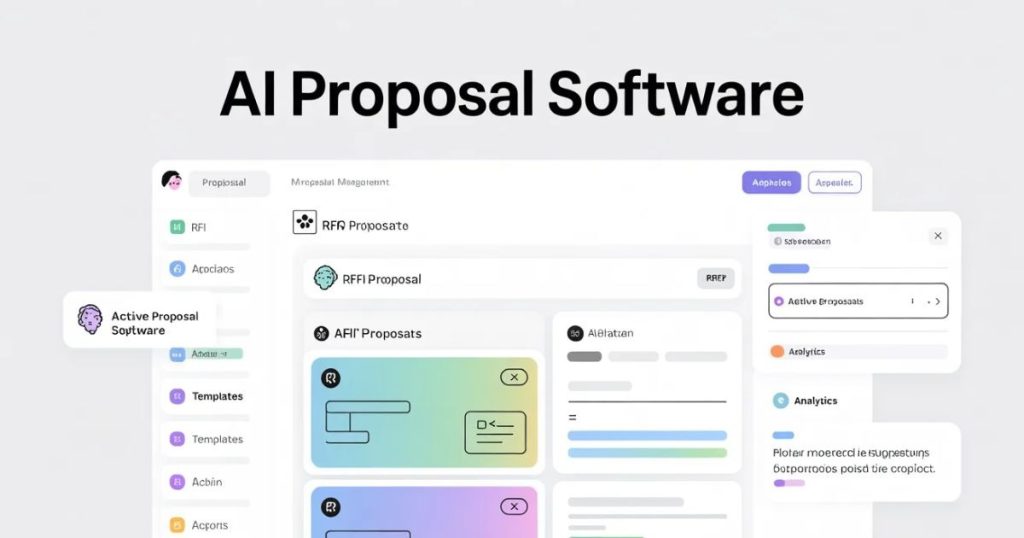
In the highly competitive modern business world, efficient proposal management can be the difference between contract success and failure. AI-powered proposal software, such as EasyAutofill by EA Global, automatically prepares RFIs, RFPs, and tenders, lessening human input and enhancing precision. With this technology, organisations can make consistent, high-quality submissions and remain compliant and ready for audits.
Using AI (NLP) and advanced machine learning, proposal software can analyse past submissions, derive pertinent insights, and generate tailored responses to new opportunities. Using such software, companies save time and foster better collaboration across departments, so that all submissions sound and look like they were made by the organisation’s experts.
What is Proposal Software?
Proposal software is a dedicated application that allows automating the process of creating, managing, and submitting business proposals. By combining NLP and AI algorithms, it can analyse the RFP requirements, extract relevant data from previous responses, and populate new documents efficiently.
Key Features of AI Proposal Tools
- Automatic Answer Reuse – Reuse already approved responses by automatic copy-pasting.
- Smart Autofill – Upload any document and get specific answers quickly.
- Collaboration Tools- Delegate questions to subject matter experts to review.
- Compliance and Audit Support – keep expiry dates of validated answers.
- Multi-Format Compatibility- Word, Excel, PDF, and other documents.
Benefits of Using Proposal Software
- Time Saving – Finish RFIs, RFPs, and tenders within minutes.
- Consistency -Make each submission compliant with corporate standards.
- Better Precision -Minimise human error by using AI-generated responses.
- Improved Teamwork – Fluid communication between teams.
- Scalability – Support a growing number of proposals without additional resources.
How NLP Enhances Proposal Automation
Natural Language Processing (NLP) allows proposal software to comprehend, interpret, and write in a natural language. It determines significant requirements, aligns them with past responses, and provides semantic correctness. This reduces redundancy and enables teams to focus on strategy rather than format and writing.
The Role of LSI Keywords in AI Proposal Software
Latent Semantic Indexing (LSI) keywords help AI identify context and relevance. The software incorporates LSI keywords related to tenders, bids, RFPs, and corporate compliance to ensure that responses are contextual, search engine-friendly, and consistent with client expectations.
Streamlining Corporate Workflows
Using software for proposals, businesses can automate end-to-end workflows:
- Upload RFIs, RFPs, and tenders to the platform.
- Auto-fill on AI-generated answers in proven templates.
- Give subject-matter experts the ability to polish responses in a shared Scratchpad.
- Send completed proposals that are ready for client review.
- This method drastically reduces turnaround time and enhances overall efficiency.
Security and Compliance
EasyAutofill proposal software provides data protection through role-based access control (RBAC) and approval workflows. Adherence is ensured through audit-ready logs and expiry dates for validated responses. This ensures that any sensitive data is kept secure and that all submissions meet regulatory standards.
Choosing the Right Proposal Software
When selecting software for proposals, consider:
- Ease of Integration – Needs to integrate with the current CRM, SharePoint, or document storage.
- AI Capabilities – NLP and LSI support for context-aware responses.
- Collaboration Features – This capability allows you to assign, review, and approve answers.
- Scalability & Support – The platform must be able to scale with your business.
The platform provided by EA Global is a solid blend of the mentioned features and is therefore an excellent pick in both the technological and corporate markets.
Future of Proposal Management
AI-based automation is the future of proposal management. Businesses can attain by adopting software with advanced NLP to make proposals:
- Faster response cycles
- Improved win rates
- Reduced human error
- Greater scalability
- Search and relevance optimised content.
The development of AI tools does not stop, as the technology includes machine learning that enhances predictive reactions and keeps corporate knowledge bases optimised.
Conclusion
Competitive companies can no longer afford to invest in proposal software as an option. Features such as EasyAutofill, offered by EA Global, use AI, NLP, and LSI keywords to automate RFIs, RFPs, and tenders, enabling faster, more accurate, and more consistent submissions. It allows businesses to concentrate on strategy and growth rather than manual document preparation by simplifying their workflows, facilitating collaboration, and ensuring compliance.
To keep up with the competition, organisations should consider adopting EA Global AI-based proposal automation tools to revolutionise the process of managing and submitting a proposal.
