


Starting a sustainable clothing brand on a limited budget creates a sequencing problem. Founders need enough evidence to make credible claims, but spending early capital on broad certifications, large inventories, or polished sustainability messaging can delay product validation.
Material selection is one of the earliest decisions customers can evaluate, but the fiber name alone is not enough. Composition records, supplier documentation, sample performance, and reorder consistency provide more substance than a broad “eco-friendly” label.
The practical goal is to verify one product, one material specification, and one defensible claim before increasing production. The following steps show where to direct a limited budget first.
Why Most Sustainable Brand Guides Get the Budget Part Wrong
The certification trap new founders fall into
Third-party certification can strengthen a brand’s claims, but a startup does not necessarily need to certify its own operation before validating demand. A practical first step is to work with suppliers that can provide documentation appropriate to the claim. For GOTS materials, verify the supplier’s valid Scope Certificate and request a Transaction Certificate covering the specific shipment; a Scope Certificate alone does not prove that the delivered goods are GOTS certified. Certification systems also serve different purposes: GOTS applies environmental and social requirements across organic textile processing, while OEKO-TEX STANDARD 100 tests textile components and products, from yarn to finished articles, for harmful substances. Early budgets are usually better directed toward samples, material verification, product testing, and claim review before the brand considers certification under its own name.
Verification depends on supplier documentation and process transparency, not simply on whether a fiber is natural or synthetic. A familiar fiber name may be easier for customers to recognize, but environmental claims must still apply to the specific textile, production process, and supply chain. Choose materials according to what can be documented, tested, and reordered rather than relying on category labels alone.
What actually signals sustainability to a first-time customer
Credibility comes from claims that are narrow, documented, and easy to check. Instead of describing a garment only as “eco-friendly,” state the correct fiber composition, identify the production step being discussed, and explain what evidence the supplier has provided. A small brand does not need a long sustainability manifesto, but it does need to distinguish verified facts from goals that have not yet been achieved. Specific statements such as a documented recycled-content percentage or a valid product certificate are more defensible than broad environmental promises.
A Lean Starting Order for a Sustainable Clothing Brand
A limited budget works best when decisions are made in gates rather than all at once:
- Claim gate: Select one sustainability claim that can be supported by supplier records or product-level documentation.
- Sample gate: Order enough material for prototypes, washing tests, fit checks, and decoration trials.
- Reorder gate: Confirm that the same composition, weight, color, finish, and performance can be supplied again.
- Scale gate: Increase production only after the product, material claim, and initial demand have been validated.
This order prevents a founder from investing heavily in branding or inventory before confirming that the product can support the story being communicated.
Material Choice Is an Early Decision for a Sustainable Clothing Brand
Compare Materials by Evidence, Performance, and Reorder Risk
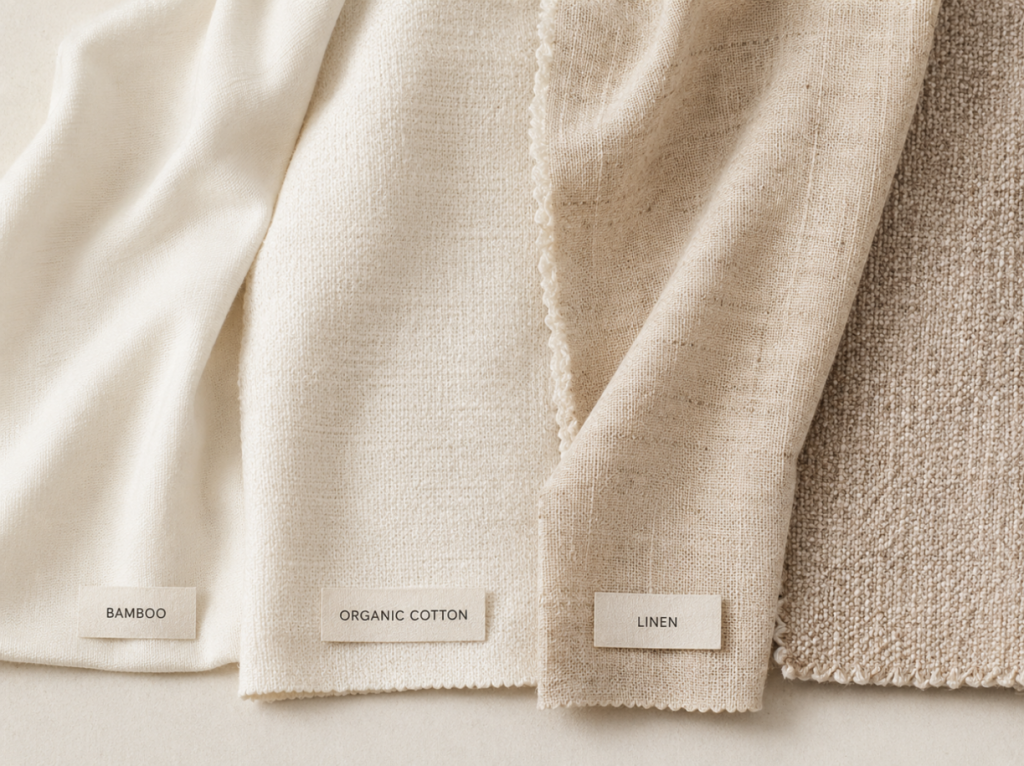
A fiber name does not establish sustainability on its own. Organic cotton, linen, recycled synthetics, and bamboo-derived rayon can differ substantially in supplier documentation, processing route, garment performance, minimum quantity, and repeat-order availability.
For a budget-conscious founder, begin with the product requirements. Confirm the needed drape, stretch, opacity, durability, care method, and decoration compatibility. Then compare which available material can meet those requirements at a testable quantity while providing records that support the claims planned for the product page.
Where Bamboo-Derived Textiles Fit—and What to Verify
Most soft apparel textiles marketed as bamboo are rayon or viscose made from bamboo rather than mechanically processed bamboo fiber. That distinction matters for both product labeling and environmental communication. Bamboo-derived rayon may still work well for basics and loungewear because many versions offer a smooth hand and fluid drape, but those characteristics depend on the yarn, knit construction, finishing process, and blend—not simply on the plant used as the cellulose source.
When evaluating bamboo fabric for clothing, ask the supplier for the exact fiber composition, manufacturing route, fabric weight, shrinkage and colorfastness results, and documentation supporting any closed-loop or chemical-management claim. Do not repeat claims such as “naturally antibacterial,” “pesticide-free,” or “biodegradable” unless they are substantiated for the finished textile rather than the bamboo plant.
Blends containing elastane or cotton can change stretch recovery, durability, opacity, and care requirements. For a small brand, the practical advantage is not that every bamboo-derived textile is automatically sustainable. It is that a clearly specified material can be sampled, tested, explained accurately, and reordered without relying on vague environmental language.
How to Source Small Batches Without Overpaying
What does “fabric by the yard” ordering mean for startup cost control
For an early sample round, buying fabric by the yard allows a founder to compare weight, color, stretch, drape, surface finish, and sewing behavior before committing to a full roll. Treat the first purchase as a controlled test rather than simply a small order: record the fabric code, lot number, usable width, GSM, fiber content, care requirements, and minimum quantity for a repeat order. The objective is to avoid approving a promising sample that cannot later be reproduced at the production scale.
For sustainable materials specifically, per-yard purchasing also reduces waste risk. You are less likely to be left with a large quantity of unsold fabric simply because a supplier required a full roll or a high minimum purchase. Waste reduction supports the sustainability argument while also protecting the brand’s cash position.
Minimum order quantities and how to negotiate them
Before negotiating an MOQ, clarify what the number applies to. A supplier may set separate minimums for the base fabric, each custom color, a dye lot, printing, or finishing. Ask whether stocked colors have lower thresholds, whether sample yardage is available, whether multiple colors can share one base-fabric minimum, and how repeat orders are matched to the approved sample.
Price is only one part of a workable small-batch agreement. Confirm lead time, lot variation, testing availability, reorder continuity, and which documents remain valid for the finished fabric. A low minimum has limited value if the same specification cannot be supplied again after the first collection sells.
Building the Brand Story Around a Sustainable Clothing Brand’s Real Materials
Connecting material sourcing to brand narrative
Once you have made a deliberate material choice, the narrative work is less about writing than about making information visible. A credible product page should explain where a material comes from, what its documented properties are, and why those properties matter to the person buying the garment.
A useful mental model: imagine your customer has just received the product and wants to tell a friend what makes it worth the price. What would you want them to be able to say? That answer becomes your product page copy. It is not marketing language — it is the factual case for the purchase, structured so that a new customer can articulate it.
Three Low-Cost Details to Add to Your Product Page
The following details can be added without a large marketing budget and help customers understand exactly what has been verified:
- Verified composition and process details. State what the documentation supports, such as “95% rayon made from bamboo and 5% elastane, 220 GSM single jersey.” Add process or origin details only when the supplier can provide records for the specific fabric being sold.
- Care and durability guidance based on testing. Publish the approved washing temperature, drying method, expected shrinkage, and any known pilling or color-transfer limitations. Accurate care information protects the product’s usable life and reduces avoidable complaints.
- A clear boundary around the claim. Explain what is verified and what is not. For example: “The fabric supplier has provided documentation for the stated fiber content. The finished garment is not currently certified under our brand.” This prevents customers from interpreting a material-level document as certification of the complete product.
A small budget does not prevent a brand from making credible sustainability decisions, but it does require a narrow starting point. Choose one product, one documented material specification, and one claim that can survive customer questions. Test the material before ordering more, retain the supplier records, and state clearly where the current evidence ends.
Sustainability becomes part of the brand when sourcing, testing, product copy, and reorder decisions all tell the same verifiable story. Start with evidence, then scale the message alongside the product.
