

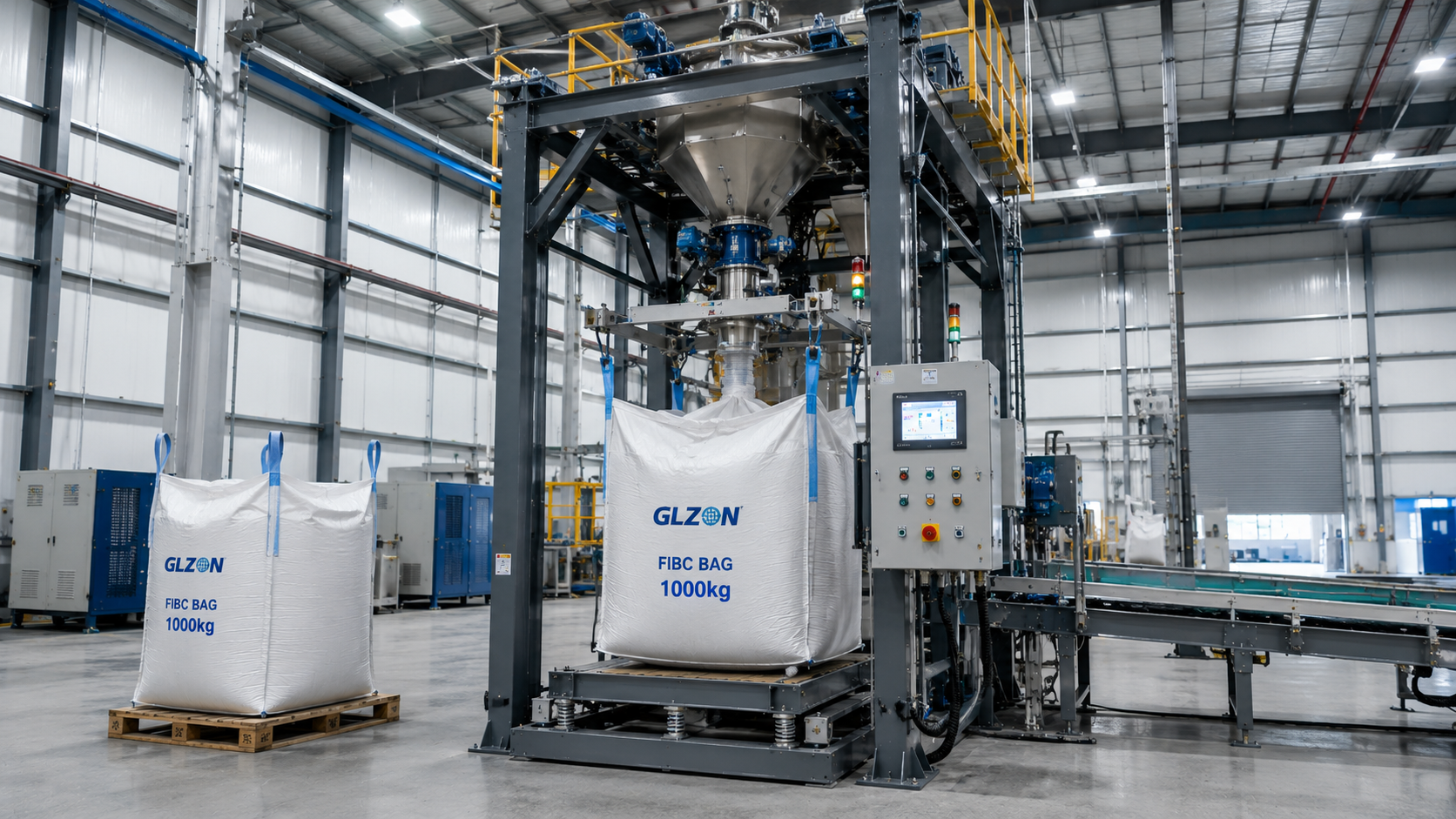
What Is Bulk Bag Filling Equipment?
Bulk bag filling equipment refers to industrial machines and systems designed to fill large flexible bags — called FIBCs (Flexible Intermediate Bulk Containers), super sacks, or jumbo bags — with bulk dry or semi-dry materials.
These bags typically hold between 500 kg and 2,000 kg per unit and are used across chemicals, agriculture, food, construction, mining, and dozens of other industries.
Bulk bag filling equipment handles the entire fill cycle:
- Hanging and positioning the empty bag
- Inflating the bag before filling
- Weighing and filling to a precise target weight
- Densifying the material for a stable, stackable bag
- Sealing and discharging the filled bag to a pallet
Why FIBCs Are the Preferred Bulk Packaging Format
Before diving into equipment, it helps to understand why FIBCs dominate bulk material packaging:
| Advantage | Detail |
| High capacity | 500–2,000 kg per bag vs. 25–50 kg for small bags |
| Lower cost per kg packaged | Fewer bags, less packaging material, less labor |
| Space efficient | Empty FIBCs fold flat — minimal storage footprint |
| Versatile | Compatible with hundreds of dry material types |
| Reusable | Many FIBC grades rated for multiple use cycles |
| Easy handling | Single lift point — forklift or hoist handles one tonne in one move |
The global FIBC market continues to grow year-on-year, driven by expanding demand in chemicals, food, agriculture, and construction sectors worldwide.
Core Components of a Bulk Bag Filling System
A complete bulk bag filling system is not a single machine — it is an integrated assembly of subsystems. Here is what each one does:
1. Fill Frame (Structural Support)
- The backbone of the entire system
- Supports the bag and full product weight throughout the fill cycle — often 1,000–2,000 kg
- Fabricated from heavy-gauge structural steel
- Carbon steel (painted or powder-coated) for general industrial use
- 304 or 316 stainless steel for food-grade, pharmaceutical, or corrosive chemical applications
- Four overhead bag-support arms or hooks align with the FIBC’s four lift loops
2. Hopper
- Positioned directly above the fill head
- Acts as the material reservoir — fed from upstream conveyors, bucket elevators, or process equipment
- Sized to hold at least one full bag fill worth of material
- Hopper geometry matters:
- Steep cone hopper → free-flowing granular materials
- Flat-bottom with agitation → cohesive or bridging powders
- Air-assisted or vibrating hopper → very fine, non-flowing powders
3. Fill Head
- The connection point between the hopper outlet and the bag inlet
- Seals to the bag spout during filling to contain dust and product
- Includes a bag inflator — pre-fills the bag with air before product flow begins, ensuring an even, well-shaped fill
- Dust containment options:
- Rubber dust seal (basic)
- Enclosed fill head with dust extraction port (powders)
- Fully contained glove-box fill head (hazardous materials)
4. Weighing System (Load Cells + Controller)
- Load cells mounted on the fill frame measure bag weight continuously throughout the fill cycle
- Digital weight controller or PLC reads load cell data in real time
- Controls fill valve position and flow rate
- Two-speed fill approach:
- Fast flow → until ~97% of target weight
- Slow dribble → final 3% for precision landing on target
- Typical accuracy: ±0.1% to ±0.5% depending on material and system
5. Densification System
- Drives air out of the bag during and after filling
- Produces a firmer, squarer, more pallet-stable bag
- Types:
- Vibrating fill deck (most common)
- Pneumatic massage pads (squeeze the bag sides)
- Combined vibration + massage (for very fine powders)
- Optional but strongly recommended for any powder material
6. Discharge and Pallet Handling
- After filling and sealing, the bag is lowered onto a waiting pallet
- Options range from manual lowering to powered pallet conveyors
- Fully automatic systems include integrated pallet dispensers and discharge conveyors
7. Control Panel (PLC / HMI)
- Manages the entire fill cycle automatically
- Stores multiple product recipes (target weight, fill speed, densification duration)
- Touchscreen HMI for easy operator control and changeover
- Data logging for batch records and quality traceability
Types of Bulk Bag Filling Equipment
Not all FIBC filling systems are the same. Here are the main configurations:
Semi-Automatic Bulk Bag Filler
- Operator manually hangs the bag and attaches the fill spout
- Machine handles weighing, filling, densification, and shutoff automatically
- Operator removes and seals the filled bag
- Throughput: 5–15 bags/hour
- Best for: Low-to-medium volume operations, multiple material types, limited capital budget
Fully Automatic Bulk Bag Filling Machine
- Bags fed from a dispenser magazine automatically
- Automated bag placement, spout connection, fill, seal, and discharge
- Minimal operator involvement — typically one person monitoring the line
- Throughput: 15–30+ bags/hour
- Best for: High-volume, single-product operations with labor cost pressure
Automated Bulk Bag Filling Machine (Integrated Line)
- Combines the filling station with upstream material handling and downstream pallet conveying
- May include automatic pallet dispensers, stretch wrappers, and labeling systems
- Full PLC integration with plant-wide MES or SCADA systems
- Best for: Large-scale manufacturing operations requiring full traceability and minimal manual touchpoints
Big Bag Filling Station
- A compact, self-contained filling unit — frame, hopper, fill head, and controls in one footprint
- Designed for facilities where space is limited or the filling station needs to be relocated
- Often the entry-level format for operations new to FIBC packaging
- Throughput: 3–10 bags/hour
Twin-Station Bulk Bag Filler
- Two filling stations fed from a shared hopper
- While one bag is filling, the other is being set up or discharged
- Dramatically increases throughput without doubling floor footprint
- Throughput: 20–40 bags/hour depending on material and fill weight
How Automated Bulk Bag Filling Works — Step by Step
Understanding the fill cycle helps you evaluate any system you are considering:
Step 1 — Pallet placement An empty pallet is positioned under the fill frame — either manually or by automatic pallet conveyor.
Step 2 — Bag hang The empty FIBC is placed on the fill frame with all four lift loops hooked securely. On automatic systems, a bag placer handles this step.
Step 3 — Spout connection and inflation The bag’s inlet spout is attached to the fill head and clamped. The inflator pre-fills the bag with air, fully opening it before product flow begins.
Step 4 — Tare and fill initiation The weight controller records the tare (empty bag weight) and initiates the fill cycle. Material flows from the hopper through the fill head into the bag.
Step 5 — Two-speed weigh-fill Fast fill to ~97% of target weight, then slow dribble feed to land precisely on target. Load cells monitor weight continuously throughout.
Step 6 — Densification Vibration or massage cycle compacts the material, drives out trapped air, and firms up the bag shape.
Step 7 — Shutoff and seal Fill valve closes at target weight. The inlet spout is tied or heat-sealed. Fill head disconnects from the bag.
Step 8 — Discharge Filled bag lowers onto the pallet. On automatic systems, a discharge conveyor moves the pallet out and a new empty pallet feeds in.
A modern automatic bagging machine configured for FIBC filling completes this entire cycle in 2–6 minutes — enabling 10–30 fills per hour on a single station.
Bulk Bag Filling Equipment for Specific Industries
Chemicals and Petrochemicals
- Materials: Plastic resins, pigments, fertilizers, industrial salts, soda ash
- Key requirements: Dust containment, ATEX explosion-proofing for flammable powders, weight accuracy for batch costing
- Typical machine: Enclosed automatic bulk bag filler with dust extraction
Food and Agriculture
- Materials: Flour, sugar, starch, grain, dried milk powder, animal feed ingredients
- Key requirements: Stainless steel contact surfaces, sanitary finishes, CIP (clean-in-place) compatibility, sometimes nitrogen purging
- Typical machine: Food-grade semi-automatic or automatic FIBC filler in 304/316 SS
Construction and Aggregates
- Materials: Sand, gravel, crushed stone, cement powder, recycled aggregates
- Key requirements: Heavy-duty abrasion-resistant hopper liners, high fill rates, robust frame for dense materials
- Typical machine: Heavy-duty semi-automatic or automatic filler with AR steel hopper lining
Mining and Minerals
- Materials: Ore concentrates, coal fines, mineral powders, mine tailings
- Key requirements: High SWL frame ratings, dust suppression, compatibility with high-density abrasive materials
- Typical machine: Heavy-duty bulk bag filling station with vibration densification
Pharmaceuticals and Specialty Chemicals
- Materials: API powders, specialty chemicals, nutraceutical ingredients
- Key requirements: Full containment, HEPA filtration, batch traceability, cleanroom compatibility
- Typical machine: Contained FIBC filling isolator with glove-box fill head and integrated weighing
What Is an Open Mouth Bagging Machine and How Does It Differ from a Bulk Bag Filler?
This is a common point of confusion for operations researching both equipment types.
| Feature | Bulk Bag Filler | Open Mouth Bagging Machine |
| Bag capacity | 500–2,000 kg | 5–50 kg |
| Bag type | FIBC / super sack / jumbo bag | Pre-made woven PP, paper, or PE bags |
| Fill format | Single large bag hung from frame | Continuous bags from magazine or roll |
| Throughput | 5–30 bags/hour | 5–120 bags/hour |
| Labor per bag | Low (high weight per fill) | Higher (more bags per tonne) |
| Cost per kg packaged | Lower | Higher |
| Typical use | Bulk industrial / export | Retail, distribution, smaller quantities |
An open mouth bagging machine is the right choice when your distribution channel requires smaller, consumer or trade-friendly bag sizes — while an FIBC filler is the right choice when you are moving bulk material in tonne-scale quantities directly between industrial facilities.
Many operations run both in parallel — bulk bag filling for wholesale and export, open mouth bagging for retail and distribution.
How to Specify the Right Bulk Bag Filling Equipment
Use this framework to define your requirements before contacting suppliers:
Step 1 — Define Your Throughput Requirement
- How many tonnes per shift do you need to package?
- Divide by average bag weight to calculate bags per hour required
- Add 25% headroom for growth and downtime
Step 2 — Characterize Your Material
- Is it free-flowing, semi-flowing, or cohesive?
- What is the bulk density (kg/m³)?
- Is it abrasive, hygroscopic, flammable, or food-grade?
- Does it require dust containment or explosion-proofing?
Step 3 — Confirm Your Bag Specifications
- FIBC type (U-panel, circular, 4-panel)
- Inlet type (spout top, open top, duffle top)
- Fill weight range (minimum and maximum)
- Safe working load requirement
Step 4 — Assess Your Automation Level
- What is your current labor cost per filled bag?
- Do you run single product or multiple materials?
- What is your available floor space?
- Do you need integration with upstream and downstream equipment?
Step 5 — Evaluate Suppliers
- Has the supplier filled your exact material before?
- Will they conduct a fill trial with your product?
- What are their spare parts lead times?
- Do they offer local service support?
Bulk Bag Filling Equipment: Buying Checklist
Before committing to a purchase, verify:
- ✅ Frame load rating exceeds maximum expected bag weight
- ✅ Hopper geometry validated for your material’s flow characteristics
- ✅ Weight accuracy specification meets your tolerance requirement
- ✅ Dust containment level appropriate for your material and workplace regulations
- ✅ Densification system included if filling powders or fine materials
- ✅ Control system stores multiple product recipes
- ✅ Stainless steel specified if food-grade or corrosive application
- ✅ Upstream feed and downstream pallet handling integration confirmed
- ✅ Material fill trial completed and results documented
- ✅ Spare parts kit pricing and availability confirmed
Frequently Asked Questions
Q: What is the difference between a bulk bag filler and a super sack filler? They are the same thing. “Super sack filler,” “bulk bag filler,” “FIBC filling machine,” and “jumbo bag filler” all refer to equipment that fills large flexible bulk containers. The terminology varies by region and industry.
Q: How accurate is bulk bag filling equipment? Modern systems with load cell weighing achieve ±0.1% to ±0.5% accuracy depending on material type, fill speed, and system quality. For a 1,000 kg fill, that means landing within 1–5 kg of target — consistently, batch after batch.
Q: Can I fill multiple materials on the same bulk bag filler? Yes — most systems support product changeovers via recipe switching on the control panel. The key consideration is cross-contamination risk. If materials must be kept separate, confirm the system’s cleanability between changeovers.
Q: Do I need a densification system? For free-flowing granular materials (sand, pellets, coarse grain): usually not essential. For powders, fine granules, or any material that traps air during filling: yes — densification significantly improves bag stability, fill density, and palletizing performance.
Q: How much does bulk bag filling equipment cost? Entry-level semi-automatic big bag filling stations start from approximately $20,000–$40,000. Fully automatic FIBC filling systems with integrated conveyors range from $80,000 to $200,000+. Contained pharmaceutical-grade systems can exceed $300,000.
Conclusion
Bulk bag filling equipment is a core infrastructure investment for any industrial operation moving material in FIBC format. Getting the specification right — matching the system to your material, throughput, automation level, and regulatory requirements — determines whether your filling station is a productive asset or a daily bottleneck.
Key takeaways:
- There is no single “best” bulk bag filling system — the right one is the one correctly matched to your operation
- Material characterization is the most important first step in equipment selection
- Always insist on a fill trial with your actual product before purchase
- Semi-automatic suits low-to-medium volume; fully automatic suits high-volume consistent runs
- Many operations benefit from running both FIBC filling and smaller bag formats in parallel
Invest the time upfront in proper specification, work with an experienced supplier, and bulk bag filling becomes one of the most efficient and cost-effective steps in your entire packaging operation.
