

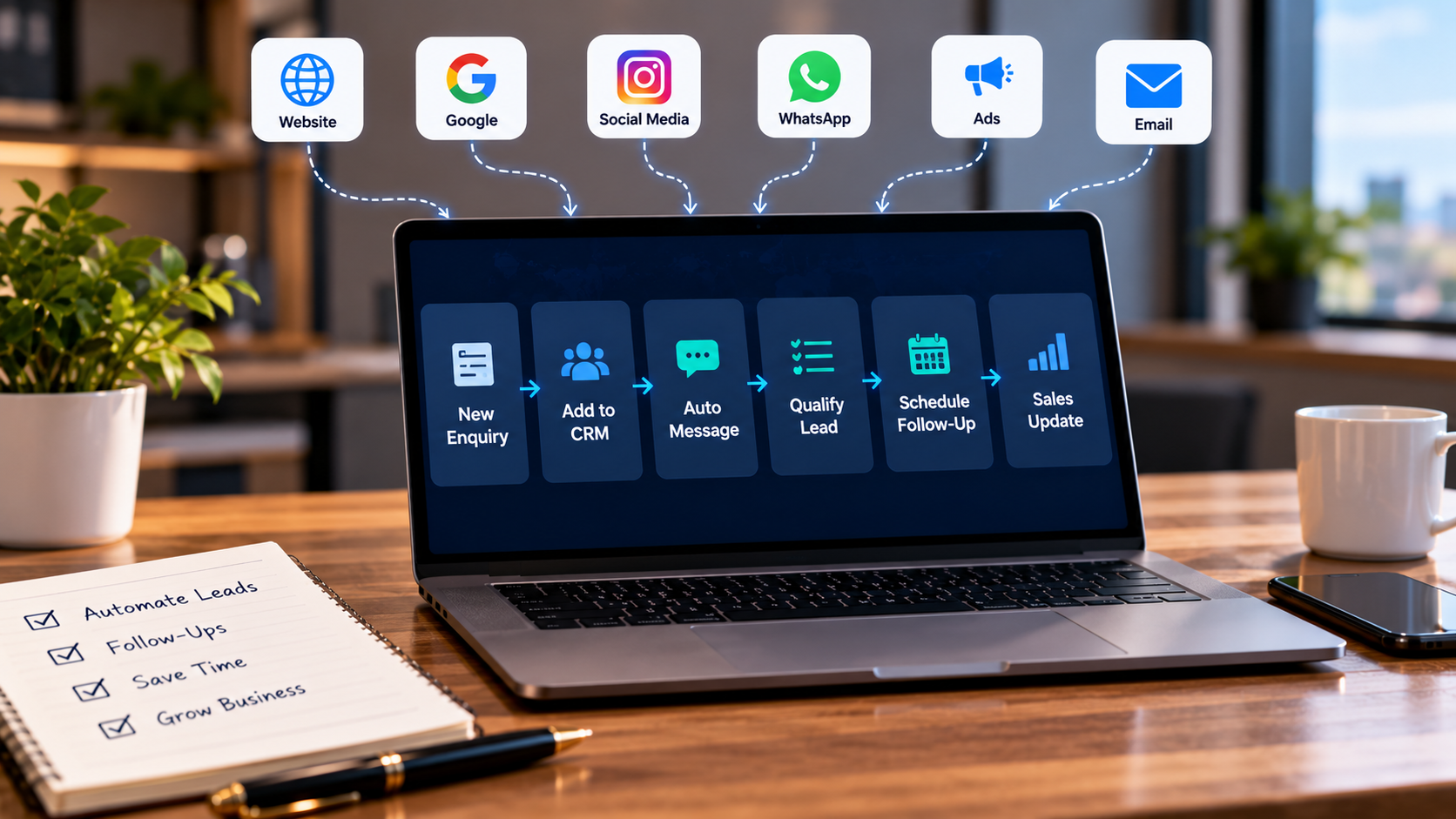
Businesses today receive leads from websites, Google, social media, WhatsApp, advertisements, and other online channels. Managing all these enquiries manually can take a significant amount of time and can lead to missed leads, delayed responses, and repetitive administrative work.
A business automation agency helps companies solve these problems by connecting technology, artificial intelligence, CRM systems, communication platforms, and automated workflows. Instead of performing the same tasks manually every day, businesses can create systems that handle repetitive processes automatically.
What Is a Business Automation Agency?
A business automation agency helps businesses identify repetitive processes and replace manual work with automated systems.
For example, when a customer submits a website enquiry, an automated system can:
- Capture the customer’s information.
- Add the lead to a CRM.
- Send an instant confirmation message.
- Ask qualification questions.
- Notify the sales team.
- Schedule a follow-up.
- Send reminders automatically.
- Update the CRM when the lead progresses.
This creates a connected business workflow instead of relying on employees to perform every step manually.
Why Business Automation Is Important
Many businesses spend valuable employee time on repetitive activities such as data entry, lead follow-ups, appointment reminders, customer messages, reporting, and updating spreadsheets.
Automation can help businesses organize these activities into structured workflows.
For example, CRM automation can automatically capture and organize enquiries, while WhatsApp automation can assist with customer communication and follow-ups. AI chatbots can also answer frequently asked questions and collect information from potential customers.
The objective is not simply to automate everything. The objective is to automate the repetitive parts of a business while allowing employees to focus on tasks that require human judgment.
Business Automation Services
A modern business automation agency can provide several different services depending on the company’s requirements.
1. AI Chatbot Automation
An AI chatbot can communicate with website visitors and answer common questions.
A chatbot can be configured to:
- Answer FAQs
- Collect customer information
- Qualify leads
- Provide basic product information
- Schedule appointments
- Direct customers to the appropriate team
- Transfer important conversations to a human representative
This can provide customers with faster initial responses while reducing repetitive work for employees.
2. Lead Qualification Automation
Not every enquiry has the same value. Lead qualification automation can collect important information and categorize leads according to predefined criteria.
For example, an automation workflow can ask:
- What service are you interested in?
- What is your approximate budget?
- When do you need the service?
- What is your business type?
- How can our team contact you?
The information can then be sent to the CRM so that the sales team can prioritize conversations according to the company’s process.
3. WhatsApp Automation
WhatsApp is an important communication channel for many businesses.
With appropriate WhatsApp Business integrations, businesses can automate workflows such as:
- New lead notifications
- Customer enquiries
- Appointment reminders
- Follow-up messages
- Order notifications
- Customer support flows
- Lead qualification
- Human-agent handoff
The exact implementation depends on the business requirements and the available WhatsApp Business/API setup.
4. CRM Automation
A CRM can become much more useful when it is connected to automated workflows.
For example:
Website Form → CRM → Lead Assignment → Notification → Follow-up → Sales Update
Instead of manually entering every enquiry into a spreadsheet, the system can automatically create a lead record and assign it to the appropriate person.
CRM automation can also trigger tasks, reminders, notifications, and follow-up workflows based on changes in the sales pipeline.
5. Follow-Up Automation
One of the common challenges for sales teams is maintaining consistent follow-up.
A business automation system can create predefined follow-up sequences.
For example:
Day 0: Instant enquiry confirmation
Day 1: Follow-up message
Day 3: Additional information
Day 7: Reminder
Day 14: Final follow-up
The business can customize the timing and messaging according to its sales process and applicable communication rules.
6. Automated Reporting
Businesses often spend hours preparing reports from different platforms.
Automation can collect information from systems such as advertising platforms, CRM software, spreadsheets, and other business applications and organize it into reports or dashboards.
Reports can include:
- Number of leads
- Lead sources
- Sales pipeline
- Follow-up status
- Conversion data
- Advertising performance
- Customer activity
This gives business owners and managers a more organized view of their operations.
How Business Automation Works

A typical automation system can be divided into five stages.
Step 1: Lead Capture
The system collects information from sources such as:
- Website forms
- Landing pages
- Google Ads
- Social media
- Other marketing channels
Step 2: Data Organization
The information is automatically stored in a CRM, database, spreadsheet, or another business system.
Step 3: Automated Processing
Rules determine what should happen next.
For example:
If lead = new → create CRM record
If lead = high priority → notify sales team
If appointment = booked → send confirmation
Step 4: Communication
The automation can trigger approved email, WhatsApp, SMS, or other communication workflows.
Step 5: Tracking and Reporting
The system records activity so the business can monitor the customer journey and measure performance.
Benefits of Working With a Business Automation Agency
Save Time
Automation reduces repetitive administrative tasks and allows employees to spend more time on customer service, sales, strategy, and other important activities.
Faster Lead Response
Automated systems can trigger an immediate response when a new enquiry arrives, depending on the communication channel and integration.
Fewer Manual Errors
Automatically transferring information between connected systems can reduce errors associated with repetitive data entry.
Better Lead Management
A centralized CRM and automated workflow can make it easier to track enquiries and sales opportunities.
Scalable Operations
As the number of leads and customers increases, automation can help businesses handle more repetitive processes without increasing manual workload at the same rate.
Who Can Use Business Automation?
Business automation can be useful for many types of organizations, including:
- Real estate companies
- Digital marketing agencies
- Educational institutes
- Healthcare businesses
- E-commerce companies
- Travel agencies
- Financial service businesses
- Restaurants
- Local service businesses
- Consultants
- Coaches
- Startups
- Professional service companies
The automation should be designed around the specific workflow of each business rather than using the same system for every company.
Choosing a Business Automation Agency
Before selecting an automation partner, businesses should understand what they actually need to automate.
Important questions include:
- Which tasks currently consume the most time?
- Where are leads being lost?
- Which software does the business already use?
- Does the CRM need integration?
- Is WhatsApp automation required?
- Are AI capabilities necessary?
- What information needs to be reported?
- Which processes still require human approval?
A good automation project begins with understanding the existing workflow and then designing the technology around that workflow.
Business Automation With Zeexas Ads
Zeexas Ads can help businesses build a stronger digital presence while exploring technology-driven approaches to marketing, lead management, and business growth.
Businesses looking to improve their online operations can consider solutions such as AI-powered customer communication, lead qualification, CRM workflows, WhatsApp automation, automated follow-ups, reporting systems, and other digital marketing services.
Instead of treating marketing and automation as completely separate activities, businesses can connect their lead-generation campaigns with their sales and customer-management processes.
For example:
SEO / Google Ads → Landing Page → Lead Capture → CRM → AI Qualification → WhatsApp Follow-Up → Sales Team → Reporting
This type of connected workflow can give a business a more structured approach to managing digital leads.
The Future of Business Automation
Artificial intelligence and workflow automation are changing the way businesses manage repetitive processes. Modern automation can connect marketing, sales, customer support, CRM systems, communication platforms, and reporting into a single workflow.
However, successful automation is not simply about adding more tools. The most useful systems are designed around real business problems and measurable processes.
Businesses that identify repetitive tasks, organize their data, and connect their systems can create more efficient digital operations.
Conclusion
A business automation agency helps companies reduce repetitive manual work by creating connected digital workflows. From AI chatbots and lead qualification to CRM automation, WhatsApp workflows, follow-ups, and automated reporting, businesses can use technology to make everyday operations more organized.
For businesses looking to combine digital marketing with automation and lead-management solutions, Zeexas Ads provides a platform to explore digital growth and automation-focused services.
Learn more at https://zeexasads.com/.
