

Introduction to Pedicle Screw Systems
What Is a Pedicle Screw System?
Let’s get straight to it—if spinal surgery had a “toolbox hero,” it would absolutely be the pedicle screw system. This system is used to stabilize the spine, especially in procedures like spinal fusion, trauma repair, or deformity correction. Surgeons insert screws into the vertebrae (specifically the pedicles), then connect them using rods to hold everything in alignment. Think of it like scaffolding on a building under repair—it keeps things steady while healing happens underneath.
Now here’s the catch: spinal anatomy isn’t forgiving. You’re working millimeters away from nerves and the spinal cord. That’s why these systems aren’t just about screws—they’re about precision engineering backed by a full instrument kit that ensures every step is controlled and accurate. A 6mm pedicle screw system, in particular, is widely used because it provides a strong hold without being overly invasive, making it suitable for many adult spinal procedures.
Why 6mm Systems Are Widely Used
The 6mm size is a sweet spot. It’s not too bulky, yet strong enough to anchor firmly into vertebral bone. Surgeons prefer it because it balances biomechanical strength and safety, especially in lumbar spine surgeries. It also integrates seamlessly with standard rod systems, making it versatile across different surgical scenarios.
Real Image Analysis of the Instrument Kit
Overall Layout of the Kit
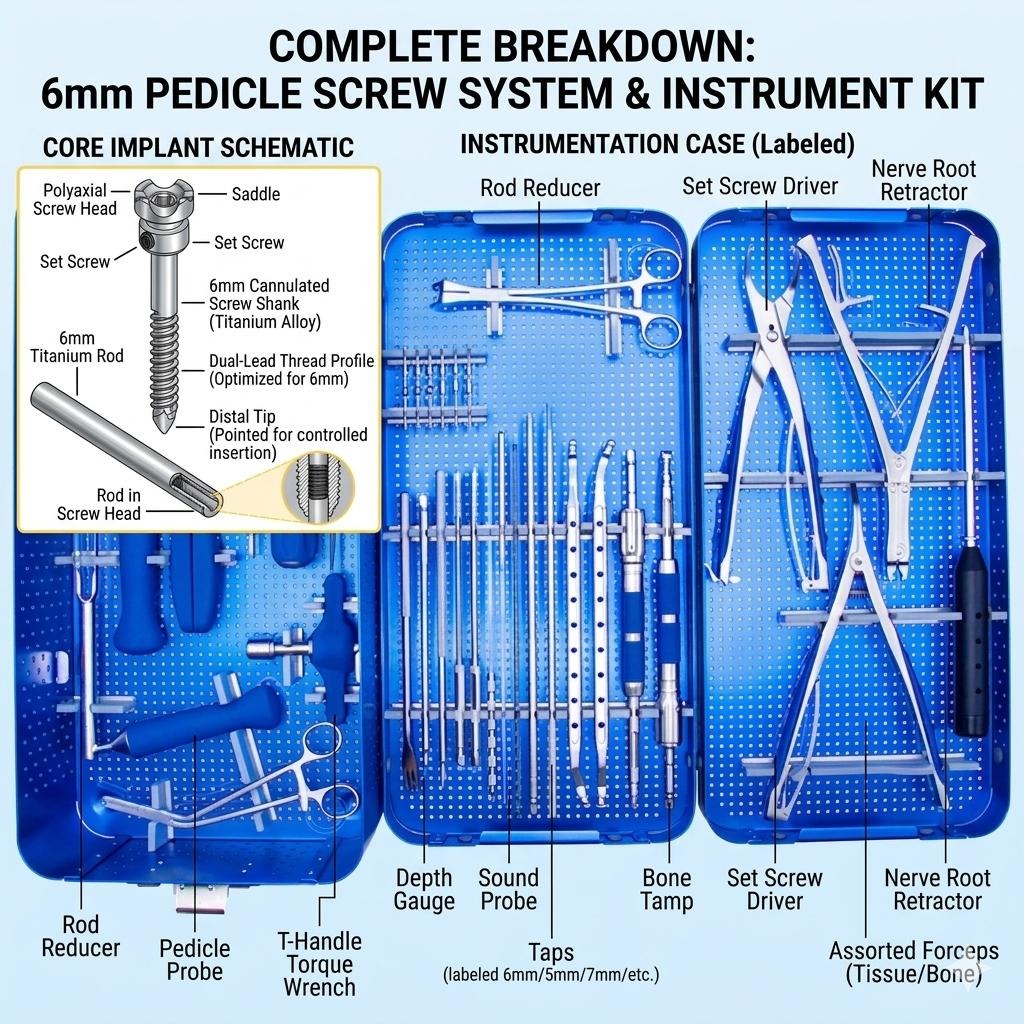
Looking at the image you provided, this is a three-tray modular instrument kit, housed in sterilizable blue anodized aluminum cases. Right away, this tells us something important: this is a professional-grade surgical system, not a basic kit. The instruments are neatly organized, each placed in precision-cut slots, which helps reduce operating time and ensures quick access during surgery.
The layout is not random—it’s strategically divided based on workflow. Each tray corresponds to a specific stage of the surgical process: preparation, insertion, and fixation. This kind of organization is exactly what surgeons rely on in high-pressure environments.
Tray-by-Tray Breakdown
- Left Tray: Heavy-duty tools (handles, drivers, torque devices)
- Middle Tray: Fine precision tools (probes, taps, drill bits)
- Right Tray: Alignment and fixation tools (forceps, rod holders)
This separation reflects a logical surgical sequence, which is a hallmark of well-designed orthopedic instrument kits.
Left Tray Components (Primary Fixation Tools)
T-Handles and Drivers
The left tray clearly contains multiple T-handles and screwdrivers, identifiable by their ergonomic grips and long shafts. These are used for inserting pedicle screws into the vertebrae. The T-shape provides better torque and control, allowing surgeons to apply consistent force without slipping.
You’ll also notice interchangeable tips—this means the same handle can be used for different screw sizes or types. That’s efficiency in action. Instead of switching tools entirely, surgeons just swap attachments.
Torque Instruments and Handles
There appears to be a torque-limiting handle in this tray, which is crucial. Why? Because overtightening a screw can damage bone or compromise fixation. This tool ensures screws are tightened to the exact required force—no guesswork involved.
Also visible are quick coupling handles, which allow rapid attachment and detachment of instruments. These small design choices make a big difference during long procedures.
Middle Tray Components (Precision Tools)
Pedicle Probes and Sounders
This tray is packed with long, slender instruments—these are pedicle probes (feelers). Surgeons use them to create and check the pathway inside the pedicle before inserting screws. It’s like testing a tunnel before sending a train through it.
There are both straight and curved probes, which allow navigation through different anatomical angles. The curved ones are especially useful in complex spinal deformities.
Screw Taps and Drill Bits
You can also see taps and drill bits arranged in sequence. These are used to prepare the bone for screw insertion. Taps cut threads into the bone, ensuring the screw fits securely.
Different sizes are included, which is essential because not every vertebra is the same. Having multiple options allows surgeons to adapt in real time.
Right Tray Components (Alignment & Rod Tools)
Reduction Forceps
This tray features larger, clamp-like instruments—these are reduction forceps. They’re used to align the spine and bring rods into position relative to the screws.
They might look bulky, but they’re incredibly precise. Surgeons use them to gently manipulate vertebrae into alignment without causing trauma.
Rod Holders and Benders
Also visible are rod holders and bending tools. Since spinal rods often need to match the patient’s anatomy, they’re manually shaped during surgery. These tools allow surgeons to contour rods accurately before placement.
There are also rod inserters, which help guide the rod into the screw heads smoothly.
Core Components of the 6mm Pedicle Screw System
Pedicle Screws
Although not shown directly in the trays (they’re usually packaged separately), the system is designed for 6mm diameter pedicle screws. These screws anchor into the vertebrae and serve as the foundation of the entire construct.
Most modern screws are polyaxial, meaning their heads can move slightly. This flexibility makes it easier to connect rods during surgery.
Rods and Connectors
The rods connect the screws and stabilize the spine. Connectors and locking caps ensure everything stays firmly in place. The instruments in your kit are specifically designed to work seamlessly with these components.
Step-by-Step Surgical Use of the Kit
The workflow using this exact kit follows a logical sequence:
- Entry Creation: Awl and probe used to access pedicle
- Path Preparation: Drill and tap prepare the bone
- Screw Insertion: T-handle driver inserts screws
- Rod Placement: Rod is shaped and inserted
- Alignment: Forceps adjust spinal position
- Fixation: Torque tool secures final assembly
Each tray supports a different stage, which is why this layout is so effective.
Complete Instrument Table (Based on Image)
| Tray | Instruments Identified | Function |
|---|---|---|
| Left | T-handles, torque drivers, quick couplers | Screw insertion |
| Middle | Pedicle probes, taps, drill bits | Path preparation |
| Right | Reduction forceps, rod holders, benders | Alignment & fixation |
Benefits of This Specific Kit Design
What stands out about this kit is its workflow-driven design. Everything is placed exactly where you’d expect it during surgery. That reduces stress, saves time, and improves accuracy.
The modular trays also make sterilization easier. Instead of handling one bulky unit, each tray can be cleaned and organized separately. Plus, the blue anodized finish isn’t just for looks—it resists corrosion and extends the life of the instruments.
How to Choose the Right Pedicle Screw Set
If you’re evaluating similar kits, focus on:
- Instrument variety and completeness
- Material quality (prefer titanium/stainless steel)
- Ergonomic design
- Compatibility with screw systems
A good kit doesn’t just include tools—it supports the entire surgical workflow seamlessly.
Cleaning, Sterilization, and Maintenance
All instruments in this kit are autoclavable, meaning they can be sterilized using high-pressure steam. Regular cleaning prevents contamination and ensures long-term performance.
Proper maintenance also includes checking for wear, especially in threaded instruments and cutting tools. Even the best tools need care to stay effective.
A high-quality pedicle screw system not only improves surgical accuracy but also enhances long-term spinal stability and patient recovery.
Conclusion
This 6mm pedicle screw system with instrument kit, as seen in your image, is a highly specialized and well-organized surgical solution. Every instrument has a clear purpose, and the three-tray layout reflects a deep understanding of surgical workflow. From precision probes to powerful reduction forceps, the kit is built to support every stage of spinal fixation.
It’s not just a set of tools—it’s a complete system designed for accuracy, efficiency, and patient safety.
FAQs
1. What makes a 6mm pedicle screw system ideal?
It offers a balance between strength and safety, making it suitable for many spinal procedures.
2. Are all instruments in the kit reusable?
Yes, they are designed for repeated use after proper sterilization.
3. Why are there three trays in the kit?
Each tray corresponds to a different surgical stage, improving workflow efficiency.
4. What are reduction forceps used for?
They help align the spine and position rods accurately.
5. Can this kit be used for all spinal surgeries?
It’s versatile but may need additional components depending on the procedure.
