

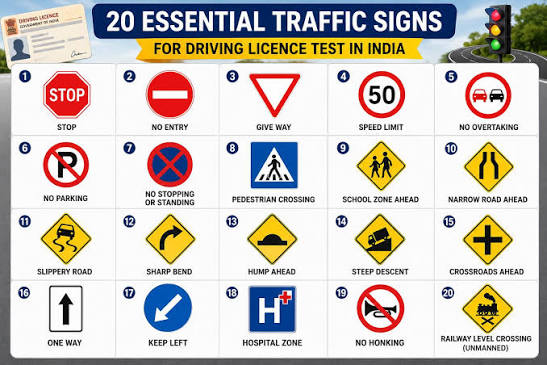
Staring at a screen full of traffic sign images and drawing a blank is something most people face while preparing for the Regional Transport Office (RTO) test. You know you have seen that triangle somewhere on the highway, but the name just will not come to you. The good part is that traffic signs follow a simple pattern once you understand how they are grouped. Whether you are getting ready for your driving test or just trying to feel more confident behind the wheel, learning these signs helps build stronger road awareness and makes everyday driving easier.
What Are the Main Types of Traffic Signs?
Most traffic signs on Indian roads fall into three main categories:
- Mandatory signs tell you what you must or must not do
- Cautionary signs warn you about possible hazards ahead
- Informatory signs guide you with directions or public facilities
The easiest way to identify them is by shape.
Mandatory signs are usually circular, cautionary signs are triangular, and informatory signs are mostly rectangular.
Once you remember that pattern, recognising them becomes easier.
Which Mandatory Signs Should You Remember First?
These are some of the most important signs to know for your test.
- A Stop sign means you must come to a complete halt before moving ahead.
- A No Entry sign tells you that vehicles are not allowed beyond that point.
- A Speed Limit sign shows the maximum permitted speed for that stretch of road.
- A Give Way sign means you need to slow down and allow traffic on the main road to pass first.
These signs are important because they directly affect how you drive and how your test is assessed.
What Do Cautionary Signs Warn You About?
Cautionary signs prepare you for what is coming next.
Some common examples include:
- Sharp curves
- Narrow bridges
- Pedestrian crossings
- School zones
- Slippery roads
These signs do not always ask you to stop. They tell you to stay alert and adjust your speed if needed.
This becomes especially important on highways or during poor weather.
How Do Informatory Signs Help During Everyday Driving?
Informatory signs are there to make driving easier.
They usually point you towards:
- Hospitals
- Petrol pumps
- Parking areas
- Bus stops
- Route directions
These signs may not always be tested as heavily, but they help you make better decisions when driving in unfamiliar areas.
Why Does This Matter Beyond the Driving Test?
Learning traffic signs is not only about clearing the exam.
It helps you react faster, avoid confusion, and make better decisions once you start driving on your own. A missed warning sign or a misunderstood speed limit can quickly turn into a risky situation on the road.
That is why road awareness matters beyond just the test.
And once you start driving regularly, it also becomes important to understand the legal and practical responsibilities that come with owning a vehicle. For example, having third-party car insurance is mandatory for vehicle owners in India under the Motor Vehicles Act.
Many drivers compare car insurance online to understand what kind of policy may suit their needs.
The better you understand the road, the easier it becomes to handle both driving and ownership responsibilities with more clarity.
Conclusion
Traffic signs are one of the first things you learn before getting behind the wheel, but their importance does not end with the driving test. Once you understand how they are grouped and what they mean, reading the road becomes much easier and responding to situations becomes quicker.
That awareness stays useful every time you drive. And as you take on other responsibilities like keeping your documents in order and understanding requirements such as third-party car insurance, it becomes part of being a more prepared and responsible vehicle owner.
