

Business phone systems installed ten years ago usually still ring. That is the problem. It works well enough that nobody revisits it until a second office opens, staff start working from home, or the maintenance contract runs out. Then the question arrives: replace the hardware, or move the whole system to the cloud?
How a hosted PBX differs from on-site equipment
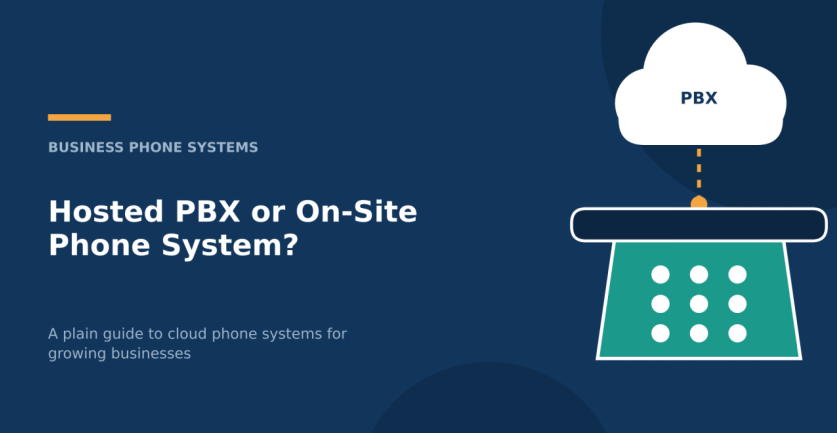
A traditional PBX is a box in a comms cupboard. It needs its own maintenance, its own backup power and a technician on site for most changes. A hosted PBX moves that box into a data centre and delivers calls over your internet connection. Adding an extension becomes a settings change instead of a site visit.
Cloud phone systems also give you more options when something goes wrong. If a site loses power or connectivity, calls can be diverted to mobiles or another office from a web portal. For a business with one location and no IT staff, that alone can justify the move.
Cost follows a different pattern too. On-site equipment is a large purchase up front, then a maintenance fee. Hosted systems are typically a monthly fee per user, which spreads the cost and makes it easier to add or remove staff as the business changes.
VoIP phone systems depend on the network
Voice over IP turns calls into data packets, so call quality depends on the network carrying them. Before replacing handsets with VoIP phone systems, test the internet service: upload speed, router quality, and whether voice traffic gets priority over file downloads.
Most complaints about choppy audio trace back to the network, not the phones. A provider that checks this before installation saves you a round of finger pointing afterwards.
Local points to check
Regional businesses have a few extra questions to ask. Anyone comparing business phone systems Newcastle suppliers offer, or business phone systems Central Coast suppliers offer, should find out which carrier delivers the service and what happens when there is a fault.
The same applies to voip phone systems Newcastle businesses are quoted on, and to voip phone systems Central Coast offices are considering. Ask whether the provider can send a technician or only fixes things remotely. A hosted PBX Central Coast shopfront or clinic runs mostly from a web portal, but handsets and cabling still need someone on site at install.
Features worth having
Every provider lists features. These are the ones that tend to change how a business works day to day:
- Call recording and reporting. Managers can review calls and see how many go unanswered, and when.
- Auto attendant and call queues. Callers reach the right person without a receptionist transferring every call.
- Multi-site dialling. Offices share one directory and call each other by extension, even across towns.
- Mobile and desktop apps. Staff take their business number with them without giving out a personal mobile.
- Number portability. You keep your existing numbers when you switch.
Beyond voice: unified communications
Unified communications solutions bring voice, video, chat and presence into one app. For businesses already on Microsoft 365, Teams calling can make the desk phone optional for some roles.
The right mix depends on the job. Receptionists and sales teams often keep a handset, while staff who rarely take calls are fine with a softphone on their laptop. Mapping this out before quoting avoids paying for licences nobody uses.
Questions to ask before you replace anything
- Carrier and fault process. Who supplies the service, and who do you call when it fails?
- Contract term. How long is it, and what happens to the handsets at the end?
- Number porting. Can you keep every existing number, including any 1300 or 1800 lines?
- Network readiness. Will the provider assess your internet and cabling before install?
- Trial or pilot. Can a small group use the system first, before the whole office moves?
An independent consultancy such as ASAP Telecom designs, deploys and migrates these systems for businesses across Australia and New Zealand, which makes it a useful reference point when you are comparing quotes.
Whichever way you go, decide on the features and the network first. The handset brand matters least.
