

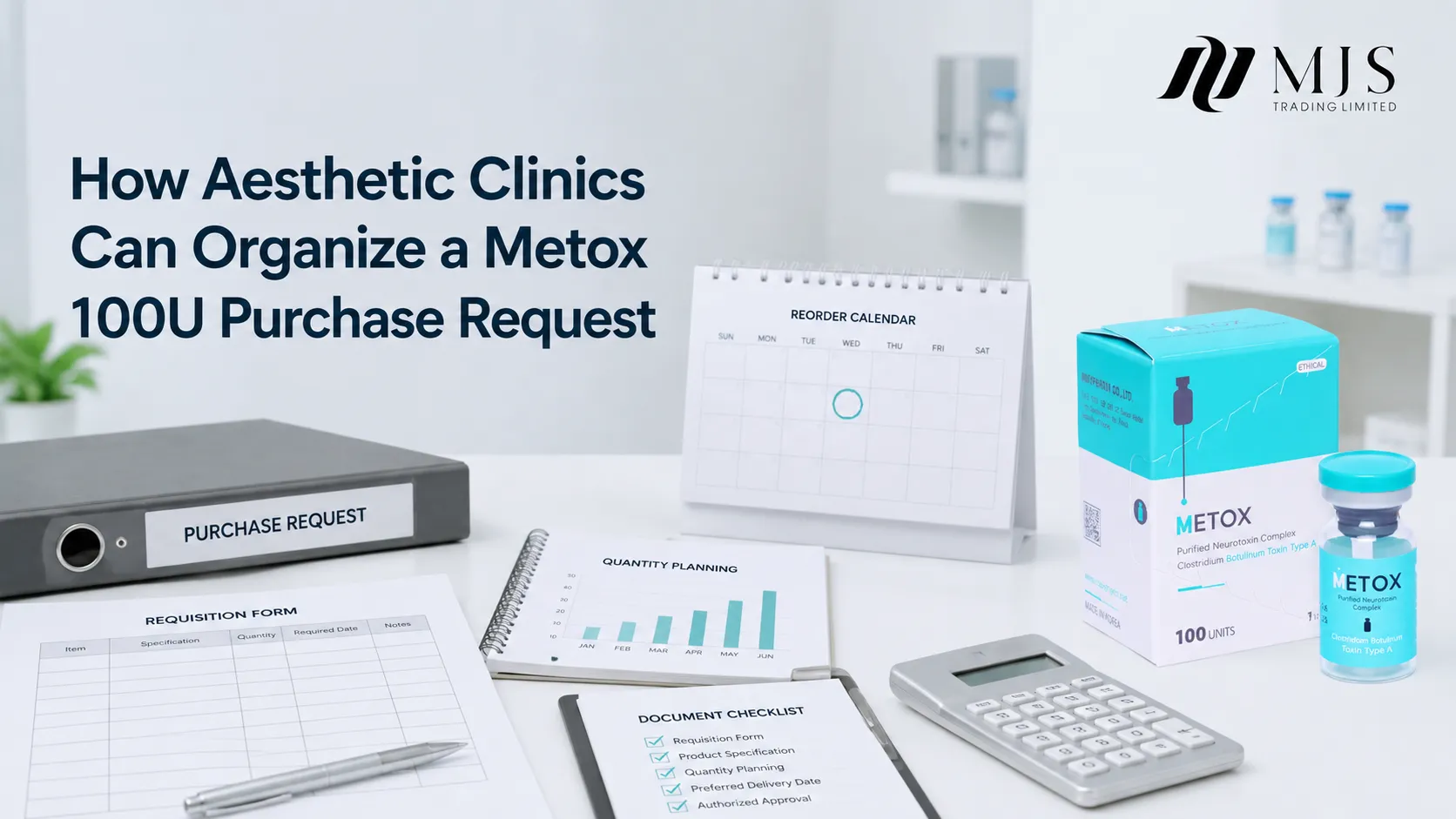
A purchase request should translate an operational need into a record that another employee can review and approve. It should not begin and end with a product name sent through a messaging app.
The current Metox 100U listing presents a named professional product and a defined box format. A clinic considering it should record the exact requested item, quantity, documents and destination-market requirements before asking for a quotation.
This article addresses purchasing administration only. Product suitability and permission to purchase or use it must be reviewed by appropriately qualified professionals under applicable local rules.
Start With a Controlled Information Structure
A useful purchase request system separates stable identity fields from information that changes with each quotation, delivery or review. The team should know who owns every field, which source supports it and when it was last checked.
| Record field | What to capture |
| Requested item | Exact product name and presentation |
| Quantity | Number of packs and internal unit definition |
| Need date | Required receipt date and reason |
| Documents | Records required before approval or at delivery |
| Inventory | Current stock and expected consumption |
| Approval | Clinical, compliance and financial reviewers |
Fields should be completed from identifiable sources. Supplier statements, packaging, invoices, manufacturer materials and regulator databases serve different purposes; the record should not imply that one source proves everything about a product.
A Practical Workflow
The following sequence can be adapted to Metox 100U while keeping clinical and regulatory decisions with appropriately qualified professionals:
- Confirm the requested commercial identity and packaging unit.
- Calculate the quantity from documented demand rather than guesswork.
- List required supplier and product records.
- Set a realistic required-by date that allows review and transport.
- Obtain approvals before confirming the order.
- Link the final quotation and purchase order to the request.
Use Catalogue Research Carefully
During early research, teams may review Metox 100U to understand how the product or category is presented. That commercial reference should be followed by the organization’s own verification, approval and destination-market checks.
Availability on an international website does not by itself establish that a product may be imported, supplied or used in a particular jurisdiction. Requirements can differ by product, intended use and market.
Keep Evidence and Marketing in Separate Fields
Product identity, ingredient or composition statements, promotional wording and evidence-based conclusions should not be merged. A disciplined record shows what the source actually says and avoids converting a catalogue statement into a medical conclusion.
Where a claim affects safety, professional use, authorization or clinical interpretation, it should be escalated to the appropriate qualified reviewer. General operations staff can preserve and route information without independently validating a clinical conclusion.
Common Mistakes to Avoid
- Using 100U as if it uniquely identifies a product
- Confusing vial quantity with box quantity
- Reordering from memory without checking stock
- Requesting documents after payment rather than before approval
- Allowing substitutions without written review
Build Records That Can Be Updated
A useful record has an owner, review date and change history. New information should create a documented revision rather than silently replacing the previous version. Open purchase orders and inventory records should be checked whenever a material field changes.
For broader catalogue and enquiry context, teams can also review MJSBeautys. The same internal controls should be applied regardless of which catalogue or supplier is being considered.
Frequently Asked Questions
Why use a structured record instead of email?
A structured record makes the same fields searchable and comparable. Email can remain supporting evidence, but it should not be the only place where a decision or product detail is stored.
Who should own updates?
Ownership depends on the field. Procurement may own quotations, inventory staff may own receiving data, and qualified clinical or regulatory reviewers should own conclusions within their scope.
How often should the information be reviewed?
There is no universal interval. The organization should set a risk-based schedule and also trigger review when packaging, suppliers, documents, availability or applicable requirements change.
Can a catalogue page confirm local authorization?
No. Catalogue availability and local authorization are different questions. Buyers should use the official sources and professional advice applicable to their destination market.
A Practical Next Step
Create a one-page requisition form and test it on the next planned reorder. Missing fields discovered during approval should become part of the standard form.
The strongest systems are not the most complicated. They are the ones that let another authorized employee understand what was recorded, where it came from, what remains uncertain and what action should happen next.
