

Business process automation has been helping companies reduce repetitive work for years. Rules can route documents, update customer records, send notifications, transfer data between applications, and trigger actions when predefined conditions are met. These systems work well when a process follows a predictable path and the exceptions are limited.
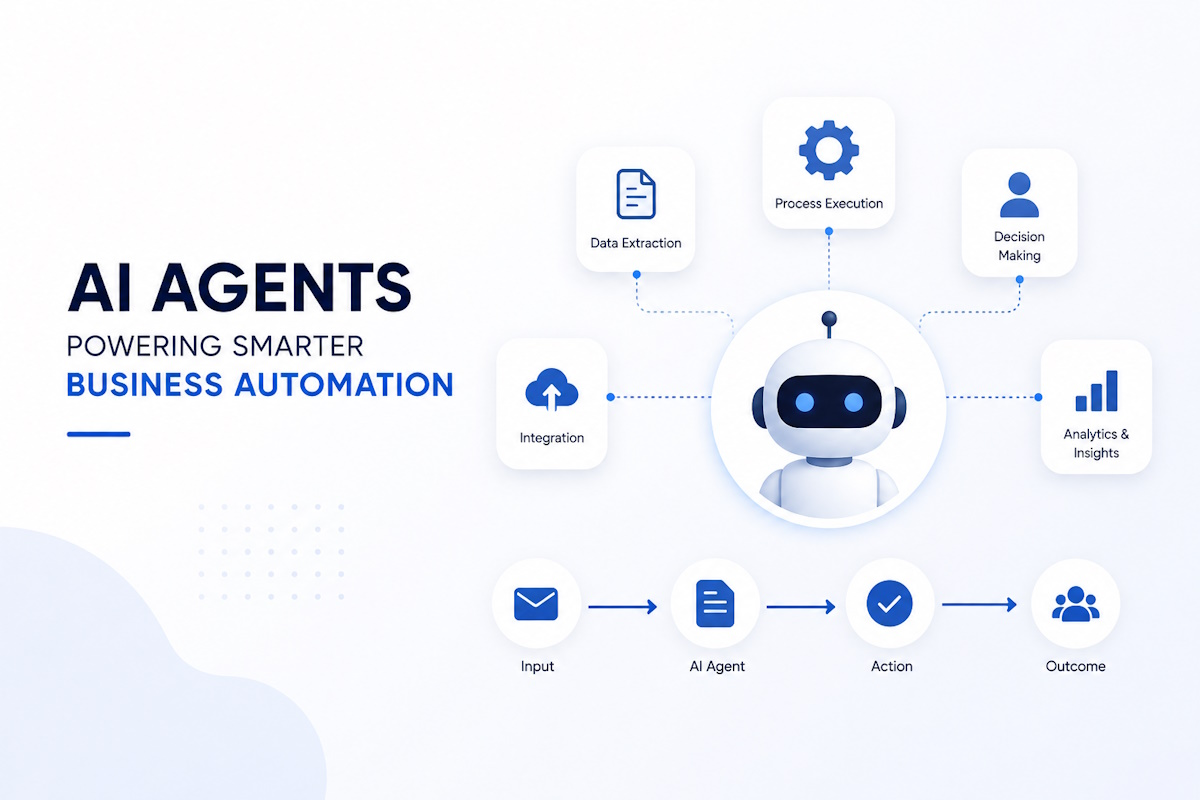
AI agents are changing what businesses can consider automating. Instead of following only a fixed sequence of instructions, an agent can interpret a goal, gather context, select from available tools, decide what action should come next, and adjust its approach when conditions change. This allows automation to move into workflows that previously required people to interpret information between each step.
That does not mean traditional automation is becoming obsolete. AI agents are better understood as another layer of business automation, particularly useful where workflows involve unstructured information, several applications, changing conditions, and decisions that cannot be reduced to a simple set of if-then rules.
Traditional Automation Works Best When the Path Is Known
Most conventional automation begins with a clearly defined trigger. A customer submits a form, an invoice reaches a certain status, a sales opportunity changes stage, or a new employee joins the company. The software then follows a sequence of predefined actions.
This approach is dependable because the business defines the workflow in advance. If condition A occurs, the system performs action B. When the process changes, someone updates the workflow so the software knows how to respond to the new situation.
Problems begin when employees constantly encounter cases that do not fit those rules. A purchase request may need different approvals depending on context. A support ticket may contain several issues written in ordinary language. A sales inquiry may need information from the CRM, previous emails, pricing tools, and product documentation before anyone knows what should happen next.
These are the kinds of processes where traditional workflow automation often stops and hands the task back to a person.
AI Agents Can Decide the Next Step
An AI agent approaches a process differently. Instead of receiving an exact sequence of actions, the agent can receive a goal and determine which permitted steps could help complete it.
Imagine an accounts receivable process. A conventional workflow might send a reminder when an invoice becomes overdue. An AI agent could first review the customer record, payment history, invoice amount, previous conversations, and existing disputes before deciding what kind of follow-up is appropriate.
The agent might prepare a reminder for one customer, flag another account for human review, identify an unresolved billing dispute in a third case, and avoid sending a message when a payment has already been recorded elsewhere.
The difference is not simply that AI generates text. The more significant change is that software can use context to select what action should happen next.
Business Automation Is Becoming Less Linear
Many business processes look simple when represented as flowcharts but become complicated in real situations. Exceptions create branches, people skip steps, information arrives in different formats, and one department may handle the same situation differently from another.
AI agents are suited to workflows where there may be several valid paths to the same goal. An agent can examine the current state of a process, use available information, choose a next action, review what happened, and continue until the task reaches a stopping point.
Consider employee onboarding. A standard automation might create accounts, send documents, schedule orientation, and notify managers. An agent could go further by identifying missing documents, checking whether required accounts were successfully created, answering common employee questions, and escalating unusual access requests.
This turns automation from a fixed chain of events into a process that can respond to changing circumstances.
Agents Can Work Across Several Business Applications
A large portion of office work exists because business systems do not naturally understand each other. Employees move information between CRM platforms, email, accounting systems, project management tools, support software, spreadsheets, and internal databases.
APIs and workflow platforms already connect many of these systems, but someone still has to define which information should move and under what conditions. AI agents can make these connections more flexible because they can determine which tool is needed based on the task.
A sales agent, for example, could retrieve customer history from a CRM, check previous email conversations, examine available products, prepare a follow-up message, and create a task for an account manager. The agent is not replacing those systems. It is coordinating their existing capabilities.
This is one of the reasons businesses exploring agentic AI development services often need to think beyond the model itself. Permissions, APIs, workflow rules, business data, error handling, and human approval all influence whether an agent can safely operate across existing software.
Unstructured Information Becomes Easier to Automate
Traditional process automation prefers structured inputs such as form fields, database values, checkboxes, and system events. Businesses, on the other hand, produce enormous amounts of useful information in emails, documents, conversations, support messages, contracts, and notes.
AI agents can interpret this unstructured material before deciding what to do with it. A customer service agent could read an incoming email, determine the nature of the request, retrieve the related customer record, check the company’s policies, and prepare the appropriate next step.
A procurement agent could examine a supplier document, extract relevant information, compare it with a purchase request, identify missing details, and send the case to the appropriate reviewer. A recruitment agent could examine candidate information and organize administrative steps without expecting every detail to arrive in perfectly structured fields.
This expands the range of processes that can be considered for automation because employees no longer have to manually convert every piece of information into a format that software can understand.
Exception Handling May Be the Bigger Opportunity
Businesses often automate the easy 70 or 80 percent of a process and leave the difficult cases to employees. The remaining cases tend to be the ones involving incomplete information, conflicting data, unusual requests, or decisions that depend on context.
AI agents could reduce some of this manual exception work. When a workflow fails because information is missing, an agent may be able to determine what is needed and request it. If two systems disagree, the agent could collect the conflicting records and prepare them for review.
This does not mean every exception should be handled autonomously. Some cases involve financial, legal, security, or customer risks that require human judgment. The useful role for an agent may simply be to investigate the exception and give a person enough context to make the final decision.
That can still save considerable time. Employees spend less effort searching through systems and more time making the judgment that actually requires their experience.
Human Approval Becomes Part of the Automation Design
The ability to take action makes AI agents useful, but it also creates risk. A chatbot that produces an inaccurate answer may confuse someone. An agent with permission to modify a customer account, approve a transaction, or change production data can cause a much larger problem.
Businesses therefore need different levels of agent authority. Low-risk activities such as collecting information, preparing summaries, or categorizing requests may run with little supervision. Actions that change important data might require confirmation before execution.
Higher-risk activities should remain under human control. Financial approvals, employee decisions, contract changes, sensitive customer actions, and security-related changes are examples where businesses may want the agent to assist rather than decide.
This creates a model in which automation is not measured by how completely people are removed from a process. A better measure is whether people are involved at the points where their judgment provides the most value.
Better Automation Depends on Better Process Design
Adding an AI agent to a poorly understood workflow does not automatically improve it. If teams cannot agree on how a process should work, what data is authoritative, or who has permission to make certain decisions, the agent inherits the same confusion. Looking at real-world uses of AI and automation can also help teams identify where automation solves an actual operational problem rather than simply adding another technology layer.
Before introducing agents, businesses should map the existing process and identify where delays actually occur. They should understand which steps follow strict rules, which depend on judgment, where data comes from, and which exceptions appear frequently.
Some parts of the workflow may be better handled by ordinary software. Others may be suitable for AI. A third group may always need a person.
This separation matters because agent-based automation should not be used simply because it is technically possible. A deterministic workflow is often the better choice when the inputs and expected outcomes are predictable.
AI Agents Could Change Customer Service Operations
Customer service provides a clear example of how agents could extend existing automation. Many support systems already categorize tickets, send acknowledgments, route requests, and recommend knowledge-base articles.
An AI agent can potentially coordinate more of the case. It might examine the customer’s history, identify the product involved, review earlier support interactions, retrieve relevant troubleshooting information, and prepare possible actions for the support employee.
For straightforward requests, the agent may be allowed to complete more of the process. For unusual or sensitive issues, it can gather the information and pass the case to a person.
This reduces the repeated preparation work that support teams perform before resolving a request. It can also help maintain context when cases move between employees or departments.
Finance Teams Could Automate More Than Data Entry
Finance automation has traditionally focused on tasks such as invoice processing, transaction matching, expense categorization, and scheduled reporting. AI agents could extend this into processes that involve investigating discrepancies.
An agent might identify an invoice that does not match a purchase order, retrieve related documents, examine previous supplier communications, and determine what information is missing. It could then prepare the case for a finance employee rather than simply marking the transaction as an exception.
Agents could also monitor routine financial workflows and identify situations requiring attention. The final decision may still belong to a person, especially where money movement or regulatory requirements are involved.
The benefit comes from reducing the administrative investigation surrounding that decision.
Sales Processes Can Become More Context-Aware
Sales automation often relies on events and schedules. Leads receive follow-up sequences, opportunities trigger tasks, and CRM records change based on activity.
AI agents can make these processes more sensitive to context. Instead of sending the same follow-up simply because three days have passed, an agent could examine the conversation, account activity, previous objections, and available product information.
It could prepare a suggested response, identify relevant material, or remind a salesperson that an unanswered technical question remains unresolved. The salesperson retains ownership of the relationship while the agent handles much of the surrounding preparation.
This is where AI agents differ from basic sales sequences. The workflow can respond to what actually happened rather than only to a timer or database field.
The Technical Work Goes Beyond Choosing an AI Model
A useful business agent needs access to data and software tools. That means teams have to address authentication, APIs, permissions, memory, monitoring, security, model behavior, fallback processes, and audit records. Building reliable AI and machine learning solutions also requires careful attention to how models interact with business data and existing software systems.
They also need to test how the agent behaves when tools fail or information is incomplete. A workflow that succeeds during a carefully prepared demo may behave very differently when connected to inconsistent production data.
Businesses building these systems often need software engineers and AI specialists working together. Product teams that need extra technical capacity may choose to hire AI/ML developers for areas such as machine learning, agent workflows, model deployment, data processing, and connections with existing applications.
Measuring Agent Automation Requires New Metrics
Traditional automation can often be measured by the number of tasks completed or hours saved. AI agents need a broader set of measurements because the same workflow may involve different actions depending on the situation.
Businesses can track successful task completion, human correction rates, escalation frequency, failed tool calls, response time, operating cost, and the number of actions requiring approval. They should also examine whether the agent is choosing unnecessary steps or making the workflow harder to audit.
Quality matters as much as speed. An agent that completes more tasks but creates more corrections downstream may not be helping the process.
This is why narrow pilots can be useful. A limited workflow makes it easier to understand how the agent behaves before giving it access to more systems or more consequential actions.
Start With the Friction, Not the AI Agent
The strongest candidates for agent-based automation are usually processes where employees spend significant time interpreting information, switching between applications, handling repeated exceptions, or deciding which standard action should happen next.
Teams can begin by identifying those friction points rather than searching for a place to deploy an AI agent. A process may contain ten steps, but perhaps only two of them actually benefit from reasoning or unstructured information.
The remaining steps can continue using ordinary software and workflow rules. Combining deterministic automation with agents can often produce a safer and easier-to-understand system than asking an AI agent to control the entire process.
This also makes business value easier to measure because the agent is solving a specific operational problem.
Business Process Automation Is Becoming More Adaptive
Traditional automation gave businesses a way to make repeated processes run consistently. AI agents add the possibility of adapting those processes when the exact path cannot be determined in advance.
That could move automation deeper into customer service, finance, sales, operations, HR, procurement, and other areas where employees currently act as the decision-making bridge between software systems.
The shift will not remove the need for rules, workflows, APIs, or human supervision. In many cases, those elements become even more important because agents need clear boundaries before they can safely take action.
The real change is that businesses no longer have to think of automation only as a fixed sequence. As AI agents gain controlled access to business tools and context, automation can begin to handle not just repeated actions, but some of the decisions that connect those actions together.
