

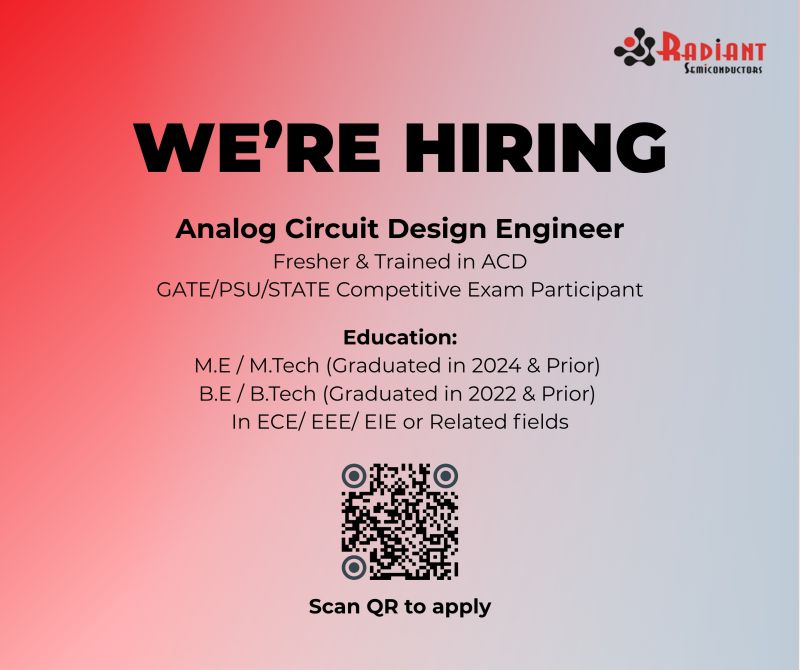
Breaking into the VLSI industry as a fresher can feel difficult, especially when most job descriptions mention “experience required.” This challenge becomes even more noticeable in specialized domains like analog layout design, where precision and practical understanding matter a lot.
However, many freshers do manage to get placed in analog layout roles every year. The difference is not luck; it’s how they prepare.
If you’re starting from zero, here’s a practical roadmap to help you move toward your first job in analog layout design.
Understand What Recruiters Actually Expect
Before focusing on preparation, it’s important to understand what companies are looking for in entry-level candidates.
For analog layout roles, recruiters typically expect:
- Strong basics in electronics
- Understanding of layout concepts (matching, symmetry, routing)
- Ability to explain a project clearly
- Some level of hands-on exposure
Notice that “experience” here often means practical familiarity, not necessarily a prior job.
Build Strong Fundamentals First
Everything in analog layout depends on how well you understand circuits.
Make sure you are comfortable with:
- MOSFET basics
- Current mirrors and differential pairs
- Basic analog building blocks
- Signal behavior and noise
These fundamentals help you understand why layout decisions matter, not just how to implement them.
Move Beyond Theory, Practice is Critical
One of the biggest reasons freshers struggle is that they stop at theoretical knowledge.
In analog layout, you need to:
- Convert schematics into layouts
- Apply matching and symmetry techniques
- Perform DRC and LVS checks
- Analyze layout-related issues
This is why many candidates prefer a structured custom and analog layout training for freshers where they can practice real design scenarios instead of just reading concepts.
Work on Meaningful Projects
Projects are your strongest proof of skill when you don’t have experience.
Focus on building:
- Basic analog blocks (current mirror, differential pair layouts)
- Matching-based layouts
- Small end-to-end layout designs
A well-executed project can often replace the need for prior work experience in interviews.
Many programs now include custom and analog layout training with internship or project-based modules, which simulate real-world tasks and make your learning more practical.
Learn Industry Tools Early
Analog layout is a tool-driven domain. Familiarity with tools like:
- Cadence Virtuoso
- Layout verification tools (DRC/LVS)
can give you an advantage during interviews.
Even basic hands-on exposure can make your profile stand out compared to candidates who only have theoretical knowledge.
Choose the Right Learning Environment
Self-learning can work, but it often lacks direction, especially in a domain like layout design.
A structured job-oriented custom and analog layout training approach helps you:
- Follow a clear learning path
- Get guidance on complex topics
- Practice consistently
- Prepare for interviews
This kind of focused preparation is what helps many freshers bridge the gap between learning and getting hired.
Prepare for Interviews the Right Way
Analog layout interviews are usually focused on:
- Concept clarity
- Project explanation
- Problem-solving approach
You may be asked:
- Why symmetry is important
- How you handled matching in your layout
- What challenges you faced in your project
Clear understanding and honest explanations matter more than memorized answers.
Common Mistakes to Avoid
- Relying only on theory
- Skipping hands-on practice
- Not working on projects
- Applying for jobs without preparation
- Choosing courses without checking practical exposure
Avoiding these mistakes can significantly improve your chances.
Final Thoughts
Getting placed in analog layout without experience is absolutely possible, but it requires a focused approach.
Instead of worrying about the lack of experience, concentrate on:
- Building strong fundamentals
- Gaining practical exposure
- Working on meaningful projects
- Preparing for interviews with clarity
When you can demonstrate real skills, companies are willing to consider you, even as a fresher.
Analog layout is a domain where precision, consistency, and understanding matter. If you invest time in learning it properly, it can lead to a stable and rewarding career in VLSI.
