

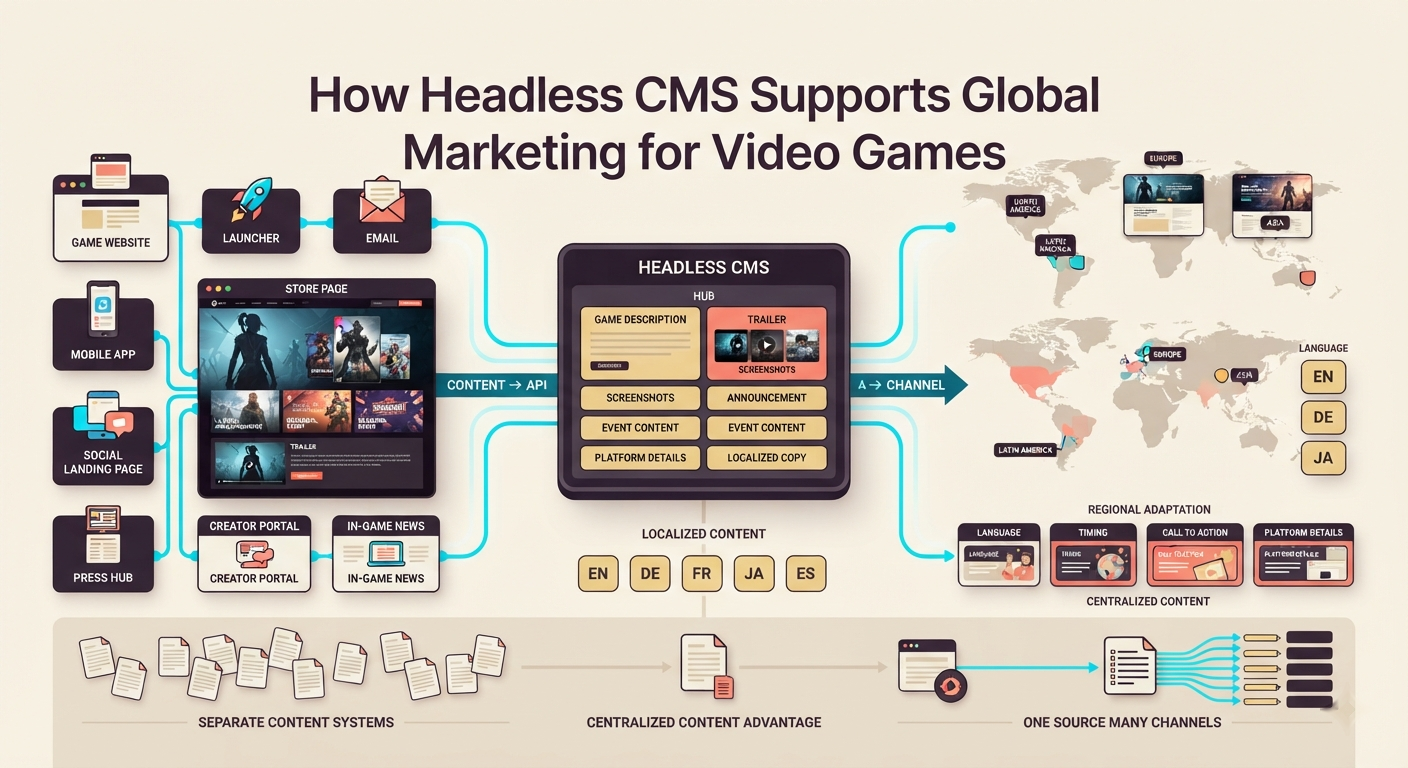
Global video game marketing is a complex process that involves many channels, regions, languages, platforms, and player communities. A new title, expansion, live event, or seasonal campaign may need to appear across websites, launchers, emails, store pages, mobile apps, social landing pages, press hubs, creator portals, and in-game news panels. At the same time, every market may require localized language, platform-specific details, regional timing, different calls to action, and content that feels relevant to local player behavior.
A headless CMS supports global marketing for video games by giving publishers and studios a centralized, flexible, and scalable way to manage campaign content. Instead of creating separate versions of the same content for every market and channel, teams can structure game descriptions, trailers, screenshots, announcements, platform details, event pages, and localized copy in one content system. Through APIs, this content can then be delivered wherever it needs to appear. This helps global teams protect brand consistency while giving regional teams the flexibility to adapt campaigns for their own audiences.
Creating a Central Global Marketing Content Hub
Global video game marketing becomes difficult when campaign content is scattered across many systems. A game description may live in one document, platform copy may be stored elsewhere, screenshots may sit in asset folders, and regional teams may create their own local versions separately. Learn about it by exploring how centralized content management can help gaming teams keep campaign assets organized, approved, and consistent across global markets. As campaigns grow, it becomes harder to know which version is approved, current, and ready to publish. This can slow down campaign production and increase the risk of inconsistent messaging across markets.
A headless CMS creates one central hub for global marketing content. Game summaries, feature descriptions, trailers, screenshots, key art, press materials, platform information, campaign messages, and calls to action can all be managed in a structured system. Global teams can define the core message, while regional teams can adapt specific fields for language, timing, and market relevance. This creates a stronger workflow because everyone works from the same source. The result is faster campaign execution and more consistent global communication.
Supporting Multi-Language Campaign Content
Video games often launch and grow across many regions, which means marketing content must be available in multiple languages. A campaign may need translated landing pages, localized store descriptions, trailer subtitles, email content, press materials, community updates, and
in-game announcements. If localization is managed manually through disconnected files, teams may struggle to track which language versions are complete, reviewed, or outdated.
A headless CMS helps manage multi-language content by connecting source content with localized versions. Each campaign field, such as headline, description, feature text, button label, FAQ answer, or platform note, can be translated and reviewed inside the same content structure. If the original copy changes, teams can identify which localized versions need updates. This makes global marketing more reliable because every market stays connected to the approved campaign foundation. Players, press, creators, and partners receive clearer information in the right language, while publishers maintain stronger control over messaging quality.
Maintaining Brand Consistency Across Markets
A global video game campaign needs to feel recognizable everywhere, even when it is localized. Players in different regions may see different language versions, platform links, or market-specific campaign angles, but the core identity of the game should remain consistent. If every region creates its own messaging from scratch, the game’s tone, positioning, and visual identity may become fragmented. This can weaken the overall campaign and make the title feel less cohesive.
A headless CMS helps maintain consistency by allowing global teams to define approved messaging, visual assets, campaign themes, and product information centrally. Local teams can adapt copy for their market, but they still work from the same core structure. This ensures that the game’s identity, genre positioning, key features, and launch message remain aligned across regions. Brand consistency matters because players often encounter campaigns through multiple sources, and a unified message helps build recognition, confidence, and excitement.
Adapting Campaigns for Regional Player Behavior
Global consistency is important, but video game marketing also needs local relevance. Player behavior, platform preference, content expectations, and marketing channels can vary from market to market. A campaign that performs well in one region may need a different emphasis elsewhere. One market may respond strongly to competitive features, while another may engage more with story, exploration, character content, or community activities. Regional timing and platform availability may also influence how campaigns are presented.
A headless CMS supports local adaptation by separating global campaign content from regional fields. The global team can define the main message and assets, while regional teams adapt
headlines, examples, calls to action, platform links, and promotional timing. This avoids the need to duplicate entire campaign pages for each market. Instead, local teams can adjust the content that needs to change while keeping the core campaign connected. This makes global marketing more flexible and more relevant to each audience.
Coordinating Game Launch Campaigns Across Channels
A global game launch campaign may need to go live across many channels at once. The official website, platform store pages, launchers, newsletters, press hubs, creator portals, community pages, and in-game messages all need accurate information. If these channels are managed separately, launch teams may struggle to keep release dates, platform details, edition information, screenshots, and calls to action aligned. Even small inconsistencies can create confusion during a major launch.
A headless CMS helps coordinate launch campaigns by providing structured content that can feed multiple channels. A single game title entry can include descriptions, feature highlights, media assets, store links, platform information, FAQs, and localized versions. Each channel can display the content in the format it needs, but the core information stays connected. This allows publishers to launch global campaigns faster and with greater confidence. Teams can update important launch details once and distribute the approved version across all connected experiences.
Managing Visual Assets for Global Campaigns
Visual assets are central to video game marketing. Trailers, screenshots, key art, logos, character renders, gameplay clips, thumbnails, banners, and platform-specific images all help players understand and remember a game. In global campaigns, these assets may need different crops, sizes, language overlays, subtitles, or regional versions. If assets are stored separately from campaign content, teams may use outdated or incorrect visuals across markets.
A headless CMS can connect approved visual assets directly to campaigns, title pages, press kits, and regional content. Each asset can include usage notes, approval status, platform requirements, captions, alt text, localization needs, and related campaign stages. This makes it easier for teams to select the right image or video for each channel. A trailer can support the website, email campaign, press hub, and launcher from the same approved source. Better asset management helps global campaigns feel polished and consistent while reducing repeated manual work.
Supporting Platform-Specific Marketing Requirements
Game marketing often needs to support multiple platforms, including PC, console, mobile, cloud services, and storefront ecosystems. Each platform may have different content requirements, image sizes, feature tags, description lengths, release timing, and promotional formats. If teams
prepare platform content manually, it can become time-consuming and error-prone. A platform page may receive outdated copy, missing media, or an incorrect feature description.
A headless CMS helps teams manage platform-specific marketing content in one organized structure. A game entry can include global descriptions as well as platform-specific fields for store copy, screenshots, feature lists, language support, edition details, and calls to action. This allows publishers to adapt content for each platform without disconnecting it from the core campaign. Platform teams can review only the fields that matter to them, while global teams maintain oversight. This improves launch coordination and helps players receive accurate platform information wherever they discover the game.
Improving Press and Creator Campaign Workflows
Press and creator outreach is an important part of global game marketing. Journalists, reviewers, streamers, and creators need reliable access to trailers, screenshots, logos, key art, fact sheets, gameplay summaries, platform details, release dates, and campaign guidelines. If these materials are gathered manually or shared through disconnected folders, teams may waste time answering repeated requests or correcting outdated information.
A headless CMS can support structured press and creator hubs. Approved assets and information can be connected to a game title entry and delivered through a public or private portal. When details change, such as release timing or platform availability, teams can update the central source and keep the hub current. This gives external partners access to accurate materials while giving publishers stronger control over how the game is represented. Better press and creator workflows help global campaigns move faster and maintain a more professional presentation.
Delivering Campaign Content Across Websites, Apps, and Launchers
Global marketing campaigns often need to appear across several digital touchpoints. A player may first discover a game through a launcher card, then visit a website, sign up for email updates, read a news post, and later receive a regional campaign message. If every channel uses separate content, the experience can feel disconnected. Players may see different descriptions, visuals, or calls to action depending on where they engage.
A headless CMS supports omnichannel campaign delivery by making content available through APIs. The same campaign entry can power website sections, app cards, launcher modules, emails, and player portals. Each channel can use a format that fits its design, but the message stays aligned. A full game overview may appear on the website, while a short campaign summary appears in a launcher. This creates a smoother marketing journey because players receive consistent information across every digital touchpoint.
Scheduling Global Campaign Phases
Global video game campaigns often unfold in phases. A publisher may begin with a teaser, then release a reveal trailer, open wishlist pages, announce a beta, publish gameplay details, launch pre-orders, and move into launch-week messaging. Each phase needs content to appear at the right time across regions and channels. If timing is managed manually, teams may accidentally reveal content too early or delay important campaign updates.
A headless CMS supports scheduled publishing for campaign phases. Teams can prepare content modules in advance, assign publication dates, set expiration rules, and define regional visibility. A teaser page can evolve into a reveal page, then into a launch hub, without rebuilding the entire experience. Countdown messages, trailer modules, platform links, and email content can all be scheduled according to the campaign calendar. This gives global marketing teams stronger control over timing and helps create a more coordinated campaign rollout.
Supporting Community Marketing and Player Engagement
Global marketing does not stop at advertising or launch pages. Community engagement is a major part of building long-term interest in a game. Players may want developer updates, event announcements, behind-the-scenes content, player spotlights, guides, and community campaign information. If community content is disconnected from the global marketing strategy, the player experience may feel fragmented.
A headless CMS helps connect community marketing with broader campaign content. Developer messages, community articles, event updates, player guides, and campaign stories can be managed in the same content ecosystem as launch pages and press materials. This allows community teams to use approved messaging while still creating content that feels more direct and player-focused. A campaign page can link to a community update, while an in-game announcement can connect to a longer article. This helps global marketing feel more active, conversational, and connected to the player base.
Conclusion
Headless CMS supports global marketing for video games by giving publishers and studios a flexible way to manage content across regions, languages, platforms, and digital channels.
Global campaigns require game descriptions, trailers, screenshots, platform copy, landing pages, press materials, creator assets, localized content, community updates, and scheduled campaign phases. Without the right content system, teams can face duplicated work, inconsistent messaging, slow updates, and difficult localization workflows.
A headless CMS helps solve these challenges by centralizing content, supporting structured localization, improving asset management, enabling omnichannel delivery, reducing developer dependency, and preparing campaigns for long-term post-launch growth. Global teams can protect brand consistency, while regional teams adapt content for local player behavior and
market needs. Players, press, creators, and partners benefit from clearer and more reliable information. As video game marketing becomes more global and multi-channel, headless CMS architecture provides the foundation needed to launch, grow, and sustain campaigns with speed and confidence.
