

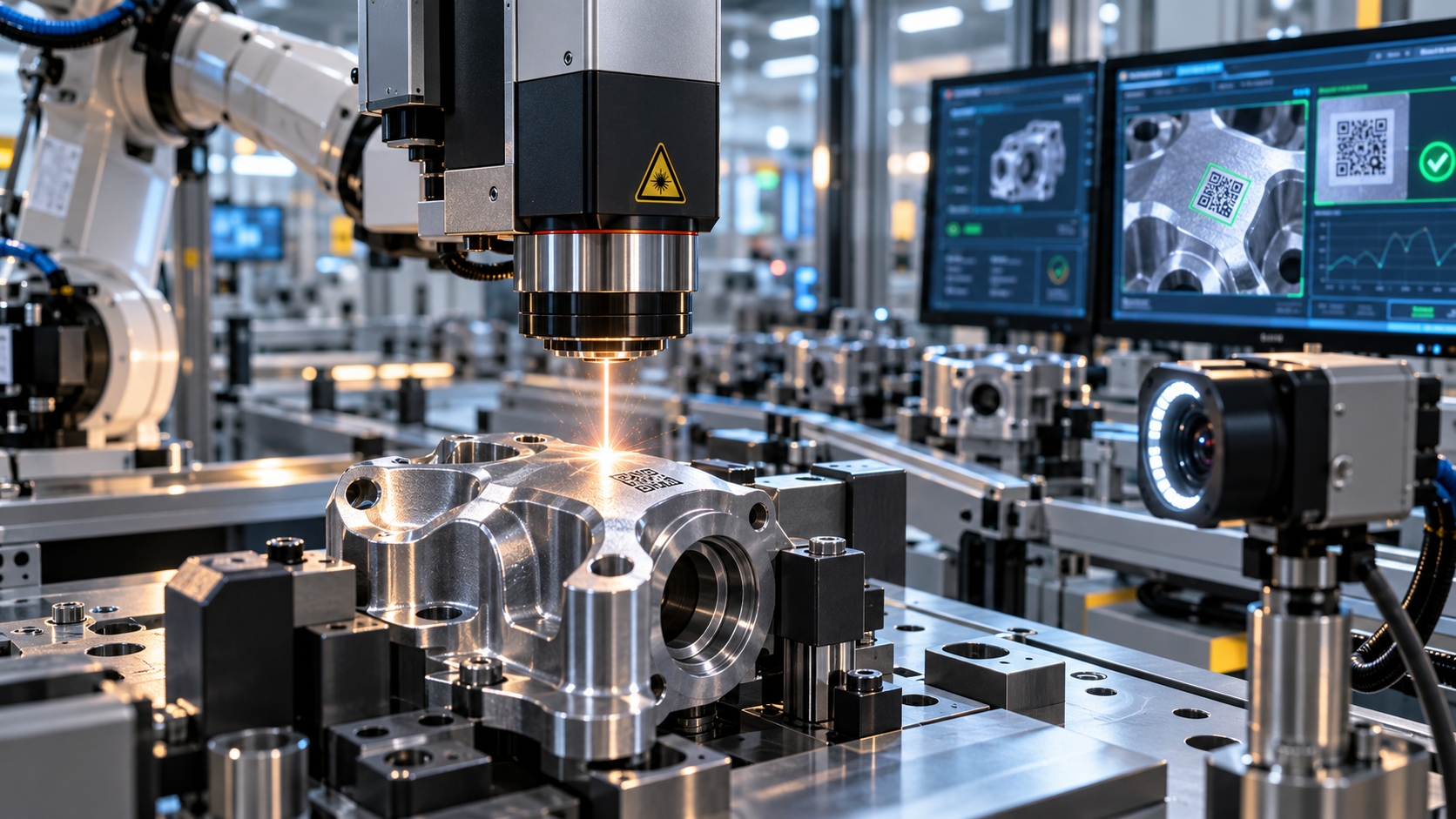
When people talk about smart manufacturing, the conversation usually focuses on artificial intelligence, robotics, industrial IoT, cloud platforms, and automated production lines.
But there is another technology quietly supporting many modern manufacturing processes: laser marking.
At first, laser marking may appear to be a simple way to put text or a logo on a product. In a connected manufacturing environment, however, a laser-marked serial number, QR code, or Data Matrix code can become an important link between a physical product and its digital production record.
This makes laser marking more than a finishing operation. It can become part of a broader system for identification, traceability, quality control, and production automation.
What Is Laser Marking?
Laser marking uses a focused laser beam to modify a specific area of a material surface.
Depending on the material and laser technology, the process may create a color change, remove a coating, create a surface contrast, produce an annealing effect, or remove material to create a deeper mark.
Common information marked onto industrial products includes:
- Serial numbers
- Part numbers
- QR codes
- Data Matrix codes
- Production dates
- Batch numbers
- Product specifications
- Logos
- Traceability codes
Unlike a temporary label, a laser mark can become part of the product itself. This can be useful when components need to remain identifiable during manufacturing, transportation, assembly, maintenance, and service.
Why Product Identification Matters in Smart Manufacturing
A smart factory depends on data.
Production systems collect information about orders, materials, machines, quality inspections, production batches, and finished products. But digital information is only useful if it can be connected to the physical product.
This is where permanent identification becomes important.
For example, an industrial component could receive a unique Data Matrix code during production. That code could be associated with information stored in a manufacturing database.
The database might contain:
- Manufacturing date
- Production line
- Batch number
- Inspection results
- Supplier information
- Product configuration
- Service history
The laser does not need to store all of this information on the component. Instead, it creates a physical identifier that allows other systems to retrieve the relevant digital information.
The concept is relatively simple:
Physical Product → Identification Code → Digital Record
This connection becomes increasingly useful as manufacturing processes become more automated.
Fiber Lasers and Industrial Metal Marking
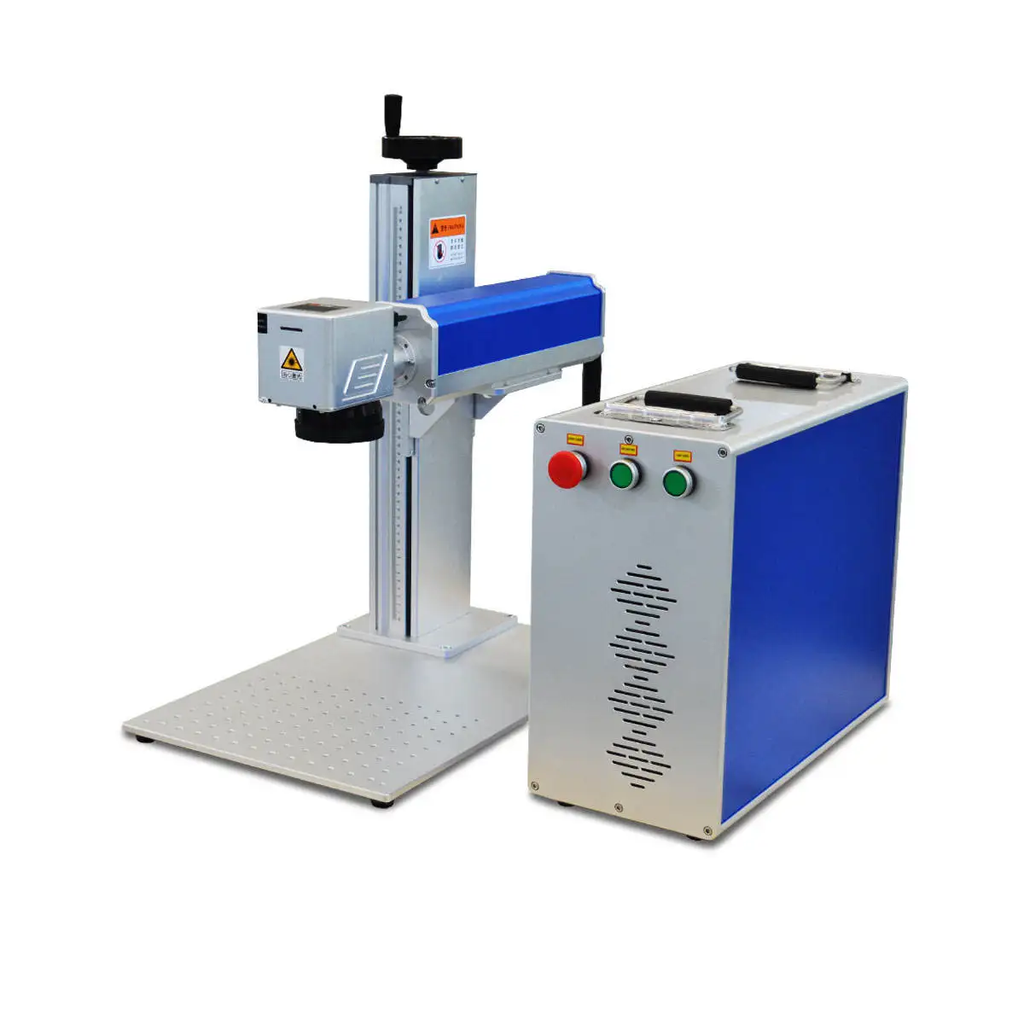
One of the most common industrial applications is marking metal components.
Fiber laser systems operating around 1064 nm are widely used for many metal marking applications, including stainless steel, aluminum, carbon steel, brass, titanium, and other industrial components.
A typical fiber laser marking machine can be configured for applications such as:
- Serial number marking
- Product identification
- Data Matrix marking
- QR code marking
- Logo marking
- Part number marking
- Surface marking
- Selected engraving applications
The actual result depends on much more than laser power. The laser source, pulse characteristics, scanner, focusing lens, marking field, material, marking content, focus position, and processing parameters all influence the finished mark.
Laser Power Is Not the Whole Story
When purchasing laser marking equipment, it is common to compare systems by power ratings such as 20W, 30W, 50W, or 100W.
Power is certainly relevant, but it should not be treated as the only measure of machine performance.
Consider two machines with the same nominal laser power. They may still produce different results because their laser sources, optical systems, scanners, software, calibration, and parameter settings are different.
The required application also matters.
A manufacturer producing simple serial numbers may have very different requirements from a company engraving deep identification marks into metal components.
This is why equipment selection should begin with the production requirement rather than simply choosing the highest available wattage.
Different Materials Need Different Approaches
Laser technology is not universal across every material.
Fiber, UV, and CO₂ lasers operate at different wavelengths and interact with materials differently.
| Laser Technology | Typical Wavelength | Common Applications |
| Fiber Laser | 1064 nm | Many metals and industrial components |
| UV Laser | 355 nm | Plastics, electronics, PCB, glass and selected sensitive materials |
| CO₂ Laser | Around 10.6 μm | Wood, acrylic, paper, leather and many non-metallic materials |
These categories are general rather than absolute. A specific material may be processed using more than one technology, but the resulting contrast, heat effect, marking depth, and production speed may differ significantly.
For that reason, testing the actual production material is usually more useful than relying only on a generic material compatibility list.
From Manual Marking to Automated Production
Laser marking becomes even more useful when integrated into an automated production line.
A basic automated workflow might look like this:
- The production system identifies the work order.
- The required product information is sent to the marking system.
- The workpiece is positioned automatically.
- The laser creates the identification mark.
- A vision system checks the result.
- The inspection information is stored in the production system.
This workflow reduces the need for operators to manually enter product information for every component.
It can also reduce the risk of marking the wrong serial number or applying incorrect product information.
The level of automation will vary depending on the factory. A small manufacturer may use a manually operated marking station, while a high-volume production line may integrate marking with conveyors, robots, sensors, and machine vision.
Machine Vision Can Close the Quality-Control Loop
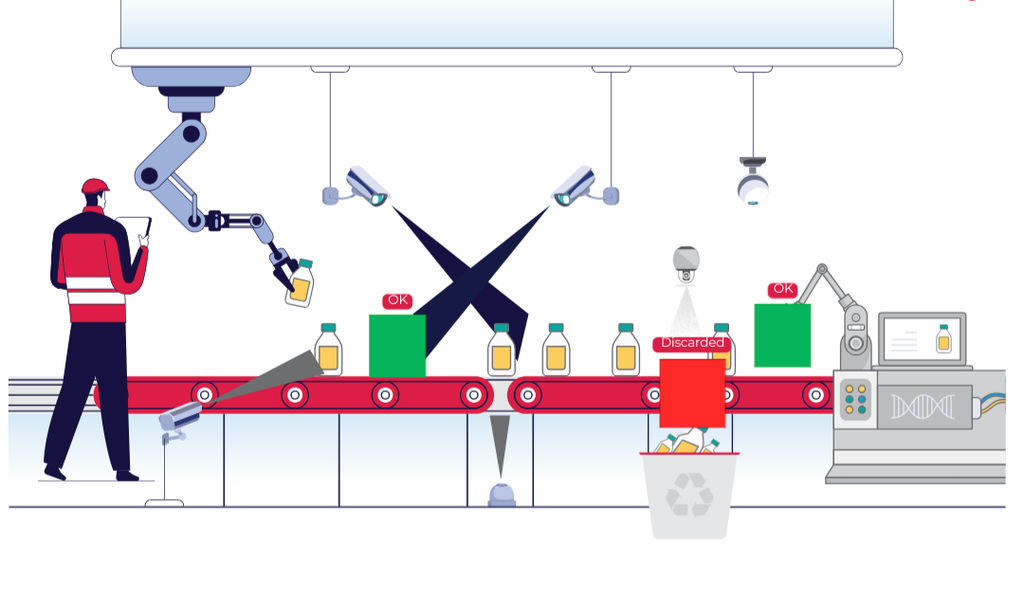
Creating a mark is only one part of the process.
For applications involving barcodes or Data Matrix codes, the mark may also need to be readable by a scanner or camera.
A machine vision system can inspect the finished mark and determine whether it meets the required criteria.
This creates a simple closed-loop process:
Mark → Inspect → Accept or Reject → Record
Such an approach can be useful in applications where traceability and quality control are closely connected.
It also demonstrates why laser marking should not always be considered an isolated piece of equipment. In a modern factory, it can become one component within a larger production system.
Why Production Cycle Time Matters
Another specification that can be misunderstood is maximum scanning speed.
A laser marking machine may advertise a high scanning speed, but that does not necessarily mean every product can be processed at that speed.
A simple line of text may require very little processing time.
A dense Data Matrix code, filled logo, or multi-pass engraving application may require considerably more time.
For manufacturers, a better measurement is the complete production cycle:
Loading → Positioning → Marking → Inspection → Unloading
This gives production managers a more realistic basis for calculating hourly output.
Why Testing the Real Product Matters
A machine specification sheet can provide useful information, but it cannot predict every production result.
Surface condition, material composition, coating thickness, workpiece geometry, marking content, and required contrast can all influence the process.
Before purchasing equipment, manufacturers should ideally test the actual production material.
A useful test can evaluate:
- Marking contrast
- Code readability
- Marking depth
- Surface damage
- Heat-affected area
- Cycle time
- Repeatability
- Long-term durability
Testing multiple samples is also important. One successful sample demonstrates that a process can work once. Repeated samples provide more information about process consistency.
How Laser Marking Supports Different Industries
Laser marking is used across a wide range of manufacturing applications.
Automotive
Automotive manufacturers may use permanent identification on engine components, brackets, tools, electrical parts, and other metal components. Serial numbers and Data Matrix codes can support component-level traceability.
Electronics
Electronics manufacturers may require small, precise identification marks on components, enclosures, PCBs, or other parts. The appropriate laser technology depends heavily on the material and thermal sensitivity.
Medical Devices
Medical components may require identification information that remains readable through handling, cleaning, and sterilization processes. The marking method needs to be selected according to the specific device material and regulatory requirements.
Industrial Equipment
Machine components and tools may require permanent part numbers, specifications, logos, or serial numbers so that individual parts can be identified during assembly, maintenance, and service.
What Businesses Should Consider Before Buying a Laser Marker
Businesses considering laser marking equipment should avoid starting with price alone.
A better evaluation begins with the actual manufacturing requirement.
Ask the following questions:
- What material needs to be marked?
- What information needs to be marked?
- What is the required marking area?
- Is surface marking enough?
- Is deeper engraving required?
- How many parts need to be processed?
- What cycle time is required?
- Does the mark need to be machine-readable?
- Will machine vision be required?
- Does the system need to communicate with MES or ERP software?
Once these questions are answered, it becomes easier to determine the appropriate laser type, power, optical configuration, software, and automation level.
If you are evaluating equipment specifically for industrial metal identification, Find more info about the configuration and applications of fiber laser marking systems.
The Future of Laser Marking in Smart Manufacturing
The manufacturing industry is moving toward greater automation and data integration.
Artificial intelligence may optimize production decisions. Industrial IoT devices may collect machine data. Machine vision may inspect products automatically. Robots may move components between production stations.
But all of these systems still need a way to associate digital information with physical objects.
Permanent identification can provide that connection.
For this reason, laser marking may become increasingly integrated with production software, machine vision, robotics, and traceability systems.
The technology itself is not new, but the role it plays within a connected factory is changing.
Final Thoughts
Laser marking is easy to underestimate because the visible result is often just a small piece of text, a logo, or a machine-readable code.
Behind that small mark, however, there can be a much larger manufacturing workflow involving product identification, quality control, production data, and traceability.
For businesses adopting smarter manufacturing processes, the important question is not simply which laser has the highest power or fastest advertised speed.
The better question is whether the complete marking system can reliably produce the required result on the actual production material, at the required cycle time, and integrate with the wider manufacturing workflow when necessary.
That perspective turns laser marking from a simple engraving operation into a useful part of modern digital manufacturing.
