

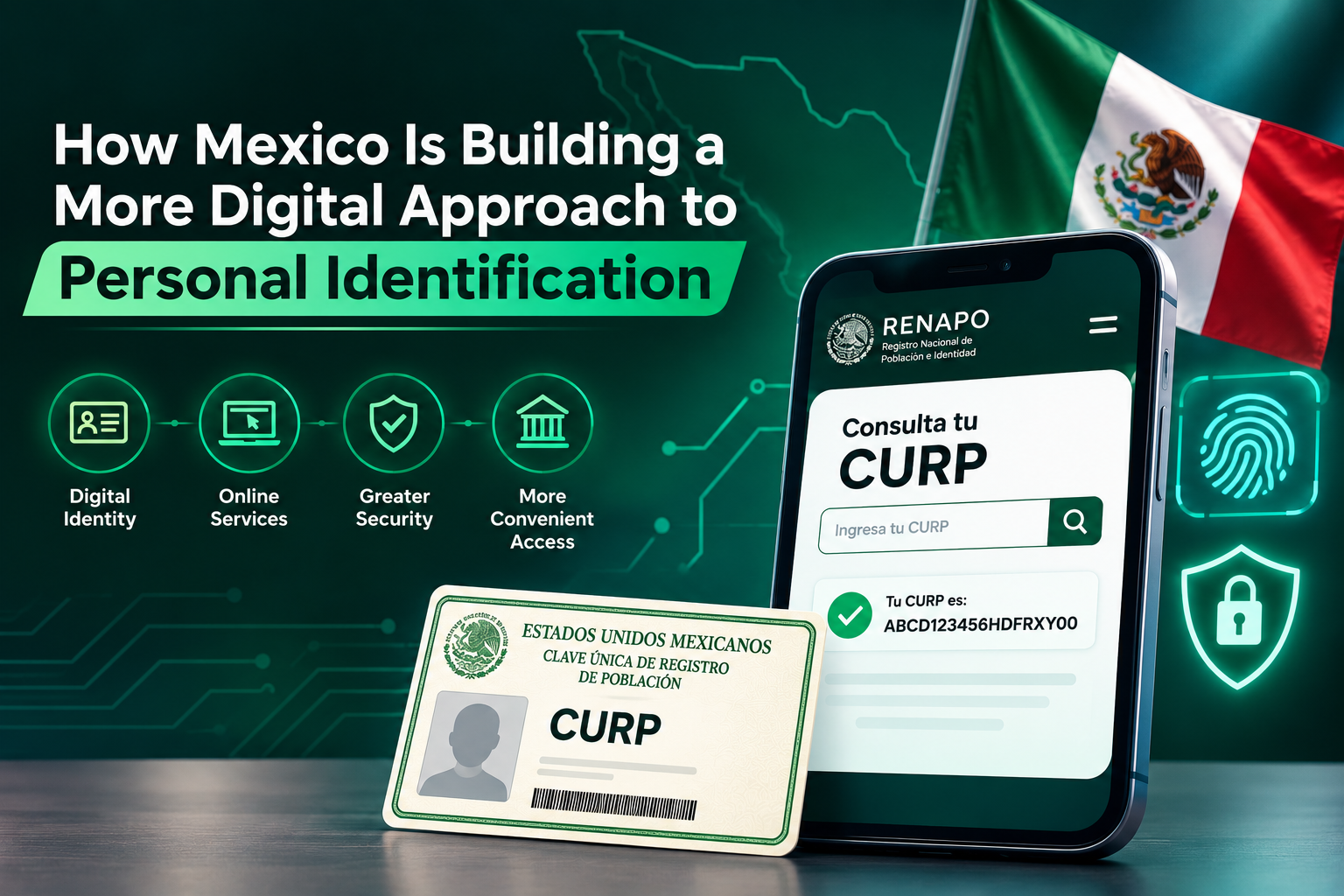
Personal identification is becoming increasingly important as everyday life moves online. Applying for public services, accessing education, completing employment procedures, managing financial matters, and interacting with government institutions can all involve digital systems that need to know who a person is.
Mexico has been developing its identity infrastructure around this changing reality. At the center of that system is the Clave Única de Registro de Población (CURP), a unique identifier used to register and identify people in Mexico. The government describes the CURP as an important instrument for exercising the right to identity and accessing public services.
The country’s direction is now moving beyond simply assigning an alphanumeric code. Mexico is working toward a more integrated approach in which identity records, digital services, verification mechanisms, and under the developing biometric CURP framework, biometric information can work together.
For ordinary citizens, this evolution could eventually mean fewer repetitive identity checks and more convenient access to digital services. But it also makes accuracy, privacy, security, and responsible data management more important than ever.
Why Personal Identification Needs to Evolve
Traditional identification systems were largely designed around physical documents and face-to-face interactions. A person could present a birth certificate, government-issued identification, or another document at an office, and an official could verify the information.
Digital services change that equation.
When a government service is accessed online, there may be no official physically present to compare a person’s face with a document. The system instead needs reliable information that can be searched, validated, and connected securely to the correct individual.
This creates several challenges:
- How can a digital service determine that an identity record belongs to the correct person?
- How can duplicate records be reduced?
- How can incorrect personal information be identified and corrected?
- How can different public institutions work with consistent identity information?
- How can sensitive information be protected while still making services accessible?
Mexico’s modernization of its population and identity infrastructure is intended to address precisely these kinds of challenges.
CURP Has Become More Than Just a Personal Code
The CURP has existed since 1996 and contains 18 alphanumeric characters. It is used to individually register people who live in Mexico, as well as Mexican citizens living abroad and certain foreign residents.
Its importance comes from its ability to provide a consistent identifier across different administrative processes.
For users, this can make an important difference. Instead of every institution creating an entirely separate way to identify an individual, a common identifier can help connect records and reduce ambiguity.
The Mexican government has also emphasized the goal of having one person, one birth record, and one CURP, with the CURP linked to the corresponding civil registration. This approach is intended to strengthen certainty around legal identity and make access to services easier.
That may sound like an administrative detail, but it becomes much more significant as government services become digital.
RENAPO’s Role in the Digital Identity Infrastructure
The modernization of personal identification cannot happen through a single website or application. It requires an institution responsible for coordinating population registration and identity information.
That is where the Registro Nacional de Población e Identidad (RENAPO) plays a central role.
RENAPO, within the Secretaría de Gobernación, is responsible for the management and coordination of Mexico’s population and identity systems. The official CURP service identifies the Dirección General del Registro Nacional de Población e Identidad as the authority responsible for the online CURP consultation process.
Understanding the role of renapo mexico is therefore useful for anyone trying to understand how personal identification works in the country. RENAPO is not simply a place where people look up a number; it forms part of the institutional infrastructure behind population registration and identity management.
Its work also involves coordinating with civil registries and other government entities so that identity records can become more consistent and reliable.
Making CURP Information Easier to Access
One of the most visible effects of digitalization is convenience.
The official online CURP service allows people to search for their CURP either by entering the 18-character key when they already know it or by providing personal information such as their name and birth details.
This matters because a digital identity system is only useful if people can reasonably access and manage the information associated with them.
For example, someone who needs a copy of their CURP document for an administrative process may search for information about how to descargar curp gratis pdf con nombre rather than visiting an office simply to retrieve information they already have a right to access.
The broader lesson is important: digital government is not only about creating databases behind the scenes. It is also about making legitimate services easier for citizens to use.
From Identification to Digital Verification
The next stage is more sophisticated than simply making documents available online.
A truly digital identity infrastructure needs to support verification.
Suppose someone submits an online application. The system may need to determine whether the person’s name, date of birth, CURP, and other information correspond to an existing identity record.
Mexico’s current legal and administrative direction increasingly recognizes this role for the CURP. A June 2026 publication in the Diario Oficial de la Federación describes provisions under which the CURP is to be used in processes for validating and authenticating people’s identities in digital environments.
This is an important shift.
The identifier is no longer relevant only when someone fills out a paper form. It can become part of the infrastructure that allows digital systems to establish that information belongs to the right person.
The Move Toward Biometric Identity
Perhaps the most significant development in Mexico’s identification strategy is the move toward a biometric component.
In April 2026, the Secretaría de Gobernación described the biometric CURP as an initiative intended to provide each person with an identity that is unique, verifiable, and protected. The government said the approach is intended to improve the delivery of government services and reduce risks associated with duplicate records, impersonation, and misuse of personal information.
The proposed biometric approach changes the nature of identification.
Instead of relying exclusively on information such as a name, date of birth, or an alphanumeric identifier, biometric systems can use characteristics associated with an individual, such as fingerprints and facial information. Government documents discussing the initiative have also referenced biometric elements and QR-based verification.
This could make identity verification more robust, particularly for services where establishing that a person is genuinely who they claim to be is important.
But biometric information is also highly sensitive. Strong safeguards are therefore essential.
Convenience and Privacy Must Develop Together
Digital identity creates a difficult but necessary balance.
People want government services to be faster and easier. At the same time, they reasonably expect their personal information to be protected.
The official CURP privacy notice explains that the online consultation service processes information such as the CURP, full name, date of birth, sex, and state of birth to search, validate, and obtain the CURP. It also identifies RENAPO as the responsible authority for the processing of that information.
This illustrates why privacy cannot be treated as an optional feature of digital government.
A modern identity system needs appropriate controls around:
- Data collection
- Authentication
- Access permissions
- Data storage
- Information sharing
- Cybersecurity
- Record correction
- User transparency
The more valuable an identity system becomes, the more attractive it can also become to criminals attempting identity theft or unauthorized access.
Better Data Can Mean Better Public Services
Digital identity is not valuable simply because it is technologically sophisticated.
Its real value comes from what reliable identity information allows public institutions to do.
Accurate identity records can help reduce duplicated registrations, improve administrative processes, support eligibility verification, and make it easier for people to interact with multiple services.
RENAPO has described its modernization work as part of a broader effort to guarantee the right to identity, strengthen inclusion, and improve the reliability of population records.
For citizens, the ideal outcome is straightforward: less bureaucracy and greater certainty.
Instead of repeatedly proving basic personal information to different institutions, people could increasingly interact with connected digital services that can securely verify the information already associated with their identity.
What Digital Identification Means for Everyday Users
For most people, the technical architecture behind population databases may seem distant from everyday life. Yet its effects can be very practical.
Digital identification can potentially make it easier to:
- Find personal records online
- Complete government procedures remotely
- Verify information without unnecessary office visits
- Reduce repetitive paperwork
- Correct identity information when errors occur
- Access services using consistent personal information
- Establish identity more securely in digital environments
The official CURP service already demonstrates part of this transition by allowing users to consult their information online rather than relying exclusively on physical processes.
The challenge is ensuring that convenience does not come at the expense of accuracy or privacy.
The Importance of Correct Identity Information
A digital identity system is only as reliable as the information connected to it.
An incorrect name, date of birth, duplicated CURP, or mismatch with a civil registration can create problems when records are checked across different systems.
This is one reason Mexico’s focus on linking CURP information with civil registration is significant. RENAPO and the civil registries have worked toward the objective of ensuring that each person has a single CURP associated with their birth record.
For users, this means personal records should not simply be viewed as static information. They are part of an administrative identity infrastructure that can affect access to services.
If information appears incorrect, people should use the appropriate official channels to request correction rather than attempting to create a second identity record.
What Comes Next for Mexico’s Digital Identity
Mexico’s identity infrastructure is moving toward a model in which the CURP can play a much broader role in digital identification and verification.
The government has described the biometric CURP as part of a broader transformation rather than simply a technological upgrade.
At the same time, official materials indicate that implementation involves multiple institutions, technical systems, civil registries, and safeguards. The goal is not merely to digitize an existing document but to create a more coordinated identity infrastructure.
The most successful system will ultimately be the one that combines several objectives:
Reliable records + secure verification + privacy protection + accessibility + simpler services
Technology can provide the infrastructure, but trust will determine whether people are willing to use it.
A More Connected Identity System
Mexico’s approach to personal identification illustrates a broader global trend: identity is moving from physical paperwork toward connected digital infrastructure.
The CURP provides an established foundation. RENAPO provides institutional coordination. Online services make identity information more accessible, while newer verification technologies are opening the door to stronger ways of establishing that a person is genuinely who they claim to be.
For citizens, the most important measure of success will not be how advanced the technology sounds. It will be whether the system makes everyday interactions with public services simpler, safer, more accurate, and more inclusive.
As Mexico continues developing its digital identity infrastructure, the challenge will be to achieve that balance, using technology to reduce administrative friction while protecting one of the most valuable forms of information a person has: their identity.
