

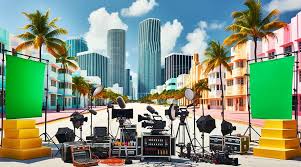
For decades, South Florida’s economic identity was anchored in three things: sun, beaches, and tourism. Today a quieter but increasingly powerful industry is rewriting that story. Visual storytelling — the business of conceiving, shooting, and editing professional video — has grown from a niche service into one of the most dynamic corners of the regional economy, and Miami sits squarely at its center.
The shift did not happen overnight. As social platforms began rewarding brands that could publish a steady stream of polished, scroll-stopping content, demand for professional production exploded. What used to be an occasional expense reserved for a single flagship television spot is now an always-on requirement. Restaurants need short-form reels. Real estate developers need cinematic property walkthroughs. Law firms, healthcare groups, hospitality brands, and tech startups all need a deep library of footage that keeps them visible across YouTube, Instagram, TikTok, and — more recently — the AI-driven search engines that increasingly surface video first.
Why Miami Became a Content Capital
Geography helped. Miami has long been a bridge between North and Latin America, which makes it a natural hub for bilingual, cross-cultural campaigns that need to land in two markets at once. But the deeper driver has been talent. Over the past several years, directors, cinematographers, editors, and motion designers have relocated to South Florida in meaningful numbers, drawn by the lifestyle, the absence of a state income tax, and a client base that is hungry for content and willing to pay for quality.
That concentration of talent created a flywheel. As more skilled crews settled in the region, the quality bar rose, which attracted larger clients, which in turn justified more investment in equipment, studio space, and post-production infrastructure. Neighborhoods like Wynwood and the Design District, already known for art and design, became informal production districts where a brand could shoot, edit, and deliver a campaign without ever leaving a few square miles.
Brands Are Choosing Local
One of the most telling trends is the move away from distant, generalized agencies toward local production partners who understand the market on the ground. A national agency can produce a beautiful film, but it rarely knows which Coral Gables rooftop catches the best light at golden hour, or how to navigate a permit for a shoot on the water, or which neighborhoods read as authentically Miami to a local audience.
This local knowledge is now a competitive advantage rather than a footnote. Agencies offering full-service Miami video production have stepped into that gap, pairing the technical polish that national brands expect with the cultural fluency that only a regional team can provide. The result is work that performs better precisely because it feels native to the place it was made.
The Rise of the All-in-One Studio
The economics of content have also reshaped how studios are structured. A decade ago, a brand might hire a separate shop for strategy, another for filming, and a third for editing and animation. That fragmented model is fading. Clients now expect a single partner who can handle concept development, scripting, on-location production, post-production, motion graphics, and even distribution strategy under one roof. Consolidating these functions lowers cost, shortens turnaround, and keeps a consistent creative vision intact from the first storyboard to the final cut.
This integrated approach has been particularly important for small and mid-sized businesses, which make up the backbone of South Florida’s economy. A boutique fitness studio or a family-owned restaurant cannot afford to assemble a roster of specialized vendors, but it can afford a single studio that delivers a month of content in one coordinated production day. By making professional video accessible to businesses that were once priced out of it, local studios have effectively widened the market and pulled an entirely new tier of clients into the creative economy.
What Comes Next
The next phase is already taking shape, and it is being driven by artificial intelligence. AI tools are accelerating parts of the editing and ideation process, but rather than replacing production teams, they are raising expectations. When a competitor can generate a rough cut in minutes, the differentiator becomes craft, originality, and the kind of authentic, location-specific storytelling that algorithms cannot replicate. That is good news for South Florida, where the supply of genuine local talent remains the region’s strongest asset.
There is also a measurable economic dimension. The film, television, and digital content sector supports tens of thousands of jobs across South Florida and feeds a long tail of adjacent businesses — equipment rental houses, catering, location scouts, post-production facilities, and freelance crews. Every campaign produced locally keeps that money circulating in the regional economy rather than exporting it to studios in Los Angeles or New York.
Miami’s transformation from a tourism economy into a content economy is far from complete, but the trajectory is unmistakable. The studios shaping that future are not chasing the look of other markets; they are building something rooted in the city itself — multilingual, fast-moving, visually distinctive, and unmistakably South Florida. As brands everywhere compete for attention through video, the region that learned to tell its own story best may find that storytelling has quietly become one of its most valuable exports.
