

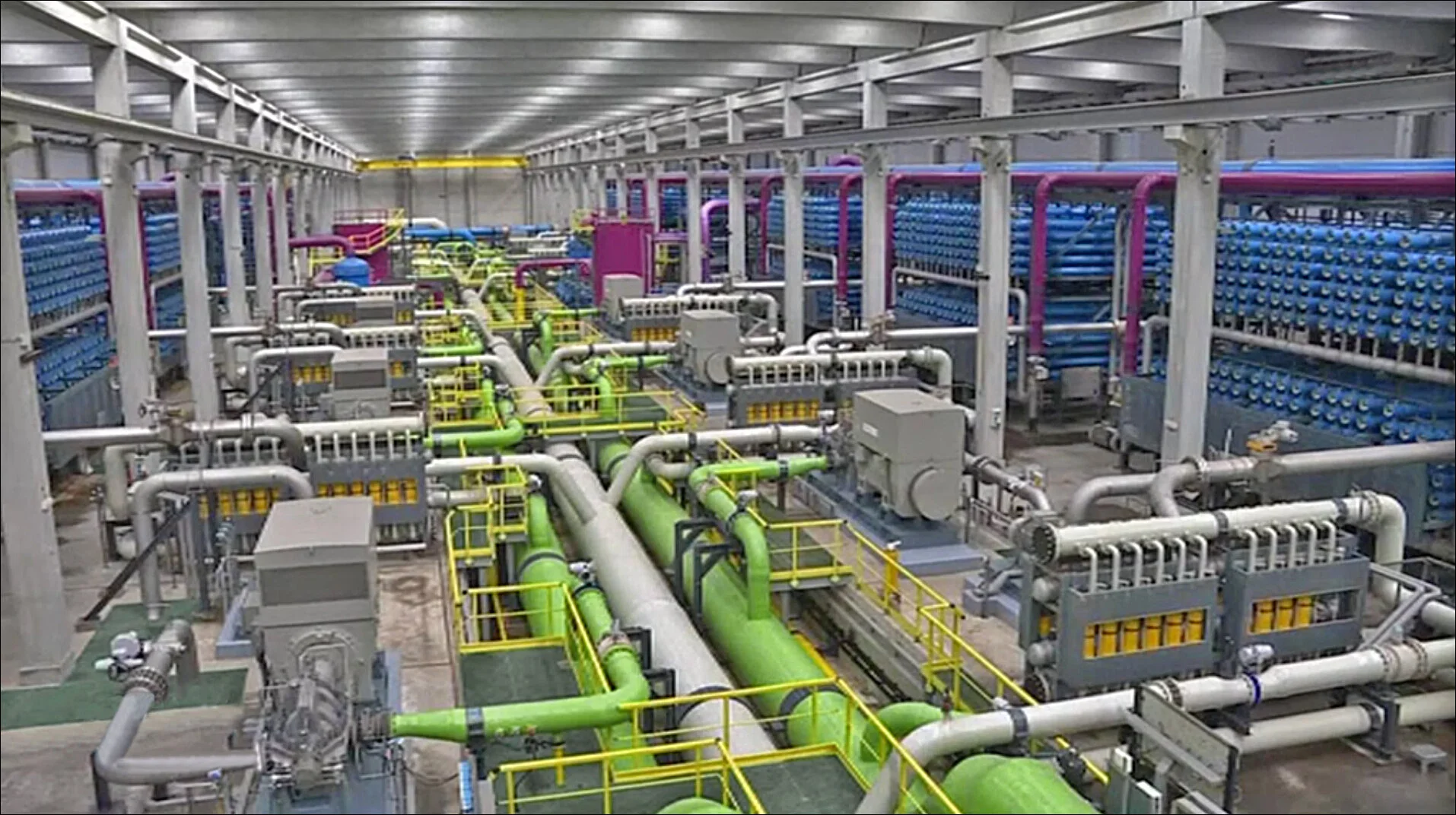
The Gulf Cooperation Council (GCC) countries are among the most water-stressed regions in the world. With very little natural freshwater and high demand from growing cities, industry and agriculture, desalination supplies a large share of drinking and processed water in the UAE, Saudi Arabia, Qatar, Kuwait, Bahrain and Oman. It is also energy-intensive, and energy is typically the largest single item in the operating budget of a desalination plant, often around one third to one half of total water production cost.
This article explains how modern plants cut that energy use and lower operating costs, from membrane choice and energy recovery to pretreatment, dosing, monitoring and maintenance. It is written as a technical overview, not a product catalogue.
Why Desalination Uses So Much Energy
Seawater in the Arabian Gulf is among the saltiest and warmest open seawater anywhere, with salinity commonly in the range of 40,000 to 45,000 mg/L total dissolved solids (TDS), compared with about 35,000 mg/L in the open ocean. Separating fresh water from it takes work, either as heat (thermal processes) or as pressure (reverse osmosis).
- Thermal desalination (multi-stage flash and multi-effect distillation) evaporates seawater and condenses the vapour. It has historically dominated the Gulf, often paired with power generation, but it needs large amounts of heat and electricity.
- Reverse osmosis (RO) pushes seawater through semi-permeable membranes at high pressure, typically 55 to 70 bar for seawater. It has become the preferred technology for new capacity because it uses far less energy.
Older thermal plants can consume the equivalent of well over 10 kWh of energy per cubic metre of water. Modern seawater RO plants commonly operate in the range of roughly 3 to 4 kWh/m³ for the whole plant, and the best designs approach the practical limits of the process. The theoretical minimum for typical seawater is about 1 kWh/m³, so the remaining gap is where engineers focus their efforts.
1. Energy Recovery Devices
The reject stream (brine) leaving an RO membrane array is still at nearly full feed pressure. Throwing that pressure away would waste a large share of the pumping energy. Energy recovery devices (ERDs) capture it.
- Pressure exchangers transfer pressure directly from the brine to a portion of the incoming feed, with hydraulic efficiencies commonly reported above 95%.
- Turbochargers and Pelton-wheel type turbines convert brine pressure into rotational energy that assists the high-pressure pump.
Before ERDs became standard, seawater RO plants used well above 6 kWh/m³. Isobaric pressure exchangers are one of the main reasons modern plants now sit near 3 kWh/m³ or lower for the RO section.
2. Better Membranes and Smarter Array Design
The RO membrane is the heart of the plant. Advances in membrane chemistry and element design allow plants to produce the same volume of water at lower pressure.
- Higher permeability membranes need less feed pressure for the same flux.
- High-rejection elements can reduce the need for a second pass, which saves pumping energy and chemicals.
- Larger-diameter elements (16-inch in addition to the standard 8-inch) reduce piping, vessel count and footprint in very large plants.
- Low-fouling surface coatings slow the rise in pressure drop that otherwise forces higher energy use over time.
When specifying elements, operators and EPC contractors typically work with an RO membrane supplier in UAE or a RO membrane supplier in Dubai who can provide performance projections for the actual feed water, including temperature, salinity and fouling potential. Gulf water temperatures can exceed 35 °C in summer, which raises permeability but also increases the risk of biofouling and affects salt passage, so projections should cover both winter and summer conditions.
Design choices such as two-stage or hybrid arrays with different membrane types in the same vessel, internally staged design (ISD), and split-partial two-pass layouts can also lower average operating pressure. Pairing these with a well-sized high-pressure pump running near its best efficiency point avoids wasteful throttling.
3. Pressure Vessels and Hydraulic Efficiency
Membrane elements sit inside pressure vessels. Reliable vessels are a structural and hydraulic part of the system, not just housing.
Fiberglass-reinforced plastic (FRP) vessels are the standard for seawater and brackish water RO because they resist corrosion in saline environments and handle high design pressures. Operators sourcing FRP vessels or an RO pressure vessel supplier in UAE typically check the pressure rating (for example 300, 450, 600 or 1,000 psi classes), the number of elements per vessel, end-port design and the quality of the seals. Poorly sealed vessels allow feed to bypass the membranes, lowering product quality and wasting pressure.
Lower internal pressure drops through vessels and manifolds means the high-pressure pump does less work. This is a small saving per cubic meter, but in plants running 24 hours a day it adds up over many years.
4. Pretreatment: The Cheapest Energy Saving
A large share of energy waste in RO plants comes from fouling and scaling. When membranes foul, operators raise feeding pressure to maintain output, and energy use climbs. Good pretreatment protects the membranes and keeps the specific energy consumption stable.
Typical pretreatment steps include:
- Intake screening and coagulation to remove coarse material and suspended solids.
- Media filtration or ultrafiltration (UF) to reduce the silt density index (SDI) of the feed. UF in particular produces consistent feed quality even during algal blooms, which are a recurring issue in the Gulf.
- Cartridge filtration as the final safeguard before the high-pressure pump. Most plants use 5-micron cartridge filters, and a reliable cartridge filter supplier in UAE will usually offer both melt-blown and pleated filter cartridge options. Pleated designs provide a larger filtration area, longer service life and lower pressure drop, which reduces replacement frequency and pumping loss. In smaller or lower-risk installations, bag filters are a practical option for pre-filtration and high dirt-holding capacity; operators often source a bag filters supplier in UAE for this purpose.
- Multi-vessel filter arrangements such as an FRP cluster filter housing in UAE, where several FRP housings are manifolded together to handle higher flow rates with a smaller footprint and easier maintenance access.
- Activated carbon filtration to remove free chlorine and organic matter. Chlorine will irreversibly damage polyamide membranes, so dechlorination by activated carbon or sodium bisulfite is essential. Plants buying from activated carbon suppliers in Dubai generally compare iodine number, hardness, ash content and particle size, because these properties determine adsorption capacity and backwash behaviour.
- Water softening in brackish and industrial applications, where calcium and magnesium would otherwise scale membranes. Automatic control valves such as Clack valves and Runxin water softener valves are widely used on softener and filter vessels to manage service, backwash and regeneration cycles. Efficient regeneration (using only the salt and water actually required) reduces consumables and waste.
5. Precise Chemical Dosing
Chemical use is the second-largest operating cost after energy in many plants. Over-dosing wastes money and can foul membranes. Under-dosing leads to scaling and biofouling.
Accurate chemical feed relies on well-selected dosing pumps. Plants working with a dosing pumps supplier in UAE commonly look for metering accuracy, turndown ratio, chemical compatibility of wet parts and the ability to pace the pump to flow signals or online analyzers. Typical chemicals dosed include:
- Antiscalant, to extend the safe recovery range
- Coagulants and flocculants
- Sodium hypochlorite (before pretreatment) and sodium bisulfite (before the membranes)
- pH adjusters and post-treatment chemicals such as lime or CO₂ for remineralisation
Flow-proportional dosing is a straightforward efficiency gain, because chemical consumption then follows actual production instead of fixed settings.
6. Instrumentation, Monitoring and Control
You cannot reduce what you cannot measure. Modern plants rely on instrumentation to catch small efficiency losses before they become expensive.
Flow meters are central to this. A flow meters supplier in UAE will typically supply electromagnetic, ultrasonic, turbine or variable-area meters for different duties: feed flow, permeate flow, brine flow and chemical dosing lines. Reliable flow data allows operators to calculate:
- Recovery rate (permeate flow divided by feed flow)
- Salt rejection and salt passage
- Normalised permeate flow and differential pressure, which reveal fouling trends early
- Specific energy consumption (kWh/m³)
Combined with pressure, conductivity, temperature, pH, ORP and turbidity sensors, this data feeds SCADA systems. Increasingly, plants add predictive analytics to optimise operating setpoints and schedule cleaning-in-place (CIP) only when truly needed, rather than on a fixed calendar.
7. Variable Frequency Drives and Efficient Pumping
Pumps account for most of the electrical load of an RO plant, including intake, booster, high-pressure and product transfer pumps. Efficiency measures include:
- Variable frequency drives (VFDs) that adjust motor speed to match demand instead of throttling valves.
- High-efficiency motors and pumps selected for the normal operating point, not just the design point.
- Optimised pipework with larger diameters and fewer restrictions to reduce friction losses.
VFDs are particularly valuable in Gulf plants because seawater temperature changes seasonally, changing the pressure needed to produce the same volume of water.
8. Renewable Energy and Grid Integration
GCC governments have been investing in solar-powered desalination and in the integration of large solar PV capacity with RO plants. The UAE, Saudi Arabia and Oman have all announced or built projects to supply desalination with renewable electricity. Because RO load is steady and predictable, it pairs well with long-term renewable power purchase agreements, and some plants are exploring energy storage and flexible operation to take advantage of low-cost daytime solar power.
Renewable power does not reduce the kWh/m³ figure itself, but it can significantly lower the cost and carbon intensity of each cubic metre.
9. Maintenance Practices That Protect Efficiency
Small operating habits strongly affect long-term costs:
- Replace filter cartridges at the right differential pressure, not too early (wasted consumables) and not too late (risk to membranes).
- Clean membranes at the first sign of fouling, using normalised data to decide, not waiting until pressure has risen significantly.
- Inspect vessels, seals and valves regularly to prevent internal leakage.
- Calibrate instruments and dosing pumps on a schedule so the data and chemical feed stay trustworthy.
- Track key performance indicators such as specific energy, recovery, chemical use per cubic metre and membrane life.
Membrane life is a significant economic factor. Plants with good pretreatment and careful operation often reach membrane lifetimes of seven years or more, which reduces both replacement cost and downtime.
10. Brackish Water and Industrial Systems
Not every GCC project involves seawater. Many industrial sites, hotels, farms and municipal facilities treat brackish groundwater, which needs far lower pressure and therefore much less energy, often in the range of 0.5 to 1.5 kWh/m³. In these systems, the choice of RO systems (skid-mounted or custom-built) and supporting industrial water treatment equipment has a direct effect on efficiency. Organisations typically work with an experienced RO systems supplier in UAE or a general water treatment equipment supplier in UAE to match system design to feed water analysis, required recovery and recycling or discharge limits.
When comparing water treatment equipment suppliers in UAE, engineers commonly look beyond price to technical documentation, availability of spares, compatibility between components (membranes, vessels, filters, valves and pumps) and local technical support. A reliable water treatment equipment supplier UAE can also help with design verification and commissioning, which has a large influence on the long-term cost of operating the plant.
11. Brine Management and Water Reuse
Brine disposal can add cost and environmental risk. Strategies being adopted in the region include:
- Diffuser outfalls designed for rapid mixing and dilution
- Higher recovery designs that reduce brine volume
- Recovery of useful minerals from brine in pilot and early commercial projects
- Using treated brine for industrial processes where permitted
While many of these steps do not reduce energy directly, they lower the compliance and environmental costs of operating a plant.
Summary: Where the Savings Come From
| Area | Main benefit | Typical effect |
| Energy recovery devices | Recover pressure from brine | Largest single reduction in RO energy |
| Modern RO membranes | Lower pressure for the same output | Lower specific energy |
| Robust pretreatment (UF, cartridge, carbon) | Less fouling and fewer cleanings | Stable energy use, longer membrane life |
| Accurate dosing | Right chemical amounts | Lower chemical cost, less scaling |
| Flow and process monitoring | Early detection of losses | Fewer surprises, better scheduling |
| VFDs and efficient pumps | Match power to demand | Reduced electricity use |
| Renewable power | Lower cost per kWh | Lower cost and emissions per m³ |
Conclusion
Reducing energy consumption and operating costs in desalination is not about a single technology. It comes from a combination of energy recovery, efficient membranes, protective pretreatment, accurate dosing, strong instrumentation and disciplined maintenance. For the GCC, where water security is closely tied to economic growth, these gains matter at every scale, from the largest seawater RO plants to smaller brackish water and industrial installations.
As membrane technology, digital monitoring and renewable energy continue to improve, the cost and energy footprint of desalinated water in the region is expected to keep falling. Operators who understand each part of the treatment train, and how the components work together, are best positioned to capture those savings.
