

Life at a remote cabin offers unmatched freedom, but it comes with a demanding reality: you are entirely on your own when the power fails. Extreme cold snaps, scorching summers, relentless humidity, and the simple fact that the nearest electrician is hours away create a uniquely unforgiving environment for any energy system. In these conditions, a battery isn’t just a convenience—it’s the lifeline keeping your lights on, your food cold, and your communications running.
The central challenge for off-grid cabin owners isn’t simply finding a battery; it’s finding one built to survive and perform where standard equipment gives up. Most conventional batteries crack under temperature extremes, demand frequent maintenance, and degrade rapidly with heavy use—none of which is acceptable when you’re living miles from the nearest town.
This guide is designed to cut through the confusion and give remote cabin owners a clear, practical framework for selecting batteries for off grid power that genuinely last. From understanding why LiFePO4 lithium chemistry has become the gold standard in harsh environments to sizing your system correctly and maximizing overall efficiency, every section delivers actionable guidance. The right battery choice transforms an unpredictable power situation into a stable, independent energy system you can rely on through every season.
Understanding the Core Demands of Harsh Off-Grid Environments
A “harsh” environment for batteries goes well beyond simply being cold or hot. It means temperatures that swing from -20°F in winter to 110°F in summer, persistent humidity that corrodes terminals, and physical vibration from wind, generators, or uneven terrain. For remote cabin owners, these conditions aren’t occasional—they’re the daily reality that every component in your power system must endure without complaint.
The demands placed on an off-grid battery are equally unrelenting. Unlike a weekend camping setup, a remote cabin requires 24/7 power for genuine essentials: refrigeration to keep food safe, lighting for safety and comfort, and communication devices that may represent your only link to emergency services. There’s no utility grid to fall back on when something fails, and the nearest qualified technician might be a four-hour drive away. This means maintenance requirements must be minimal, and reliability must be absolute across years, not months.
Standard batteries—the kind designed for cars, boats, or even typical home backup systems—simply aren’t engineered for this combination of stresses. Flooded lead-acid batteries freeze in deep cold and require regular water top-offs that are impractical in remote settings. Conventional lithium-ion chemistries can become thermally unstable under extreme heat. Most standard batteries also degrade rapidly when repeatedly drained deeply, which is exactly how off-grid systems operate during cloudy stretches or high-demand periods.
Think of the battery bank as the heart of your entire off-grid power system. Solar panels and wind turbines generate energy, but the battery is what stores it, regulates its delivery, and determines whether your cabin has power at 2 a.m. during a winter storm. Choosing the wrong battery doesn’t just mean shorter lifespan—it means system failure at the worst possible moment.
Why LiFePO4 Lithium Batteries Dominate for Durability
When comparing battery chemistries for harsh off-grid use, the differences aren’t subtle—they’re decisive. Flooded lead-acid batteries are cheap upfront but demand regular water top-offs, vent corrosive gases, and deliver only 200–500 cycles before significant capacity loss. AGM and Gel variants eliminate the maintenance headache but still suffer from poor performance in cold temperatures and limited depth of discharge, typically around 50%. Push them harder, and their lifespan collapses quickly. Lithium iron phosphate—LiFePO4—operates in an entirely different league.
The chemistry itself is what sets LiFePO4 apart. Unlike standard lithium-ion cells, which use cobalt-based cathodes prone to thermal runaway under heat or physical damage, LiFePO4 has an inherently stable molecular structure. This translates directly into safety in unattended remote locations where a battery fire would be catastrophic. More practically, LiFePO4 batteries routinely deliver 3,000 to 5,000 full charge cycles—often more—compared to a few hundred for lead-acid alternatives. Manufacturers like Vipboss have built their off-grid battery lines around this chemistry precisely because those cycle counts hold up in the real-world conditions remote cabin owners actually face. For a remote cabin, that gap means the difference between replacing your battery bank every three years or every fifteen.
Depth of discharge is another critical advantage. LiFePO4 batteries can be safely discharged to 80–90% of their rated capacity without damaging the cells, effectively doubling the usable energy compared to lead-acid at the same nominal capacity. They also perform reliably across a wide operating temperature range, maintaining meaningful output even in sub-zero conditions where lead-acid batteries become sluggish and weak.
The upfront cost is higher, but the math favors LiFePO4 decisively over time. Fewer replacements, lower maintenance, and greater usable capacity mean the total cost of ownership over a decade is substantially lower—a critical consideration when every supply run to your remote location costs time and money.
Key Specifications to Evaluate in a LiFePO4 Battery
Reading a battery datasheet doesn’t require an engineering degree, but knowing which numbers matter saves you from costly mistakes. Cycle life tells you how many full charge-discharge cycles the battery is rated for at a specified depth of discharge—higher is always better for longevity. Depth of discharge indicates how much of the rated capacity you can use without degrading the cells; look for 80% or above. The operating temperature range reveals the true cold- and heat-weather limits for both charging and discharging, since charging below freezing without protection can permanently damage cells. Charge and discharge C-rates determine how quickly the battery can accept or deliver power—a higher continuous discharge rate supports demanding loads like well pumps or power tools. Finally, energy density affects how much power you can store in a given physical space, which matters when your battery enclosure is limited. Cross-referencing these figures against your actual cabin loads ensures the battery you choose performs in the real world, not just on paper.
The Non-Negotiable Role of a Battery Management System (BMS)
A LiFePO4 battery without a quality Battery Management System is like an engine without a governor—capable of impressive performance, but vulnerable to catastrophic failure at the worst possible moment. The BMS is the electronic brain embedded in every modern lithium battery pack, continuously monitoring and controlling the conditions under which the cells operate. For remote cabin owners who can’t check on their system daily, it’s not optional—it’s the difference between a battery that lasts fifteen years and one that fails silently over a single harsh winter.
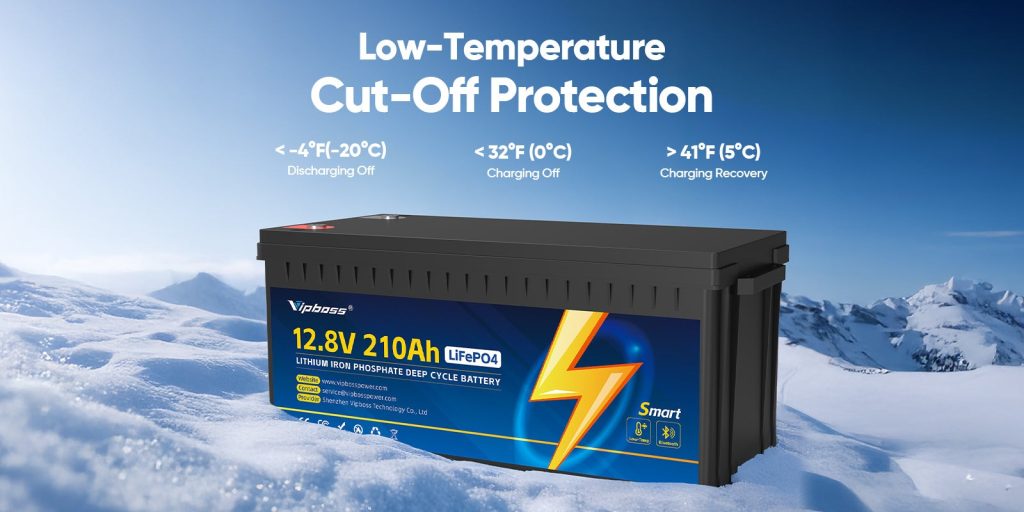
The BMS performs several critical functions simultaneously. Cell balancing ensures that individual cells within the battery pack charge and discharge evenly, preventing weaker cells from being overworked and degrading ahead of the rest. Overcharge and over-discharge protection cuts power flow before voltage levels reach thresholds that would permanently damage the chemistry. Short-circuit protection responds in milliseconds to fault conditions that could otherwise cause fires or irreversible cell damage. Temperature monitoring is equally vital—a quality BMS will halt charging automatically when temperatures drop below freezing, since pushing current into cold lithium cells causes metallic lithium plating that permanently reduces capacity.
When evaluating a LiFePO4 battery for harsh off-grid use, scrutinize the BMS specifications directly. Look for a continuous discharge current rating that exceeds your highest expected load, a low-temperature charging cutoff that activates before cell damage can occur, and active or passive cell balancing rather than no balancing at all. A BMS with Bluetooth monitoring capability is a genuine practical advantage in remote settings—it lets you check cell voltages, state of charge, and temperature from your phone without physically accessing the battery enclosure. Prioritize batteries from manufacturers who publish detailed BMS specifications rather than leaving those figures vague.
Step-by-Step Guide: Choosing Your Off-Grid Battery System
Step 1: Calculate Your True Energy Needs. Start with a detailed load audit before purchasing a single component. List every electrical device in your cabin—refrigerator, lighting, water pump, communication equipment, fans—and note each item’s wattage and daily hours of use. Multiply wattage by hours to get watt-hours per device, then sum everything for your total daily consumption. Add a 20% buffer for inefficiencies and unexpected loads. This number is your baseline; everything else in your system design flows from it.
Step 2: Size Your Battery Bank Correctly. Raw daily consumption isn’t enough—you need to account for days of autonomy, meaning how many consecutive days without solar input your system must survive. In harsh climates with extended cloudy periods or heavy snowfall covering panels, three to five days of autonomy is a reasonable target. Divide your total energy requirement by your battery’s usable depth of discharge, then multiply by your autonomy days. Also confirm your system voltage—12V, 24V, or 48V—since higher voltages reduce current draw and improve efficiency over longer wire runs common in cabin installations.
Step 3: Prioritize Durability Features. Once capacity is determined, evaluate specific durability characteristics before committing. Key features to verify include:
- Temperature compensation and low-temperature charging cutoff built into the BMS
- A robust IP-rated enclosure that resists moisture and dust intrusion
- Low self-discharge rate, critical during seasonal cabin absences
- A manufacturer warranty of at least five years with clear capacity retention guarantees
Step 4: Plan for Integration and Maintenance. Even the best battery underperforms without proper installation. Mount batteries in an insulated, temperature-controlled enclosure to buffer against extreme cold and heat—this single step can dramatically extend lifespan. Use a compatible MPPT charge controller sized for your solar array, since mismatched controllers waste energy and stress cells. Establish a simple monthly monitoring routine: check state of charge, inspect terminals for corrosion, and review BMS data via Bluetooth if available. Proper integration turns individual components into a cohesive, resilient system.
Maximizing Energy Efficiency in Your Off-Grid System
Choosing the right battery is only half the equation—how that battery integrates with the rest of your system determines whether you’re getting every usable watt-hour from your investment. LiFePO4 batteries already have a significant efficiency advantage here: their round-trip energy efficiency typically exceeds 95%, meaning nearly all the energy stored gets delivered as usable power. Lead-acid batteries, by contrast, lose 15–25% of stored energy to heat during charge and discharge cycles. Over months and years, that gap translates directly into fewer solar panels needed, smaller battery banks required, and longer overall system life.
Pairing your LiFePO4 bank with a high-quality MPPT charge controller is the single most impactful supporting upgrade you can make. MPPT controllers harvest up to 30% more energy from your solar array compared to older PWM technology, which is especially meaningful during low-light winter days when every watt counts. On the output side, select a pure sine wave inverter rated appropriately for your peak loads—oversized inverters run inefficiently at partial load, while undersized ones strain under demand spikes from motors and pumps.
Where possible, run appliances directly on DC power rather than converting to AC through an inverter. Each conversion step introduces losses, and DC refrigerators, LED lighting, and USB-powered devices eliminate that overhead entirely. Prioritizing DC loads for your highest-consumption devices can meaningfully reduce the daily energy draw your battery must cover. Taken together, these efficiency measures don’t just stretch your battery’s range—they reduce the total system size you need to purchase, making a properly optimized off-grid setup both more reliable and more cost-effective from the start.
Building a Resilient Off-Grid Power System That Lasts
Building a reliable power system for harsh off-grid living comes down to one foundational principle: durability cannot be compromised when there’s no fallback. LiFePO4 batteries, paired with a quality Battery Management System, represent the clearest path to that durability—delivering thousands of cycles, stable performance across extreme temperatures, and the kind of low-maintenance reliability that remote cabin life demands.
The path to getting there is straightforward when approached methodically. Understand exactly what your environment throws at your equipment, calculate your true energy needs without guesswork, select batteries whose specifications match those real-world demands, and integrate everything into a properly sized, well-installed system. Efficiency gains from MPPT controllers, quality inverters, and DC appliances compound over time, stretching every watt-hour further and reducing the overall burden on your battery bank.
The right battery investment isn’t just a technical decision—it’s what transforms a remote cabin from a place of constant energy anxiety into a genuinely comfortable, self-sufficient home. When a winter storm rolls in at midnight or a week of clouds settles over your solar array, a well-chosen, properly integrated battery system means you simply don’t worry. That peace of mind, season after season, is the true return on a thoughtful investment in durable off-grid power.
