

Proxies are used for a wide range of online tasks, from web scraping and SEO monitoring to automation, accessing localized content, and checking websites from different countries. However, proxy requirements can vary significantly depending on the task.
For one use case, a large IP pool and frequent rotation may be essential. For another, keeping the same IP throughout a long session is more important. In some cases, geography is the priority; in others, speed or traffic cost matters more.
That is why the question is not simply which proxy service to choose, but which type of proxy is best suited to a specific task.
Let’s look at the main options and the situations in which they can be used in 2026.
Why Proxy Type Matters
A proxy acts as an intermediary between a device or application and the target internet resource. A request first passes through the proxy server and is then sent to the target website using the proxy’s IP address.
In practice, different tasks have different requirements for this connection.
For example, large-scale data collection may require regular IP rotation. When working with a sequence of related requests, on the other hand, keeping the same address may be important. For localized content checks, GEO becomes a key factor, while processing large numbers of pages puts more emphasis on speed and cost.
This is why there is no single proxy type that is equally suitable for every scenario.
Main Types of Proxies
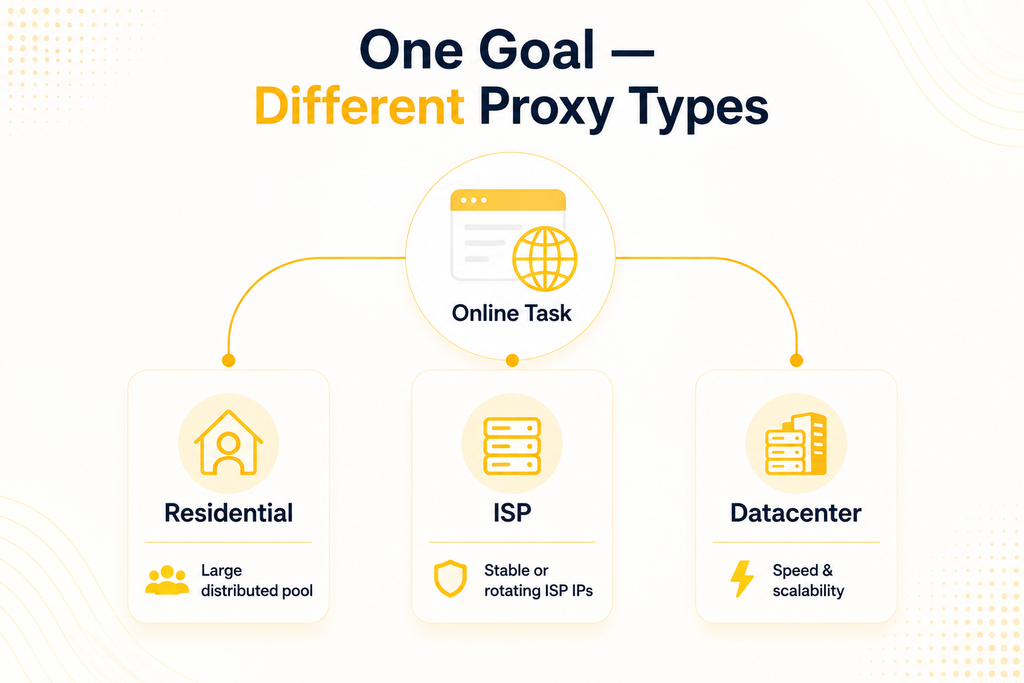
For most online tasks, three main IP categories are used: residential, ISP, and datacenter proxies. Within these categories, both static and dynamic options are available.
Residential Proxies
Residential proxies use IP addresses associated with internet service providers and user networks.
One of their main advantages is access to large, distributed IP pools across different countries. Addresses can be rotated regularly, which is useful for tasks that require a large number of requests to be distributed across multiple IPs.
Residential proxies can be used for:
- web scraping;
- price monitoring;
- SEO research;
- localized content checks;
- e-commerce analytics;
- market research;
- automated collection of publicly available data.
They are particularly useful when a project requires a large number of IPs and broad geographic coverage.
Residential Light Proxies
Not every task requires precise city- or region-level targeting.
If you need to work with content from a particular country, selecting the country and accessing a large residential IP pool may be enough.
For example, MangoProxy offers Residential Light Proxies with a pool of more than 85 million IPs and support for 200+ countries. This option provides country-level targeting and supports HTTP, HTTPS, and SOCKS5.
Residential Light can be a suitable choice for large-scale tasks where a large IP pool and country selection are important, but more detailed GEO targeting is not required.
Dynamic ISP Proxies
ISP proxies use IP addresses registered with internet service providers.
The dynamic option allows IP addresses to rotate regularly, combining rotation with the characteristics of ISP networks.
These proxies can be used for:
- large-scale data collection;
- automation;
- monitoring;
- processing large numbers of pages;
- tasks where both performance and IP rotation are important.
Dynamic ISP proxies are particularly useful when a static address is not required but the project needs to distribute requests across multiple IPs.
Static ISP Proxies
Static ISP proxies keep the same IP address for an extended period.
This makes them useful for scenarios where a sequence of actions needs to be performed from the same address.
For example, static ISP proxies can be used for:
- long-running sessions;
- sequences of related requests;
- monitoring where keeping the same IP is important;
- automation that requires a consistent address;
- accessing services where frequent IP changes are undesirable.
MangoProxy provides Static ISP Proxies with access to more than 50 locations and support for HTTP, HTTPS, and SOCKS5. The promo code KONGOTECH gives an 8% discount on Static ISP Proxies.
Dynamic Datacenter Proxies
Datacenter proxies use IP addresses associated with hosting providers and datacenter infrastructure.
They typically offer high speeds and more affordable pricing compared with residential solutions.
Dynamic datacenter proxies distribute requests across different IP addresses and can be used for:
- web scraping;
- technical monitoring;
- processing large numbers of pages;
- automation;
- working with publicly available data.
They can be a particularly cost-effective option for resources that work well with datacenter IPs.
Static Datacenter Proxies
Static datacenter proxies combine the high speed of datacenter infrastructure with a consistent IP address.
They can be used for:
- automated processes;
- monitoring;
- long-running connections;
- services that do not require residential or ISP IPs;
- tasks where the cost of each static address is important.
When choosing between Static ISP and Static Datacenter proxies, it is important to consider the target resource’s requirements regarding IP origin.
Static vs. Dynamic Proxies: What’s the Difference?
One of the main decisions when choosing proxies is whether the IP address should remain consistent or rotate regularly.
When Rotation Is Needed
Rotating proxies are suitable for tasks involving a large number of independent requests.
For example, if an application processes thousands of pages one after another, requests can be distributed across different IP addresses from the same pool.
Rotation is commonly used for:
- web scraping;
- price monitoring;
- SEO analysis;
- large-scale data collection;
- working across multiple GEOs.
However, the rotation frequency should match the logic of the specific task. Changing the IP as often as possible is not always necessary.
When a Static IP Is Needed
Static proxies are suitable for scenarios where maintaining a consistent network address is important.
This is particularly relevant for sequential actions and long-running sessions.
If several requests are part of the same process, an unexpected IP change between them may be undesirable.
In these situations, a static proxy or a sticky session that temporarily keeps the same IP may be a better choice.
Which Proxy Type Should You Choose for Different Tasks?
Let’s look at several common scenarios.
Web Scraping
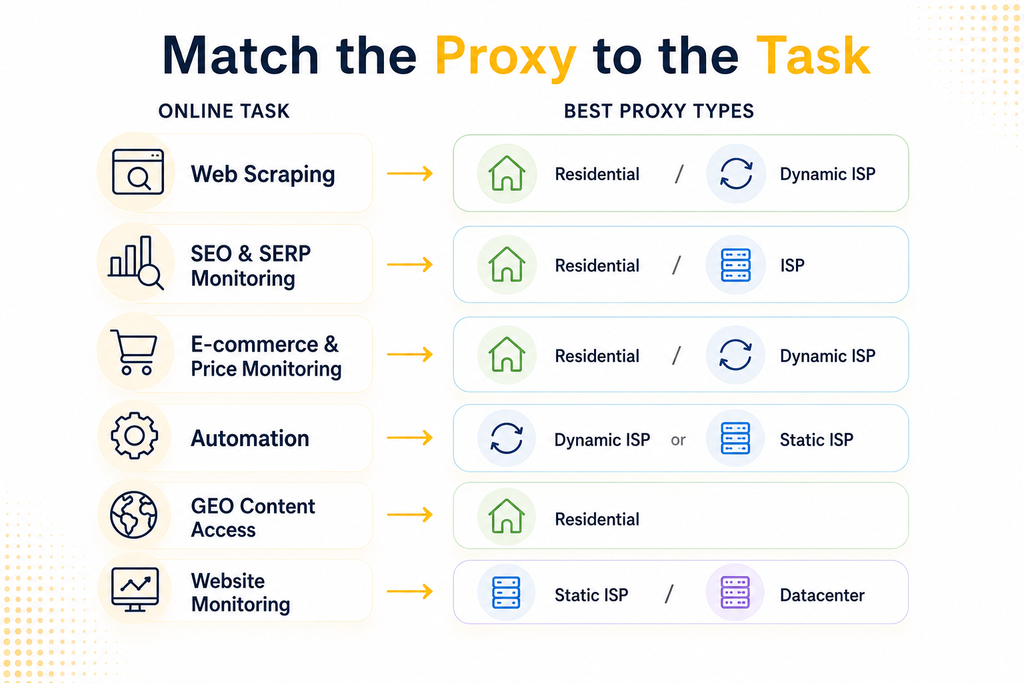
Rotating proxies are often suitable for large-scale web scraping.
When working with a large number of pages, possible options include:
- Residential;
- Residential Light;
- Dynamic ISP;
- Dynamic Datacenter.
The right choice depends on the target website’s requirements, required GEO, budget, and data volume.
For less demanding resources, datacenter proxies can be the most economical option. For projects that require a large distributed IP pool, residential solutions are often more appropriate.
SEO and Search Results Analysis
IP geography is especially important for SEO monitoring.
Search results may vary depending on the country or region, so proxies make it possible to perform checks from different locations.
Residential or ISP proxies with the required GEO can be used for these tasks.
If only country selection is required, country-level targeting may be sufficient. More localized results may require more precise geographic targeting.
Price Monitoring and E-Commerce
Prices, product availability, and catalogs can vary between countries.
For this reason, proxies with broad GEO coverage are often used for e-commerce monitoring.
If a large number of product pages need to be checked regularly, rotating residential or dynamic ISP proxies can be used.
For a smaller number of resources, static solutions may also be sufficient.
Automation
Proxy requirements for automation depend heavily on the process itself.
If an application performs a large number of independent actions, rotation may be useful.
If the automated process involves a long sequence of related requests, maintaining the same IP may be preferable.
As a result, automation workflows may use Dynamic ISP or Residential proxies as well as Static ISP or Static Datacenter proxies.
Checking GEO-Specific Content
Many websites change their content depending on the user’s location.
This may affect:
- language;
- currency;
- prices;
- product catalogs;
- search results;
- advertising offers;
- availability of certain pages.
In these scenarios, the main criterion is access to IP addresses in the required countries or regions.
If only country-level checks are required, country-level targeting is usually sufficient. More precise research may require regional or city-level targeting.
Regular Website Monitoring
Proxies are also used for ongoing checks of websites, APIs, prices, product availability, and other content.
If requests are sent at a moderate frequency and the resource works well with a single address, a static proxy may be sufficient.
As the number of requests increases, the workload can be distributed across multiple IPs.
Working with Large Data Volumes
When request volumes become large, infrastructure cost becomes an important factor.
Using residential IPs for every source is not always the most cost-effective approach.
Some resources may work well through more affordable datacenter proxies, while residential or ISP IPs can be reserved for websites with more demanding requirements.
This approach can help optimize costs without relying on a single proxy type for the entire infrastructure.
What to Look for When Choosing Proxies
Regardless of the specific task, several key parameters should be considered.
GEO
First, determine which countries the requests need to come from.
If a project operates in only one market, a huge list of available countries may not be particularly important. For international projects, however, broad GEO coverage becomes a major consideration.
IP Pool Size
A large pool is particularly important for rotating proxies.
The more addresses available, the easier it is to distribute a high volume of requests.
However, you should consider not only the advertised total network size but also the availability of IP addresses in the locations your project actually needs.
Speed and Latency
For large-scale tasks, speed directly affects performance.
If every request takes significantly longer, the difference becomes substantial when hundreds of thousands of pages are being processed.
For this reason, both bandwidth and connection latency should be considered.
Success Rate
Success rate represents the percentage of requests completed successfully.
This metric is most useful when evaluated together with speed and stability. A high success rate does not necessarily compensate for excessively long response times.
Rotation Management
For dynamic proxies, it is important to understand how IP addresses are changed.
Useful options include:
- automatic rotation;
- IP changes on new connections;
- sticky sessions;
- configurable session duration.
The more control you have over rotation, the easier it is to adapt proxy infrastructure to a specific task.
Protocols
HTTP and HTTPS are suitable for most standard web tasks.
SOCKS5 provides a more universal way to route traffic and can be used with applications and tools that require support for this protocol.
Price
Cost should be evaluated together with the pricing model.
Some proxies are priced by traffic volume, while others are sold by the number of IP addresses.
Rotating residential solutions are often billed by GB used, while static ISP and datacenter proxies are commonly priced per IP.
The right model depends on the workload.
One Proxy Type or Several?
For a small project, one proxy type may be enough.
As the infrastructure grows, however, using several types can become more practical.
For example:
- Residential – for tasks requiring a large distributed IP pool;
- Residential Light – for large-scale tasks with country-level targeting;
- Dynamic ISP – for high-performance tasks requiring rotation;
- Static ISP – for long-running sessions;
- Datacenter – for high-speed and less demanding data sources.
Instead of routing all traffic through the most expensive solution, data sources can be divided by their requirements and assigned the most suitable proxy type.
Mango Proxy as a Flexible Proxy Infrastructure
Mango Proxy provides several proxy types within one service:
- Residential Proxies;
- Residential Light Proxies;
- Dynamic ISP Proxies;
- Static ISP Proxies;
- Dynamic Datacenter Proxies;
- Static Datacenter Proxies;
- Dedicated Mobile Proxies.
The overall network includes more than 90 million IPv4 addresses, while residential solutions are available across 200+ countries. HTTP, HTTPS, and SOCKS5 are supported.
Having different IP types available within a single service makes it possible to use one provider for multiple tasks and select infrastructure based on the requirements of each project.
For example, rotating proxies can be used for large-scale data collection, Static ISP proxies for long-running sessions, and Datacenter proxies for tasks where speed and cost are the main priorities.
FAQ
Which proxy type is the most versatile?
There is no universal option. Residential proxies are suitable for many tasks thanks to their large IP pools and broad GEO coverage, but ISP or datacenter proxies may be more efficient and cost-effective in certain scenarios.
Which is better: static or dynamic proxies?
It depends on the task. Dynamic proxies are suitable for large numbers of independent requests. Static proxies are better suited to long-running sessions and processes where the same IP needs to be maintained.
When should you choose ISP proxies?
ISP proxies are suitable for tasks where a stable connection and IP addresses associated with internet service providers are important. Dynamic ISP proxies can be used for rotating scenarios, while static ISP proxies are suitable for long-running sessions.
When are datacenter proxies enough?
Datacenter proxies are suitable for websites and services that work well with these types of IP addresses. They are particularly useful when high speed, scalability, and cost efficiency are priorities.
Is city-level targeting necessary?
Not always. Country selection is sufficient for many tasks. More precise targeting is useful only when data or content genuinely varies by region or city.
Can different proxy types be used in the same project?
Yes. For larger projects, this is often the most practical approach. Different data sources can be routed through different proxy pools depending on GEO, rotation, stability, and cost requirements.
Conclusion
Choosing proxies in 2026 should start with the task rather than a specific type of IP address.
If you need to process a large number of independent requests, rotating solutions are worth considering. Static IPs are better suited to long-running sessions. GEO becomes essential when working with localized data, while large-scale data processing requires a balance between speed, stability, and cost.
Residential, ISP, and Datacenter proxies each have different strengths. As a result, the most effective infrastructure does not necessarily rely on a single type of IP. In larger projects, different proxy types can be combined, with the most appropriate option selected for each scenario.
