

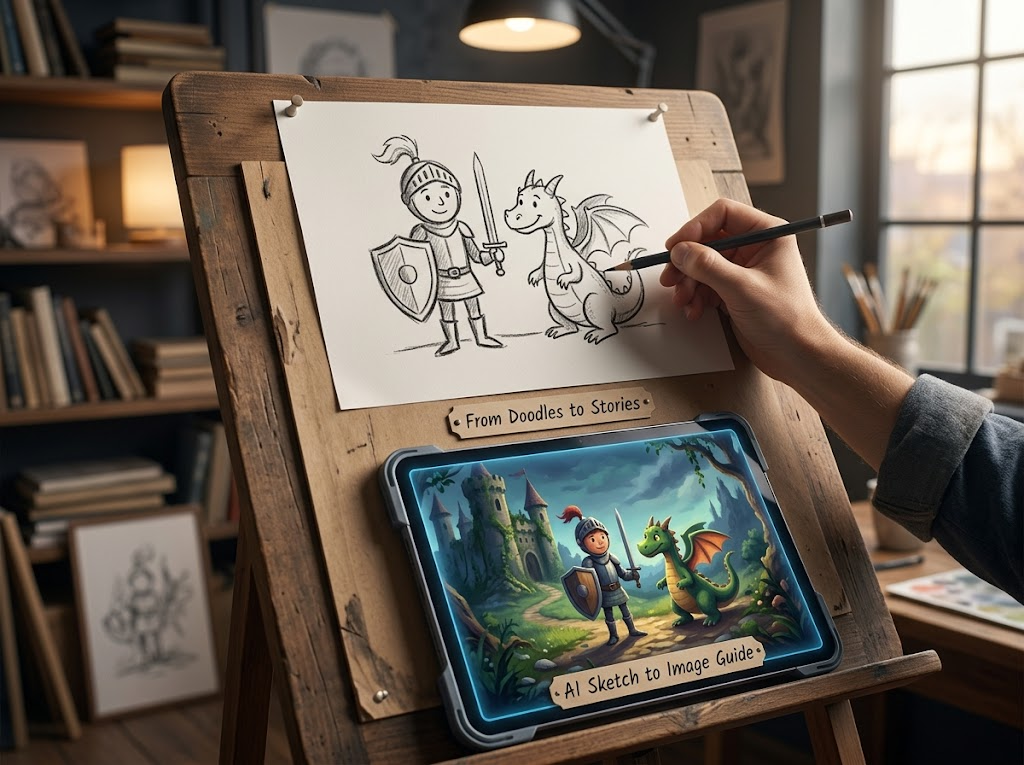
Every creative journey begins with a spark—a fleeting vision of a brave knight, a talking forest, or a lonely robot. But for many, that spark often flickers out when the pencil hits the paper. We’ve all been there: the “masterpiece” in our mind ends up looking like a collection of shaky sticks and circles. This gap between imagination and execution has silenced countless stories, but the era of the “silent sketch” is over. Through the power of sketch to image technology, your roughest outlines can now find their voice. It acts as a bridge, translating your spatial intent into breathtaking visuals. By integrating sketch to image into your creative workflow, you are no longer limited by your manual dexterity, but only by the depth of your dreams.
Turn Doodles into Stories: AI Stretch to Image Guide
The Alchemy of Lines: Turning Doodles into Narrative Gold
The transition from a static drawing to a living story is a form of modern alchemy. When we talk about making a picture book, we aren’t just talking about “nice pictures”; we are talking about visual world-building that resonates with a reader’s soul.
The Democratization of Visual Storytelling
In the past, publishing a picture book required a gatekeeper’s approval or a heavy investment in a professional illustrator. This meant that many unique, culturally diverse, or deeply personal stories never saw the light of day. AI-driven tools change the narrative by putting the brush back in the storyteller’s hand. If you can dream it and draw a basic layout, you can now produce a book that rivals the quality of major publishing houses.
Maintaining the “Director’s Cut” of Your Vision
Unlike generating images purely from text, where the AI often takes “creative liberties” that drift away from your intent, starting with a sketch keeps you in the director’s chair. You define the composition, the perspective, and the relationship between characters. The AI doesn’t replace your creativity; it polishes it, ensuring that the final page looks exactly how you staged it in your mind’s eye.
From Napkin Sketches to Published Pages: A Creative Roadmap
How does one actually go from a messy notebook to a polished manuscript? It’s not just about clicking a button; it’s about a collaborative dance between human intuition and machine precision using ColorifyAI sketch to image.
Stage 1: The Blueprint of Your Protagonist
Every great book needs a soul—a character that children want to follow. You don’t need to be a master of anatomy. A simple circle for a head and a triangle for a body is enough for the AI to understand “character.” By using ColorifyAI, you can upload this blueprint and prompt for a “fluffy blue monster in watercolor style.” The AI respects your placement, but breathes life into the fur and eyes. This allows you to create a “character sheet” that stays consistent across every chapter.
Stage 2: Choreographing the Action
Picture books are about movement. A sketch allows you to map out action sequences—a jump, a fall, a celebratory dance—that text prompts often struggle to capture accurately. By sketching the “arc” of the movement, you guide the tool to place the limbs and energy exactly where the story demands. It’s about capturing the feeling of the moment, not just the pixels.
Stage 3: Crafting the Atmosphere and Depth
A story set in a rainy city feels vastly different from one set in a sun-drenched meadow. Here, you can use rough shading in your sketch to tell the AI where the light comes from. ColorifyAI’s engine interprets these shadows to create cinematic lighting, adding a layer of professional mood-setting that would take a human artist hours of blending to achieve.
The Educator’s Edge: Interactive Learning
For those in fields like Physical Education or early childhood development, this tool becomes a teaching assistant. Imagine sketching a specific sports posture—like a badminton swing—and instantly turning it into a clear, stylized illustration for a training manual. It makes complex movements digestible and visually engaging for students, turning a dry lesson into a vibrant visual guide.
Breaking the “Blank Page” Anxiety
The hardest part of any project is the start. Sketch-to-image tools act as a powerful brainstorming partner. You can throw down five different messy layouts for a cover, run them through the AI, and see which one “speaks” to you. It turns the solitary, often frustrating act of drawing into a dynamic conversation, where every stroke leads to a new possibility.
Why ColorifyAI is the Ultimate Storyteller’s Companion
While there are many tools on the market, creating a 32-page picture book requires specific technical capabilities that go beyond simple filters. ColorifyAI is designed with the “full-project” creator in mind.
Why ColorifyAI is the Ultimate Storyteller’s Companion
Precise Spatial Fidelity
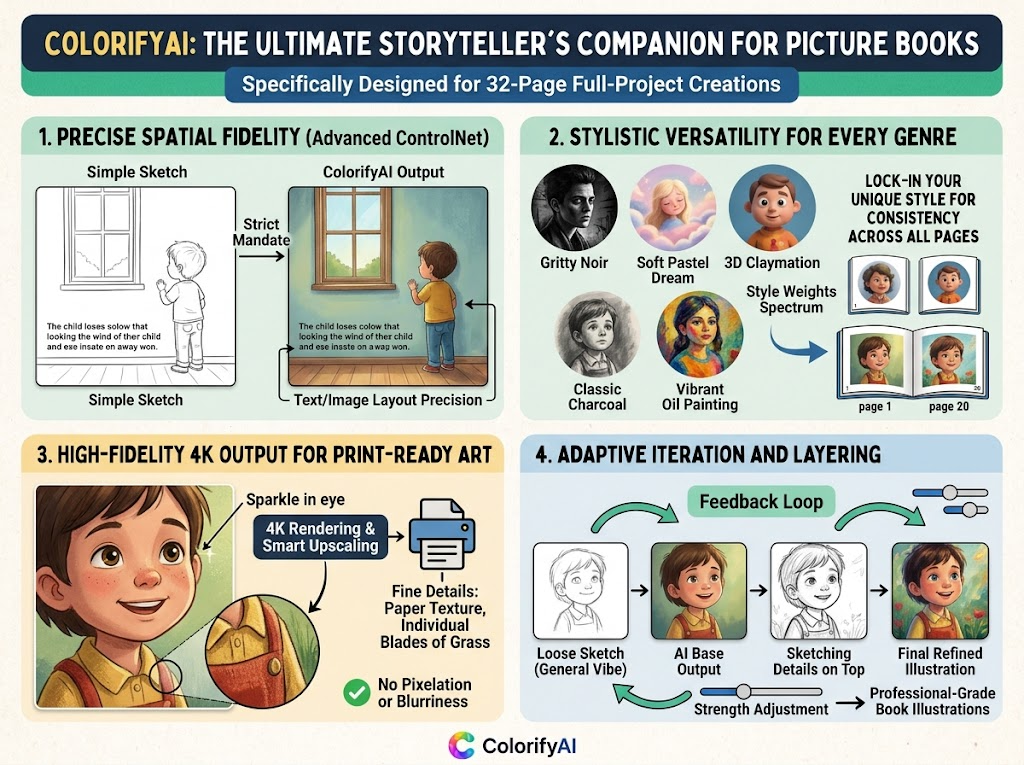
The most common frustration with AI is when it “ignores” the sketch. ColorifyAI utilizes advanced ControlNet architectures that treat your lines as a strict mandate. If you draw a window on the left, the window stays on the left. This precision is vital for picture books where the text and image must interact in a specific layout.
Stylistic Versatility for Every Genre
Whether your story is a gritty noir for young adults or a soft pastel dream for toddlers, the tool offers a spectrum of “Style Weights.” You can choose from “3D Claymation,” “Classic Charcoal,” or “Vibrant Oil Painting.” More importantly, once you find a style that fits your book’s tone, you can lock it in, ensuring that page 1 and page 20 look like they belong in the same universe.
High-Fidelity 4K Output for Print-Ready Art
Digital art is one thing, but a physical book needs high resolution. ColorifyAI supports 4K rendering and smart upscaling, meaning your digital creations won’t look pixelated or blurry when they hit the physical page. It captures the fine details—the texture of the “paper,” the individual blades of grass, and the sparkle in a character’s eye—with stunning clarity.
Adaptive Iteration and Layering
Great art is rarely finished on the first try. The tool allows for “strength adjustment,” letting you refine your image in layers. You can start with a very loose sketch to get the general vibe, then take that AI output, sketch more details on top of it, and run it through again. This “feedback loop” is how professional-grade book illustrations are born.
Conclusion: One Sketch, A Thousand Possibilities
We are living in a golden age of personal expression where the only thing standing between you and your original picture book is the courage to pick up a pen. By embracing ColorifyAI sketch to image, you are not cheating the artistic process; you are evolving it. You are taking the “language” of your rough doodles and translating it into a visual masterpiece that can inspire, educate, and entertain. Your sketches have been waiting to tell their story—it’s finally time to let them speak.
