

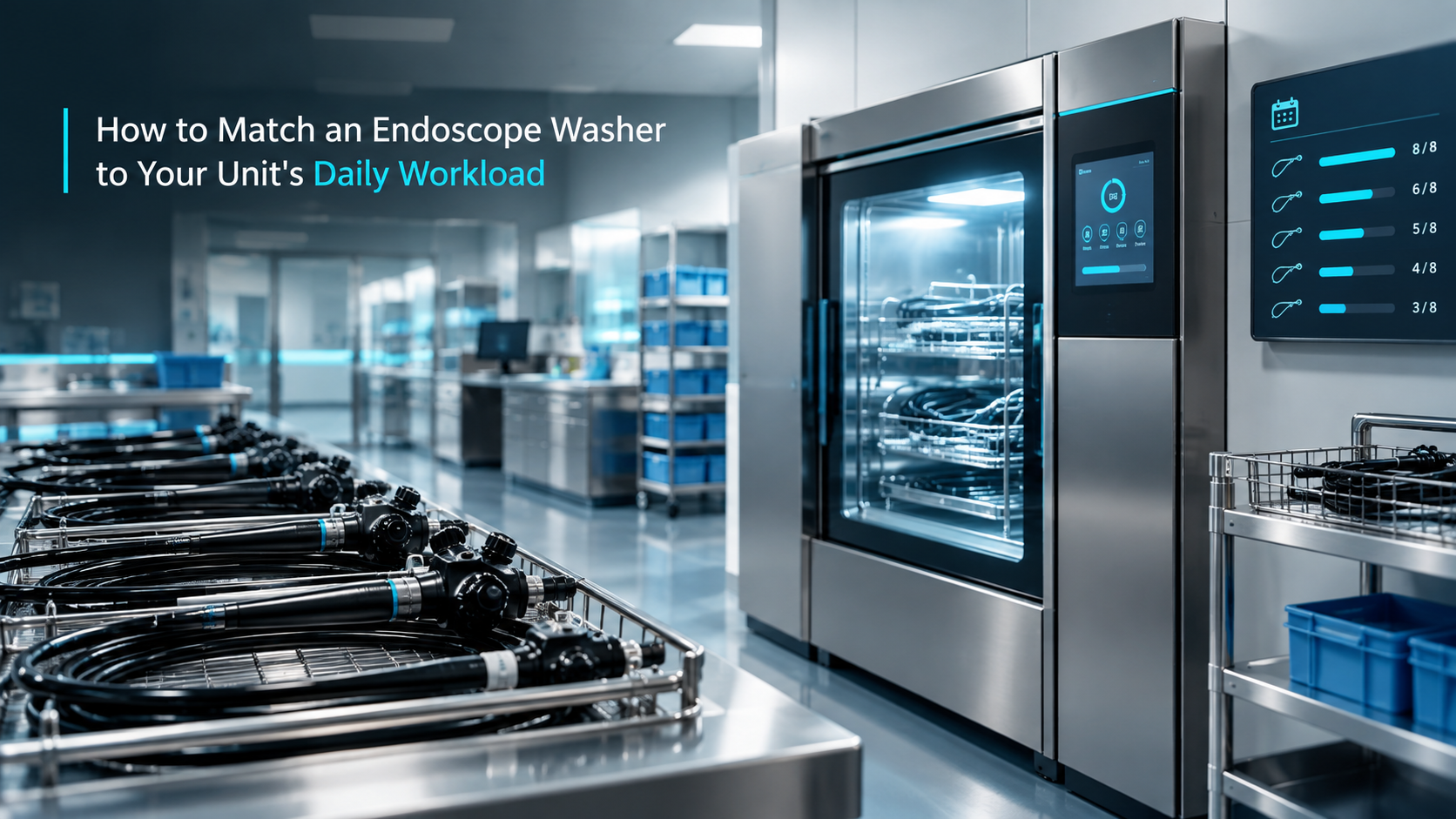
The right machine for an endoscopy unit is decided by what happens between the first list of the day and the last, not by which specification sheet runs longer. Detro Healthcare publishes two Detrowash lines for flexible endoscopes under its Detrox product brand, and they are not two versions of one idea. The 6000-8000 Series (AER3) is organized around getting a scope back into service quickly. The 5000-7000 Series (AER1) is organized around flexibility in how a unit runs its programs and which disinfectant it keeps.
Both are devices that clean and disinfect the outer surface and all of the channels of an endoscope without damaging it. The reason the manufacturer gives for the move to fully automatic units is that bringing the process under automatic control removes the risks created by an incorrectly performed manual routine. That baseline is shared. Everything below is about which of the two designs matches the way your unit already works.
Start from the list your unit actually runs
Before any feature comparison, write down five answers. They narrow the field faster than a side by side table does, because the two lines separate on exactly these points.
- How many flexible endoscopes come back for reprocessing in a session, and whether they arrive together or spread through the day
- Whether a scope has to be ready for the next patient, or whether the schedule leaves enough slack for a short queue
- Whether the unit has already settled on a disinfectant it intends to keep using
- How many scope types and channel configurations pass through the same machine
- Who loads the device, how often that person changes, and how much chemical handling the role involves
A unit running back to back lists with a small scope inventory has a turnaround problem. A unit with a settled disinfectant policy and a mixed caseload has a flexibility problem. Those are two different purchases, even though they sit under the same heading in a tender document.
Two Detrowash lines built around different priorities
Both lines answer the same job description, and Detro Healthcare sets that description out in its own guide to what an endoscope washer has to take over from manual reprocessing. The published field of use is identical for the two: washing and disinfection of heat-sensitive flexible endoscopes after use. A unit whose main load is rigid instrumentation is asking a question these lines are not published to answer. What separates them is what each design optimizes once that shared baseline is met.
| Decision point | Detrowash 6000-8000 Series (AER3) | Detrowash 5000-7000 Series (AER1) |
|---|---|---|
| What the design is built around | Finishing washing and disinfection in a short time with no separate drying step, so scopes are ready for use once the process ends | Covering the everyday reprocessing load of flexible endoscopes |
| Program choice | No program count is published | 12 different washing programs |
| Disinfectant model | Concentrated-Single Use products that keep staff contact with the chemical to a minimum | Disinfectants can stay in use over a long period, and the line is not tied to a single disinfectant brand |
| Load and handling | Single or double endoscope option, automatic cover, foot pedal | Lid locking system |
| Water handling | Advanced water filter system | Optional U/V system for the incoming mains water |
| Monitoring | Automatic leak testing among the control parameters, active through the process | Optional flow sensor system for fluid flow, and self-disinfection |
| Published validation | Microbiological studies and EN 15883-1, 4, 5 tests confirming cycle accuracy and disinfection performance | Cycle accuracy approved by accredited laboratories, EN 15883-1, 4, 5 tests completed successfully |
Read the gaps in that table carefully. Where something is published for one line and not for the other, the honest reading is that the manufacturer publishes it for one line, not that the second machine lacks it. Program count is the clearest case: 12 different washing programs are published for the 5000-7000 line, and no program count is published for the 6000-8000 line. Anything that will end up inside your specification has to be confirmed in writing for the exact configuration being quoted.
When immediate turnaround is the constraint
If the schedule has no slack, the characteristic that changes your day is that the 6000-8000 line completes washing and disinfection in a short time and does not depend on a separate drying stage afterwards, which is why the manufacturer describes scopes as ready for immediate use when the process ends. The option to run two endoscopes instead of one also changes how many loading events a heavy list generates.
What is not published is any number attached to that. Neither line carries a published cycle time, throughput figure or chamber capacity, so a turnaround claim that reaches you in a quotation is something to have confirmed in writing against the model and the options quoted, not a specification you can lift from a brochure.
The reverse case deserves the same weight. If scopes are not being chased and the lists leave gaps, buying primarily for speed spends the budget on the axis your unit is least constrained by. In that situation the 5000-7000 line, designed to cover the daily needs of flexible endoscopes and offering 12 different washing programs, leaves more room to match a program to the scope in front of the operator.
Handling belongs in the same calculation, because it repeats with every load. On the 6000-8000 line, an automatic cover and a foot pedal make placing a scope into the chamber easier, and its Concentrated-Single Use disinfectant products are built around keeping staff contact with chemicals as low as possible. The 5000-7000 line has a lid locking system, presented by the manufacturer as a safety measure for the wash itself. Small differences at the loading step accumulate across a full list far more than a feature used once a month.
Disinfectant strategy is bought together with the machine
The device decision commits a unit to a consumable pattern, and the two lines commit it to different ones. The 5000-7000 line allows disinfectants to be used over a long period and is suitable for brand independent disinfectant use, so a unit that has already settled on a product and does not want to reopen that decision keeps its freedom. The 6000-8000 line runs on Concentrated-Single Use disinfectant products whose stated purpose is to put employee safety first by minimizing contact with the chemical.
Those two models spread work and cost differently across a year. One consumes a fresh single use product on every run. The other consumes a solution that stays in service and therefore carries whatever in use checks your own policy requires. Ask a supplier to model both against your real annual volume before comparing the two lines on the purchase figure alone.
Detro Healthcare builds the machines and formulates the high level chemistry that goes into them, and one practical consequence is that a single manufacturer answers for the pairing of machine and product. That does not remove the step that comes first: manual pre-cleaning stays a separate task performed before the load goes in, whichever line the unit buys.
What validation evidence should show before you sign
Validation is the point where a description turns into something a buyer can check, and both lines carry published evidence, although the wording differs and the wording is what goes into the file. For the 6000-8000 line, microbiological studies together with EN 15883-1, 4, 5 tests are stated to confirm the accuracy of the cycle and its disinfection performance. For the 5000-7000 line, cycle accuracy was approved by accredited laboratories on the basis of microbiological work, and the EN 15883-1, 4, 5 validation tests were completed successfully under disinfection conditions.
Treat those sentences as pointers to documents rather than as the documents themselves. Before signing, ask for the following.
- The reports themselves, with the issuing laboratory named
- Confirmation that the tested configuration is the configuration you are buying, including options such as the U/V system or the flow sensor
- Which parts of EN 15883 each report covers, and whether the parts named in the quotation are the parts named in the report
- The manufacturer’s instructions for use, because the cycle you are buying is the cycle described there
It also helps to keep two categories apart while reading a proposal. Control and monitoring features describe what the machine watches while it runs. Automatic leak testing sits among the control parameters of the 6000-8000 line and stays active through the process, picking up small leaks in an endoscope. The 5000-7000 line can be specified with a flow sensor system that follows fluid flow as a way of monitoring the scope, and the line is self-disinfecting. Water handling differs as well, with an advanced water filter system built into the 6000-8000 line and an optional U/V system on the 5000-7000 line that disinfects the incoming mains water.
None of that is validation evidence. Monitoring tells you what the device observes. The EN 15883 reports and the microbiological studies tell you whether the cycle achieves what is claimed for it. Those are two separate documents, and a procurement file needs both.
There is also a limit on what manufacturer evidence can settle. Testing carried out for the manufacturer describes the device as tested in a laboratory. It does not stand in for the checks your own infection control policy requires once the machine is installed, connected to your water supply and running against your caseload.
Put these in writing before the order
- The exact series and model, with every option you are paying for named individually
- The program set the machine will ship with, since a published count exists for one line and not for the other
- Copies of the EN 15883-1, 4, 5 reports and the microbiological studies for the quoted configuration
- The cleaning and disinfection products the machine is validated to run, together with the compatibility statement from the manufacturer of the endoscopes your unit owns
- The after sales terms, written into the contract rather than agreed in conversation
Detro Healthcare, which manufactures the Detrox range and states that it exports to 100+ countries, publishes maintenance, repair, spare part supply and usage guidance as the scope of its after sales service, alongside CE certification, ISO 13485 and ISO 9001 as its own quality declarations. Those are exactly the statements a procurement file is entitled to see documented.
The comparison does not end with a winner. A unit under constant turnaround pressure and a unit committed to a disinfectant it does not intend to change are solving different problems, and each line answers one of them more directly. Whichever way the decision goes, three documents govern what happens after installation, and none of them is a sales sheet: the device manufacturer’s instructions for use, the compatibility statement issued by the maker of the endoscopes you own, and the infection control policy your own institution applies.
