

There is a specific kind of fundraising pain that almost no founder talks about: spending three weeks personalising emails to a VC who, behind the scenes, hasn’t deployed capital in eleven months. Their website still says “actively investing.” Their partner still posts on LinkedIn. Their portfolio page still scrolls. But the fund is dry, the cycle is over, and you are pitching a ghost.
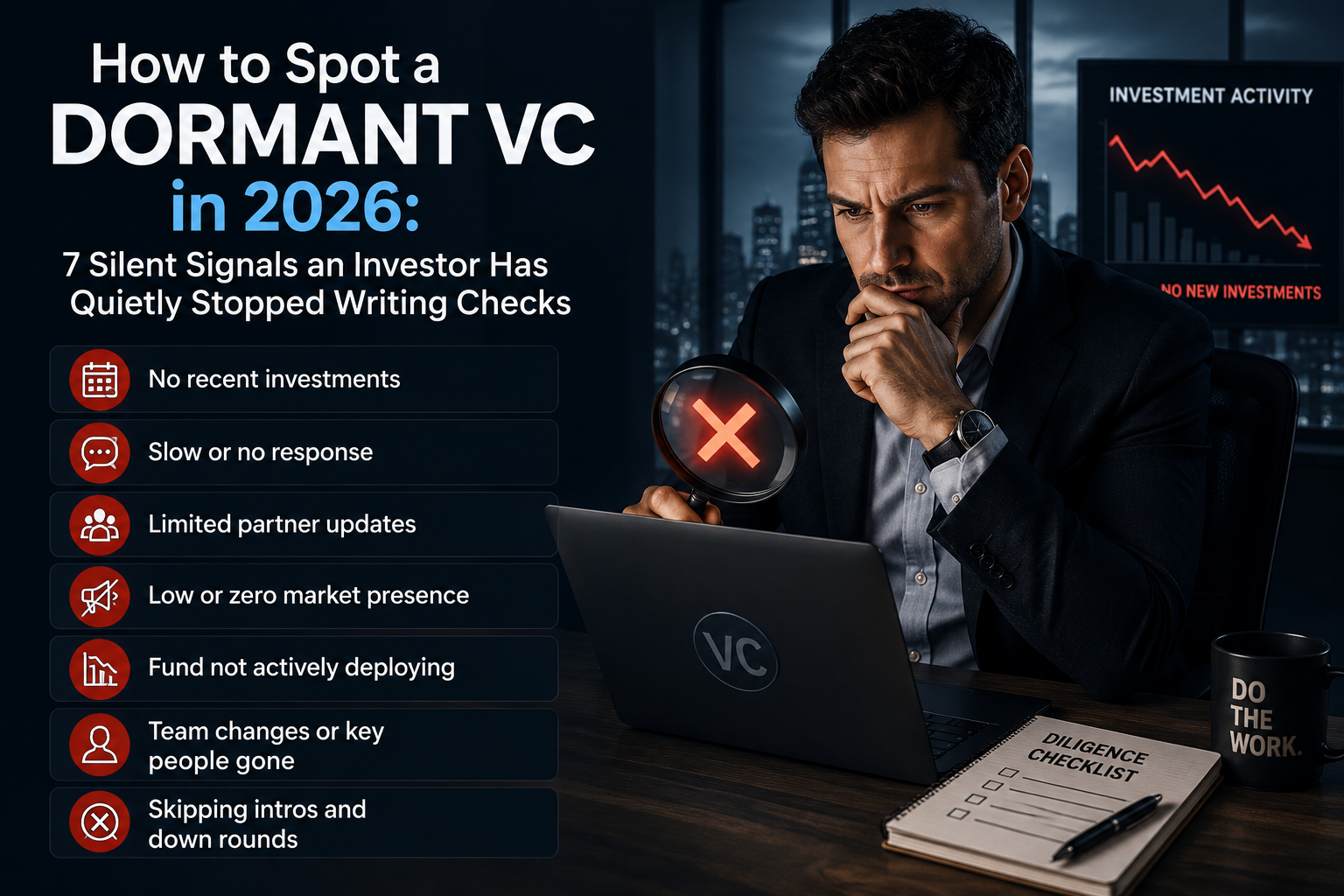
In 2026, the difference between a fundraise that closes in 90 days and one that drags into a death spiral usually comes down to a single skill: the ability to tell, before you reach out, whether a VC is still writing checks. Founders who find active investors with surgical accuracy are not better at pitching, they are better at filtering. Here are the seven signals I look at first.
1. Investment cadence has collapsed in the last 6 months: A healthy early-stage VC closes between 6 and 14 deals a year. If you can see only one or two announced investments in the past two quarters, the fund is either between vintages or quietly winding down. Check announced rounds, not portfolio page additions, portfolio pages get backfilled.
2. The partners who lead your stage have gone silent on deals: Many funds have one partner who actually leads seed checks and a different partner who leads Series A. If the seed-lead partner has not been quoted in a single funding announcement in 4+ months, treat that as a hard yellow flag. You can still get a meeting; you probably will not get a term sheet.
3. The fund’s most recent vintage is 4+ years old: A 2021 fund is, in most cases, fully deployed by mid-2026. Without a new fund close announced, the firm is in reserves-only mode, meaning the only checks going out are follow-ons to existing portfolio companies. You are not a follow-on.
4. LP-facing communication has shifted from “deploying” to “harvesting”: This one is harder to spot, but partner essays, podcast appearances, and annual letters telegraph it. When you start hearing “we’re focused on supporting our existing companies through the cycle,” translate it as: we are not writing new checks at your stage right now.
5. The associates have stopped attending pitch events: Associates are a fund’s sourcing engine. When they disappear from demo days, conferences, and AMAs, the firm is no longer building top-of-funnel — which means leadership is not asking them to.
6. Recently announced deals all sit inside one narrow thesis: If the last six investments are all infrastructure AI, but you are pitching consumer health, the partnership has clearly converged on a wedge. They are not “sector agnostic” anymore, whatever the website says.
7. Partner turnover with no replacement announcement: A general partner leaving without a public successor is one of the loudest signals in venture. Decision authority concentrates, deal velocity slows, and new commitments get postponed until the next fund.
Why static databases miss all seven
Every signal above is recent, measured in weeks and months, not years. Traditional investor databases were built to answer “who exists?” not “who is active right now?” That mismatch is exactly why founders waste 40+ hours building lists that are 30–50% dormant the day they finish them. The fix is upstream: pull from a live investor intelligence feed that scores activity, cadence, and partner movement continuously, not a static monthly export.
A real-time investor layer flips the model. Instead of starting with the universe and trying to filter out dormancy, you start with announced check activity in the last 90 days and work backwards into a target list. Founders who switch to this approach typically cut their fundraising outreach volume in half while doubling their first-meeting rate.
If you are running a raise this quarter and want to bypass the dormant-VC trap, the fastest move is to start from a live, behaviour-based pool of investors instead of a static database. That is what SheetVenture’s find active investors layer is designed for, every profile is updated against announced rounds, cheque sizes, partner moves, and fund vintage in near real time.
The one rule that beats every signal
When in doubt, weigh recent action over reputation. A tier-2 fund that wrote four checks last month is more useful to your raise than a tier-1 fund that wrote two checks all year. If you want to go deeper on the behavioural side of investor qualification, this primer on how to verify whether a VC is actually investing this year is a good next read.
The founders who close fastest in 2026 are not the ones with the best decks. They are the ones who only pitch awake investors.
