

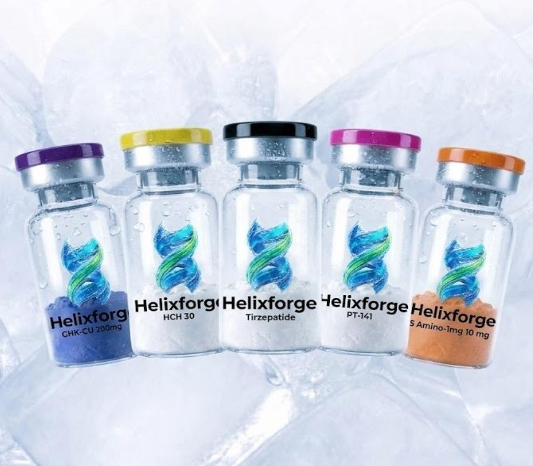
When a peptide supplier in Canada publishes a purity figure, that number means nothing without knowing who produced it. A supplier testing its own compounds has a direct financial interest in those results looking favorable.
So this article will give you a better idea of why independent testing is non-negotiable when looking for a compound online.
One thing that Helixforge Peptides places a high importance on. So you can verify every order before spending a dollar.
What Does Independent Testing Actually Mean?
Independent testing means the laboratory analyzing a compound has no financial connection to the supplier selling it. The testing facility is a separate, unaffiliated entity that conducts its analysis under its own name and issues its own Certificate of Analysis.
When the laboratory is genuinely independent, its results carry weight because there is no incentive to report anything other than what the data shows. A self-certified supplier can print any purity figure it wants. An independent laboratory cannot do this. Its professional credibility depends on the accuracy of every result it publishes.
Why Does Self-Certification Fail Researchers?
Self-certification fails because it asks the seller to be the judge of what it is selling. A supplier that synthesizes, packages, and also verifies its own compounds controls every step of the process, including the one that is supposed to hold all the others accountable.
In a Canadian research context, this matters beyond the purchasing decision. When a compound enters a laboratory study, its purity figure goes into the protocol documentation.
If that figure was self-reported, it cannot be independently traced or verified by an ethics board, an institutional review committee, or a co-investigator auditing the study records. Self-certification does not just risk inaccurate data. It creates a documentation gap that cannot be filled after the fact.
What happens when self-reported purity turns out to be wrong?
The compound enters the study at an assumed concentration. If the actual purity is lower than reported, the results are compromised from the first assay. The study cannot be replicated correctly, and in institutional settings, that failure may require disclosure to the research governance committee.
What Does a Complete Independent Testing Chain Look Like?
A complete independent testing chain covers three separate analytical methods, each confirming a different dimension of compound quality. Purity alone is not enough. Identity and contamination status matter equally.
HPLC: The Purity Confirmation
High-performance liquid chromatography separates sample components and measures each fraction. The purity percentage on a CoA represents the proportion of the sample that is the target compound. HPLC tells the researcher how much of what is in the vial is the compound ordered.
Mass Spectrometry: The Identity Confirmation
Mass spectrometry confirms the molecular identity of the compound by measuring its mass. HPLC tells you how pure a compound is. Mass spectrometry tells you what it is. Both together provide identity and purity confirmation from two independent analytical methods. One without the other leaves a gap.
Endotoxin Testing: The Contamination Confirmation
Bacterial endotoxin in a research peptide can trigger non-specific responses in cell culture models, generating false data unrelated to the compound being studied. An endotoxin test confirms the compound is clean at the cellular level. For any researcher running cell-based in vitro assays, this result is as important as the purity figure.
Why Is the Laboratory Name on a CoA So Important for Canadian Researchers?
The laboratory name is how independent testing becomes verifiable for any peptide supplier in Canada. Without it, a CoA is an unsigned claim. With it, the result becomes a traceable record tied to a facility with its own professional accountability.
A Canadian researcher or procurement officer can look up the named laboratory, confirm it is a real, accredited analytical facility, and verify it has no connection to the compound supplier. That verification step takes minutes and converts a document into a credible record rather than a marketing asset.
How Does HelixForge Peptides Handle Independent Testing?
Helix Forge structures its supply process around independent verification as the baseline, not as an optional upgrade. Every compound in the catalog undergoes the complete three-method testing chain described above before it is listed or shipped.
Here is what that looks like in practice:
- Every CoA is produced by an external, unaffiliated third-party laboratory.
- The laboratory name appears on every CoA, making results independently verifiable.
- HPLC, mass spectrometry, and endotoxin test results on every batch.
- The CoA is issued before the compound ships.
- All catalog compounds are held to 99%+ purity by HPLC.
- Age verification and research affiliation confirmed at checkout.
- Ships to qualified researchers across every Canadian province.
For Canadian research institutions from British Columbia to Nova Scotia evaluating suppliers for procurement approval, every one of these standards is documented and verifiable before a first order is placed.
Frequently Asked Questions
Why does independent testing matter more than a supplier’s purity claim?
A supplier testing its own compounds has a financial interest in favorable results. An independent laboratory has no such interest. Its credibility depends entirely on reporting accurately, which is what makes those results trustworthy for research documentation.
What should every research peptide CoA include?
The compound name, batch number, HPLC purity percentage, mass spectrometry identity confirmation, endotoxin test results, the independent testing laboratory name, and the testing date. Any CoA missing the laboratory name is not independently verified.
Why does endotoxin testing matter for in vitro research?
Bacterial endotoxin can trigger non-specific responses in cell culture models, producing data unrelated to the compound being studied. A clean endotoxin result confirms the compound will not interfere with cell-based assay work.
Does HelixForge Peptides provide documentation before the compound ships?
Yes. The Certificate of Analysis is issued with the order confirmation before the compound leaves the facility. Researchers receive the analytical record before the package arrives, allowing them to review batch data and complete institutional documentation in advance.
How can a Canadian researcher verify that a supplier’s testing is genuinely independent?
Check the CoA for a named laboratory with a verifiable address and no disclosed connection to the supplier. A supplier that cannot or will not name its testing facility is not providing independent verification.
