

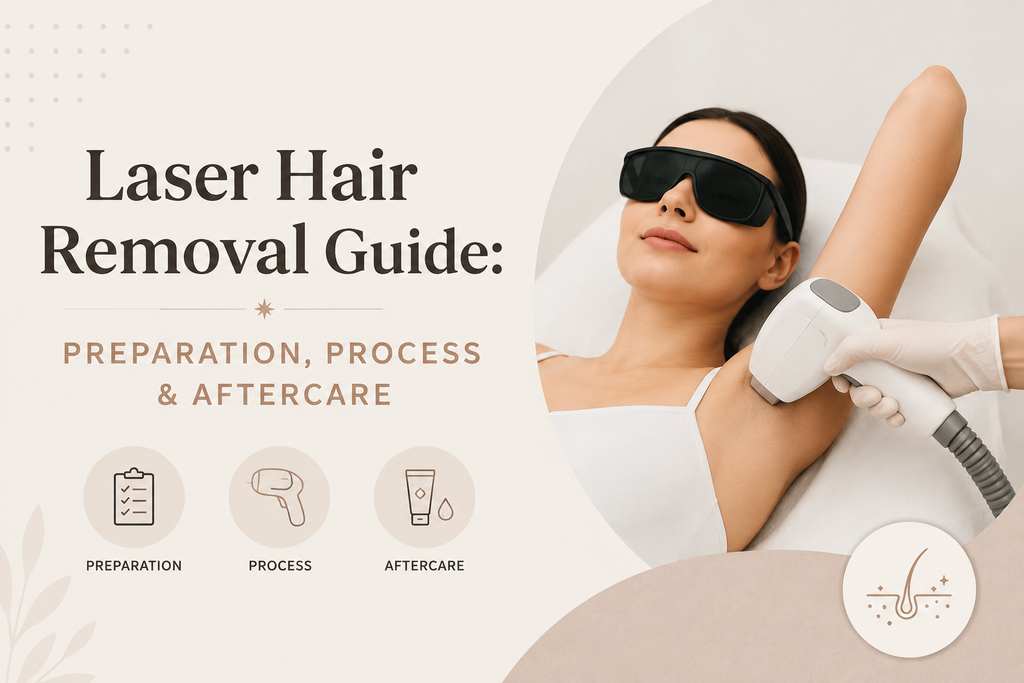
Unwanted hair can turn shaving, waxing, and plucking into a repetitive part of everyday grooming. This Laser Hair Removal Guide: Preparation, Process & Aftercare explains how laser treatment works, what to do before an appointment, what happens during a session, and how to care for your skin afterward.
Understanding the process can help you set realistic expectations and make safer decisions about treatment.
Laser hair removal uses concentrated light energy to target pigment within the hair. The absorbed energy converts to heat and damages structures involved in hair growth, allowing treated areas to produce less hair over time.
What Is Laser Hair Removal?
Laser hair removal is a cosmetic procedure designed to reduce unwanted hair by directing light energy toward melanin, the pigment found in hair. When the hair absorbs this light, heat reaches the follicle and interferes with its ability to produce future hair.
The procedure can be performed on many areas of the face and body. Common treatment areas include the underarms, legs, bikini area, back, chest, upper lip, chin, neck, and shoulders.
At World of Beauty Miami, treatment plans can be selected according to the area being treated, hair characteristics, skin tone, and individual cosmetic goals.
How Does Laser Hair Removal Work?
Hair follicles do not all grow at the same time. Each follicle moves through different stages of a natural growth cycle, which is one reason multiple laser sessions are usually required.
Laser treatment is most effective when hair is actively growing because there is enough pigment within the hair structure to absorb the laser energy. Follicles that are resting may need to be treated during a later session.
This explains why one appointment cannot normally target every hair in an area effectively.
The Hair Growth Cycle
Understanding the growth cycle makes the treatment schedule easier to understand.
| Growth stage | What happens | Importance for laser treatment |
| Anagen | Hair is actively growing | Usually the most responsive stage |
| Catagen | Hair growth begins to slow | Treatment response may be lower |
| Telogen | Hair rests before shedding | The follicle may need treatment later |
| New growth | A new growth cycle begins | Additional sessions can target newly active follicles |
Because follicles enter these stages at different times, appointments are generally spaced apart rather than completed on consecutive days.
How Effective Is Laser Hair Removal?
Results vary according to hair color, skin tone, treatment location, hormonal influences, laser technology, and the number of treatments completed.
According to the American Academy of Dermatology, patients can expect approximately 10 to 25 percent hair reduction after the first laser treatment. The organization also reports that most patients require approximately 2 to 6 treatments.
Mayo Clinic notes that laser hair removal can greatly reduce hair growth, although it cannot guarantee that hair will never grow again. Some people experience results lasting months or years, while others need occasional maintenance sessions.
| Treatment fact | Research based figure or finding |
| Hair reduction after first treatment | About 10 to 25 percent according to the American Academy of Dermatology |
| Typical initial treatment course | About 2 to 6 sessions for many patients |
| Downtime | Usually little or no significant downtime |
| Regrowth | Possible over time |
| Maintenance treatment | May be required for some patients |
These numbers should be treated as general guidance rather than promises. Every treatment area and individual response is different.
Is Laser Hair Removal Permanent?
Laser treatment is better described as producing long lasting hair reduction rather than guaranteeing permanent removal of every hair.
The American Academy of Dermatology reports that after a sufficient treatment course, results can be permanent in many body areas. Hormonal influences can make facial hair in women more likely to return.
Mayo Clinic takes a similarly careful position, explaining that some hairs can eventually grow back. When regrowth occurs, the new hair may be finer and lighter than it was before treatment.
This distinction matters when comparing professional laser hair removal in Miami with temporary methods such as shaving or waxing.
Who Is a Good Candidate?
Laser technology has developed significantly, and people with many different skin tones can now receive treatment. However, the device, wavelength, settings, and practitioner experience are especially important when treating darker skin.
Traditionally, dark hair combined with lighter skin produced a strong contrast that made targeting pigment easier. Modern treatment approaches can accommodate a broader range of skin tones when appropriate technology and settings are used.
Dark, coarse hair generally responds better because it contains more melanin. Blonde, white, gray, and some red hair can respond poorly because there may not be enough suitable pigment for the laser to target effectively.
How to Prepare for Laser Hair Removal
Good preparation begins before the appointment. The exact instructions may vary according to the technology used and your medical history, so instructions from your treating professional should take priority.
Avoid tanning before laser treatment. Recently tanned skin can increase the amount of pigment competing with the hair for laser energy, which may increase the risk of skin irritation or pigment changes.
The American Academy of Dermatology also recommends avoiding sunless tanning products before treatment and protecting exposed skin with broad spectrum sunscreen with an SPF of at least 30.
Should You Shave Before Laser Hair Removal?
Shaving is commonly recommended before treatment because it removes hair above the surface while leaving the follicle and pigment below the skin available for the laser to target.
Your provider should tell you when to shave. Instructions can differ depending on the area and equipment.
Waxing, plucking, and threading generally should be avoided before treatment because these methods remove hair from the follicle. If the target hair has been pulled out, the laser has less pigment available within the follicle to target.
What Should You Tell Your Provider?
A consultation is an important part of laser hair removal. Your provider needs enough information to evaluate your skin, hair, and possible risk factors.
Tell the practitioner if you have recently tanned, have a tendency to develop scars or keloids, experience recurring cold sores, or have experienced unusual reactions after previous cosmetic procedures.
You should also disclose medications, supplements, topical treatments, and recent prescription acne treatment. Certain medications or skin conditions may change how your skin reacts to light based procedures.
What Happens During Laser Hair Removal?
The session begins with preparation of the treatment area. Protective eyewear is required because laser energy can damage the eyes.
The practitioner positions the laser device against or near the skin and delivers controlled pulses of energy to the treatment area. The exact technique depends on the device being used.
Some systems also use cooling technology to protect the surface of the skin and improve comfort.
What Does Laser Hair Removal Feel Like?
People describe the sensation differently. The American Academy of Dermatology reports that many patients compare laser pulses to warm pinpricks or the feeling of a rubber band snapping against the skin.
Sensitivity varies considerably according to the body area. The upper lip, bikini area, and other regions with dense hair may feel more sensitive than areas with finer or more widely spaced hair.
Numbing products may sometimes be considered for sensitive areas. They should only be used according to professional instructions.
How Long Does a Session Take?
Treatment time depends largely on the size of the area. A small area such as the upper lip may require only a few minutes, while larger areas such as the legs or back can take considerably longer.
The American Academy of Dermatology notes that larger areas can require more than an hour.
| Treatment area | General time consideration |
| Upper lip | Usually one of the quickest areas |
| Chin | Generally a relatively short appointment |
| Underarms | Usually shorter than large body areas |
| Bikini area | Time varies with treatment coverage |
| Legs | Larger surface area requires more time |
| Back | May require a longer appointment |
| Full body | Treatment duration depends on the number and size of areas |
Exact treatment times should always be confirmed with the provider because equipment, hair density, and treatment coverage vary.
What Happens Immediately After Treatment?
Temporary redness and swelling around treated follicles are common. These reactions can resemble a mild sunburn and usually settle with appropriate care.
A cool compress may help with temporary discomfort. Your practitioner may also recommend specific products depending on how your skin responds.
Hair does not necessarily disappear immediately. Mayo Clinic explains that treated hairs can shed over several days or weeks following treatment.
Laser Hair Removal Aftercare
Sun protection is one of the most important parts of aftercare. Freshly treated skin can be more vulnerable to sun related irritation and changes in pigmentation.
Avoid intentional tanning and follow your provider’s instructions about direct sun exposure. Broad spectrum SPF 30 or higher sunscreen should be applied to exposed treated areas as directed.
Keep skincare simple if the area feels sensitive. Avoid aggressively rubbing, scratching, or exfoliating freshly treated skin.
Can You Exercise After Laser Hair Removal?
Some providers recommend temporarily avoiding activities that create significant heat, sweating, or friction if the treated area is irritated.
This may include strenuous exercise, very hot showers, saunas, or hot tubs for a short period. The appropriate interval depends on your skin response and your provider’s protocol.
If the skin looks and feels normal, you can usually return to routine activities quickly because laser hair removal generally requires little downtime.
Can You Shave Between Laser Sessions?
Shaving is normally the preferred method of managing hair between appointments because it does not remove the hair from its follicle.
Waxing and plucking can interfere with the treatment plan by removing the target hair before the next laser session.
Do not shave irritated or damaged skin. If your skin remains sensitive after treatment, follow your provider’s instructions before resuming shaving.
Laser Hair Removal Versus Waxing
Both methods remove or reduce unwanted hair, but they work differently.
Waxing pulls visible hair from the follicle and provides temporary smoothness. Laser treatment directs energy toward the follicle with the goal of reducing future hair growth.
| Factor | Laser hair removal | Waxing |
| Main action | Targets pigment associated with the hair follicle | Pulls hair from the follicle |
| Goal | Long lasting hair reduction | Temporary hair removal |
| Treatment schedule | Requires a series of sessions | Repeated as hair returns |
| Hair between sessions | Shaving is generally permitted | Hair needs enough length for waxing |
| Long term regrowth | Can become significantly reduced | Hair continues to regrow |
| Suitability | Depends on skin, hair color, and technology | Can be used for many hair types |
For a more detailed comparison, read laser hair removal versus waxing before deciding which method best fits your routine.
What Are the Possible Side Effects?
Temporary redness, swelling, and mild discomfort are among the most common reactions after laser hair removal.
Changes in skin pigmentation can also occur. Skin may become temporarily lighter or darker, particularly when treatment settings, sun exposure, or skin characteristics increase sensitivity.
Less common complications can include blistering, crusting, infection, scarring, or other skin injury. Proper equipment selection, treatment settings, practitioner experience, and appropriate aftercare help reduce avoidable risks.
Can All Skin Tones Have Laser Hair Removal?
Many skin tones can be treated, but treatment must be selected carefully.
Darker skin naturally contains more melanin, which means laser settings and wavelength selection are particularly important. The goal is to target pigment in the hair while minimizing unnecessary energy absorption by the surrounding skin.
The American Academy of Dermatology recommends choosing someone experienced in performing laser hair removal on your particular skin tone.
Why Are Multiple Sessions Necessary?
Multiple sessions are primarily needed because hair follicles are operating at different stages of their growth cycle.
A follicle that is effectively targeted during one treatment may produce significantly less hair, while another follicle that was not in the optimal growth stage may need to be treated later.
This is why progress is usually evaluated across a treatment series rather than after a single appointment.
When Should You Schedule Your Next Treatment?
The interval between appointments varies by treatment area, hair growth pattern, technology, and practitioner protocol.
Hair on different parts of the body grows at different rates. Your provider should evaluate regrowth and recommend an interval appropriate for the area being treated.
Scheduling treatments too closely does not automatically produce faster results because the next group of hairs needs time to enter a treatable stage.
How Can You Get Better Results?
Consistency matters. Attend appointments according to your treatment plan, protect your skin from excessive sun exposure, and avoid removing hair from the follicle between sessions unless instructed otherwise.
Follow preparation and aftercare instructions carefully. Changes in medication, hormonal conditions, pregnancy status, skin health, or sun exposure should be discussed before another treatment.
Progress photos can also be useful because gradual hair reduction may be easier to recognize when images are compared under similar lighting and conditions.
When Should You Contact Your Provider?
Mild redness and swelling can be expected shortly after treatment, but severe or worsening symptoms deserve attention.
Contact your provider if you experience significant blistering, persistent pain, signs of infection, extensive crusting, or unexpected changes in pigmentation.
If you are considering treatment and are unsure whether your skin or hair type is suitable, a consultation is the best place to begin. You can contact the World of Beauty Miami team to discuss treatment areas, preparation, and appointment planning.
Frequently Asked Questions About Laser Hair Removal
How many laser hair removal sessions are usually needed?
The American Academy of Dermatology states that most patients need approximately 2 to 6 treatments. Some people require additional appointments depending on the treatment area, hair characteristics, hormones, and individual response.
Does hair fall out immediately after laser treatment?
Not always. Treated hair can shed gradually over several days or weeks.
Can laser hair removal eliminate every hair permanently?
Results vary. Laser treatment can produce substantial and long lasting reduction, but some hair can return and maintenance treatments may occasionally be necessary.
Does laser hair removal work on blonde or gray hair?
Results are generally poorer for blonde, white, gray, and some red hair because these hair colors contain less of the pigment typically targeted by hair removal lasers.
Can you wax between laser appointments?
Waxing is generally discouraged during a laser treatment course because it pulls the target hair from the follicle. Shaving is usually preferred.
Can laser hair removal cause burns?
Burns and blistering are possible complications, although they are not expected outcomes. Correct device selection, appropriate settings, professional technique, and following sun exposure precautions are important for reducing risk.
Final Thoughts
Laser hair removal can significantly reduce the amount of unwanted hair and the time spent shaving, waxing, or managing frequent regrowth. The best outcomes depend on appropriate technology, realistic expectations, careful preparation, and consistent treatment.
Remember that laser hair removal works progressively. Results develop across multiple hair growth cycles, and occasional maintenance may be necessary even after a successful initial treatment series.
Preparing properly, following aftercare instructions, protecting treated skin from the sun, and choosing an experienced provider can help you approach laser hair removal with greater confidence and a clear understanding of what to expect.
