

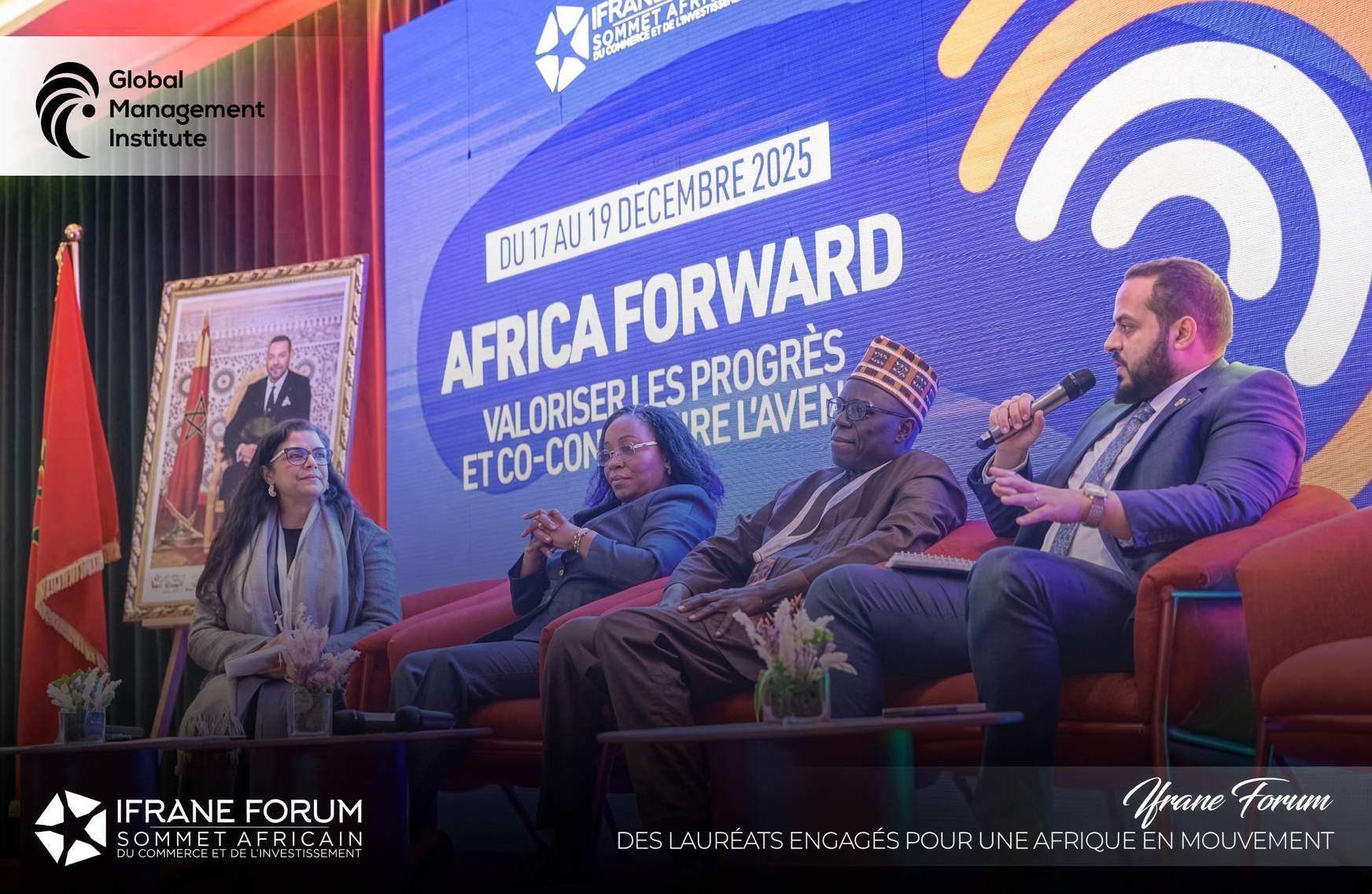
[Global Management Institute (GMI), a QAHE-accredited institution based in Marrakech, takes part in a panel at the Ifrane Forum — Sommet Africain du Commerce et de l’Investissement – Photo: Ifrane Forum / Global Management Institute]
Education in North Africa is moving faster than the old campus map. Casablanca and Marrakech offer executive programmes to managers across Francophone Africa. Cairo’s professional institutes teach in Arabic and English at once. Tunis still hosts the Arab world’s principal educational organisation. Working adults want credentials they can carry, not only a seat in a lecture hall. The International Association for Quality Assurance in Pre-Tertiary and Higher Education (QAHE) has stepped into that space with a clear proposition: an international institutional review for providers that already teach, train and certify across borders.
QAHE reviews the organisation behind the offer — governance, programmes, staff, learner support, public information and evidence that teaching works — and lists those that meet its standard. For a Maghreb market that already lives between national rules and international students, that second look is the service.
Tunis first: a partnership that belongs on the regional map
The signal that matters most to a North African reader is not a slogan. It is the memorandum of understanding signed in 2026 between QAHE and the Arab League Educational, Cultural and Scientific Organisation (ALECSO). ALECSO sits in Tunis, was founded in Cairo in 1970, and works under the League of Arab States as the region’s specialised body for education, culture and science. The agreement opens cooperation on quality assurance, the exchange of practice, academic events, and recognition of distinguished academics. It places QAHE inside a conversation that already runs through Tunis, not only through a distant website.
That Arab-facing layer is reinforced by QAHE’s arrangement with the Arab Organization for Quality Assurance in Education (AROQA), created to raise standards across the Arab world and to work with international and local agencies. In Egypt, QAHE also works with the Information Systems Security Association, Egypt Chapter (ISSA Egypt), a professional link for technology and security-related training. Together these partnerships tell a regional story: QAHE is not arriving in the Maghreb as a stranger to Arab quality debates.
Marrakech as a working laboratory
On the institutional side, Morocco is where the directory is currently densest — and the names are the professional academies that already serve the African executive market.
IPM Afrique, based in Targa, Marrakech, holds current QAHE institutional accreditation through April 2027. It delivers blended and online professional education across Africa: executive certificates and higher professional pathways in management, finance, tourism, health and technology. QAHE’s renewal recognised a provider that had put governance, programme quality, faculty and learner support on the table and kept them there.
Digital Academy for Professional Training (ADF-PRO), also Moroccan, remains listed through April 2027. It is built for the professional who will not leave a job for a three-year campus cycle: interactive online certificates and MBA and DBA pathways, paced for people already at work.
EXEC Education in Marrakech, listed through November 2026, occupies the same band with a sharper executive brief — finance, audit, performance, risk, data and digital leadership — taught from the Attawfique Business Center to a regional cohort.
Global Management Institute (GMI), headquartered in Marrakech with a published presence in Casablanca and Tangier, is listed through January 2027. It presents bachelor, master and doctorate pathways in business administration for managers in Morocco and across Africa. QAHE’s listing is of GMI as the institution. It is not a claim that those titles are Moroccan state degrees. It is confirmation that the organisation offering them submitted to review.
That cluster is the point. Morocco already exports professional education. QAHE’s current North African file is the set of private institutes that chose to be examined and stayed on the list.
What a listing is for
What the listing does offer is visibility in an international directory, a documented file, and a place in a network that now includes ALECSO in Tunis and AROQA in the Arab quality-assurance space, alongside QAHE’s wider counterparts in Europe, Asia and Africa. For a North African academy that already teaches beyond one city, that is the argument: not that the ministry has been displaced, but that the institution has been willing to put its quality on a public record.
Institutions that recognise themselves in this market — executive academies, distance providers, professional schools, faith-based and vocational institutes — can consult the current directory and the ALECSO announcement at www.qahe.org. The Maghreb does not need another empty badge. It needs providers that can survive inspection. That is the standard QAHE upholds, and the standard the current Moroccan cluster has agreed to meet.
