

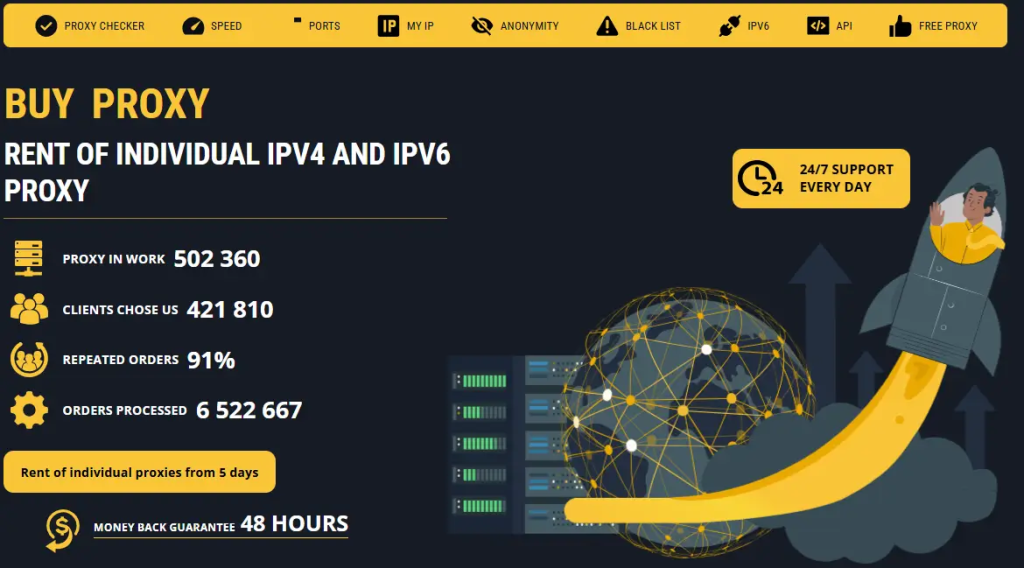
| Official website: ProxyLine |
How this review was prepared
| I reviewed ProxyLine as a buyer comparing product categories, rental flexibility, protocols, setup support, pricing structure, and operational risks. Exact inventory and prices can change, and I did not independently benchmark every country. The article therefore separates provider-published details from the checks a customer should perform with a small order. |
Quick verdict
| Category | Assessment |
|---|---|
| Best suited to | Individuals and teams that want small orders, short rental periods, private or shared IPv4, IPv6, and account/API controls. |
| What stands out | Several proxy categories, HTTP/SOCKS5 support, broad country choice, flexible rental lengths, and volume pricing. |
| Main caution | Shared proxies and inexpensive IPv6 plans are not direct substitutes for private IPv4 in sensitive workflows. |
| Buying approach | Use a five-day or small-quantity pilot, test the exact country and destination, then scale only with documented results. |
First impression: ProxyLine makes it easy to start small
ProxyLine.net sells individual IPv4, shared IPv4, IPv6/32, and MTProto proxy products through an online account. The catalog is organized by proxy type, country, quantity, and rental period, which makes it possible to purchase a single address for a short test instead of committing immediately to a large package.
That flexibility is one of the service’s strongest characteristics. A buyer can compare an individual IPv4 address with a cheaper shared product, or test IPv6 compatibility before building a larger workflow. ProxyLine also publishes setup instructions for browsers, operating systems, extensions, and selected applications, which can help users who are new to proxy configuration.
The official ProxyLine website should be used to confirm the current prices, countries, inventory, rental periods, refund rules, and product-specific restrictions before purchase.
Understanding the four main product categories
Individual IPv4
This is the most broadly compatible and predictable option. One customer controls the address during the rental period, reducing interference from unrelated traffic. It is the logical starting point for business browser sessions, regional website checks, long-lived accounts, and software that expects IPv4.
Shared IPv4
Shared IPv4 is the budget option. ProxyLine has described these addresses as being used by a small number of customers. That lower price comes with a real tradeoff: another user’s activity can influence reputation, rate limits, or blocking. Shared proxies are better suited to low-risk tests than valuable accounts.
IPv6/32
IPv6 plans can be dramatically cheaper and provide access to a large address space. They make sense only when the target website, application, DNS path, and local software support IPv6 properly. Compatibility should be proven with the real destination before volume is purchased.
MTProto
MTProto proxies are specialized for Telegram connectivity. They are not a general replacement for HTTP or SOCKS5 and should be used only for legitimate communication needs in accordance with local rules and platform terms.
Pricing: attractive entry points, but category matters more than the headline number
When the pricing page was reviewed in July 2026, ProxyLine displayed low starting examples for short-term shared IPv4, individual IPv4, IPv6/32, and MTProto plans. It also showed lower per-address prices at larger quantities and rental lengths ranging from a few days to many months.
The useful takeaway is not one exact number, because inventory and promotions can change. The real lesson is that ProxyLine allows inexpensive pilots. A five-day order can answer the most important questions: does the target website accept the address, is the location accurate, is the route stable, and does the software authenticate correctly? That information is more valuable than saving a few cents on an untested annual order.
HTTP and SOCKS5 support
ProxyLine has advertised HTTP and SOCKS5 formats. HTTP works well for browsers, web requests, and many automation tools. SOCKS5 is useful for applications that need a more general TCP proxy. The buyer should confirm whether the selected product supports both formats, how credentials are delivered, and whether DNS requests are resolved through the proxy.
A successful proxy-checker result does not prove the entire application is routed correctly. Browsers, launchers, extensions, and background services may use different network paths. Testing must happen inside the real workflow.
Account management and API value
For a single proxy, a dashboard is enough. For dozens or hundreds, the operational layer becomes important. ProxyLine’s account controls and API can help with ordering, inventory, renewal, and automation. Teams should still maintain their own record of ownership, purpose, location, credentials, renewal date, and target-site behavior.
An API should be introduced only after the manual process is understood. Automating a poor selection rule or an undocumented workflow creates mistakes faster. A good internal system prevents duplicate assignments, expired endpoints, and accidental reuse across unrelated projects.
How I would test ProxyLine before a large order
- Choose one individual IPv4 address in the exact country required.
- Use the shortest practical rental period for the first test.
- Confirm location in multiple databases and compare it with the provider label.
- Configure the real browser or application with the delivered HTTP or SOCKS5 credentials.
- Check DNS, IPv6, and WebRTC behavior to identify local-network leaks.
- Run normal low-volume activity for several days and record errors, CAPTCHAs, and session drops.
- Compare a shared or IPv6 product only if the project can tolerate the associated risk.
- Test the support and replacement process before purchasing volume.
- Use the API only after the product-selection rules are documented.
Where ProxyLine fits—and where it does not
ProxyLine appears well suited to budget-conscious buyers who want datacenter proxies with flexible quantities and rental periods. It can support regional testing, approved account administration, software configuration, and internal automation when the target accepts the selected network.
It is not the same as a residential or mobile proxy network, and it does not provide whole-device encryption like a VPN. Datacenter addresses may receive more challenges from sites with aggressive anti-abuse controls. Buyers needing enterprise compliance, guaranteed performance, residential sourcing, or managed scraping may need another provider or a mixed architecture.
Strengths and limitations
| What looks strong | What deserves caution |
| • One-address and short-term purchases reduce pilot cost. | • Shared addresses can be affected by other customers. |
| • Private, shared, IPv6, and MTProto products cover different needs. | • IPv6 is not suitable for every website or application. |
| • HTTP and SOCKS5 are widely supported formats. | • Datacenter IP reputation can vary by network and country. |
| • Country and quantity selection is straightforward. | • Low prices can encourage buyers to skip proper testing. |
| • API access can support larger, organized deployments. | • Exact replacement and refund eligibility must be checked per product. |
Final assessment
ProxyLine’s strongest selling point is flexibility. It allows a buyer to begin with a single, short-term proxy, compare product types, and grow into larger orders or API-based management. That is a sensible structure for users who prefer evidence over a large upfront commitment.
My verdict is favorable for small pilots and controlled datacenter-proxy workflows. Individual IPv4 should be the default for important sessions; shared IPv4 and IPv6 should be treated as specialized cost-saving options, not automatic replacements. If the exact country, route, reputation, and support process pass the test, ProxyLine can offer good practical value.
| Check the current plans and terms on ProxyLine. |
