

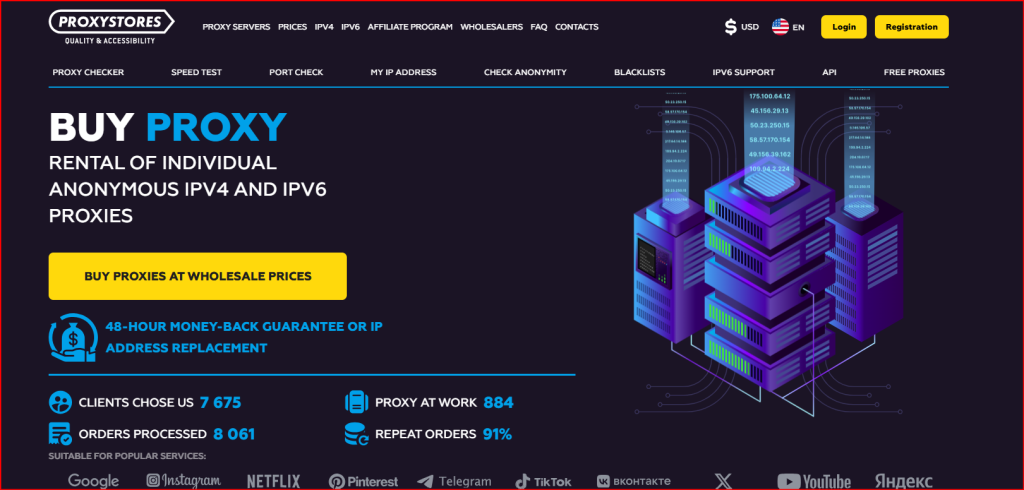
| Official website: ProxyStores |
How this review was prepared
| I reviewed the service as a cautious buyer would: product types, protocol choices, exclusivity, location controls, published safeguards, and the practical risks of shared addresses. This article does not claim an independent speed test of every location. It explains what the advertised features mean and how to verify them with a small pilot. |
Quick verdict
| Category | Assessment |
|---|---|
| Best suited to | Buyers who want a choice between individual IPv4, IPv6, and lower-cost shared IPv4 options. |
| What stands out | Manual IP/subnet selection, HTTP and SOCKS5 formats, broad network variety, and small-order flexibility. |
| Main caution | Shared proxies may be inexpensive, but another user can affect reputation and reliability. |
| Buying approach | Match the proxy type to the value of the account or workflow; use private IPv4 for important sessions. |
The main decision is not ProxyStores versus another brand—it is private versus shared
ProxyStores presents several products that look similar on a pricing page but behave very differently in practice. The service has described individual IPv4 and IPv6 proxies, HTTP and SOCKS5 output formats, manual IP and subnet selection, immediate activation, API access, and a large catalog of networks. It has also offered shared IPv4 addresses that may be used by a small number of customers.
That last distinction deserves more attention than it usually receives. A private proxy gives one customer control of the address during the rental period. A shared address can be affected by traffic generated by people the buyer does not know. For disposable research, the price difference may matter most. For a valuable business login, payment workflow, or long-lived client account, reputation and predictability matter more.
The official ProxyStores website should be checked for the current list of countries, product eligibility, prices, and replacement rules before an order is placed.
What a private proxy changes in day-to-day use
A private proxy does not guarantee a perfect reputation, but it removes simultaneous use by unrelated customers as a variable. That makes session continuity easier to understand. If a website starts returning errors, the team can investigate its own traffic, the route, and the address history without wondering whether another buyer is generating a completely different workload through the same endpoint.
Private IPv4 is the most practical option for important browser profiles, authorized social-media administration, marketplace management, recurring regional checks, and software that expects a stable address. It costs more than a shared endpoint, but the difference can be small compared with the cost of account recovery or interrupted operations.
When a shared proxy may still make sense
Shared proxies are not automatically useless. They can be sensible for low-risk, short-lived tasks where occasional blocks are acceptable and no valuable account is attached. Examples include basic website reachability checks, testing a development tool, or confirming that an application can connect through a proxy at all.
The problem begins when a budget product is used for a high-value workflow. If the same address is used by several customers, one user’s volume or behavior may influence how a target website treats everyone else. ProxyStores has previously warned that shared products carry more block risk and may have different refund or replacement conditions. That warning should be taken seriously, not hidden in the purchasing process.
- Use shared proxies only for tasks that can tolerate interruption.
- Do not attach them to sensitive payment, banking, or administrator sessions.
- Assume the IP reputation may change without warning.
- Read the product-specific replacement rules before ordering.
IPv4 versus IPv6: compatibility should decide
Choose IPv4 when the target environment is uncertain
IPv4 has the broadest compatibility and is the simplest choice when the team cannot fully control the destination, browser, or software. It is the safer default for first-time buyers and for accounts that need consistent, long-lived sessions.
Choose IPv6 only after a real compatibility check
IPv6 can be cost-effective and technically appropriate for modern tools, but support is not universal. A proxy checker may say the address is online while the actual target site behaves differently. The only meaningful test is the real application against the real destination.
HTTP and SOCKS5: small configuration details matter
HTTP is usually enough for browser traffic, web requests, and many automation tools. SOCKS5 is more flexible because it can carry traffic for a wider range of applications. Neither label tells the whole story. Buyers should confirm whether DNS is resolved locally or through the proxy, which authentication methods are available, and whether the software has a native proxy setting or merely inherits the operating system configuration.
A frequent source of failure is not the proxy itself but an application that routes only part of its traffic. WebRTC, background update services, DNS resolvers, or helper applications can still use the normal connection. A clean deployment includes leak checks and process-level validation.
How I would evaluate ProxyStores in a real pilot
- Define the exact application, country, protocol, and session duration before shopping.
- Purchase one private IPv4 address first, even if shared pricing looks more attractive.
- Confirm geolocation, DNS behavior, and authentication in the production application.
- Run normal, low-volume activity for several days and record errors and CAPTCHAs.
- Compare one IPv6 address only if the target service officially or practically supports it.
- Test support response with a precise question about replacement eligibility.
- Document which project owns each address and when the rental renews.
- Use the API only after the manual workflow is understood and repeatable.
The human factor: inventory management is part of proxy quality
Once a team manages more than a few proxies, organization matters almost as much as raw network performance. Each address should have an owner, location, protocol, authentication method, assigned browser or application, purchase date, renewal date, and notes about target-site behavior. Without that record, teams accidentally reuse addresses, lose credentials, or renew endpoints that are no longer needed.
ProxyStores’ advertised API and manual selection features can support a more structured workflow, but tools do not create discipline by themselves. A simple spreadsheet or internal dashboard should remain the source of truth.
Who may need a different service
Buyers who require residential, mobile, rotating, or pay-per-gigabyte proxy networks may need a different product category. Likewise, an enterprise team may require formal compliance documentation, service-level agreements, dedicated account management, or integration support that should be confirmed directly before purchase.
A datacenter proxy is also not a full security solution. It changes the network endpoint for configured traffic; it does not encrypt every device connection like a VPN, and it does not provide remote compute resources like a VPS.
Strengths and limitations
| What looks strong | What deserves caution |
| • Clear choice between private and shared products. | • Shared addresses can inherit problems caused by other users. |
| • IPv4 and IPv6 options support different technical needs. | • Different product types may have different replacement conditions. |
| • HTTP and SOCKS5 are common, practical formats. | • IPv6 compatibility must be checked against the real destination. |
| • Manual selection can improve location and subnet consistency. | • Datacenter IPs may face stricter filtering on some platforms. |
| • API access can reduce repetitive account management. | • A proxy alone does not separate browser storage or device identity. |
Final assessment
ProxyStores is easiest to recommend when the buyer understands the tradeoff between price and exclusivity. The private products appear suitable for stable, authorized sessions and repeatable regional work. The shared products may lower cost for low-risk tests, but they should not be presented as a direct substitute for a dedicated address.
My practical recommendation is simple: begin with private IPv4, verify the route and target-site behavior, and introduce IPv6 or shared options only when there is a clear reason. That approach costs slightly more at the start but usually produces cleaner evidence and fewer surprises.
| Check the current plans and terms on ProxyStores. |
