

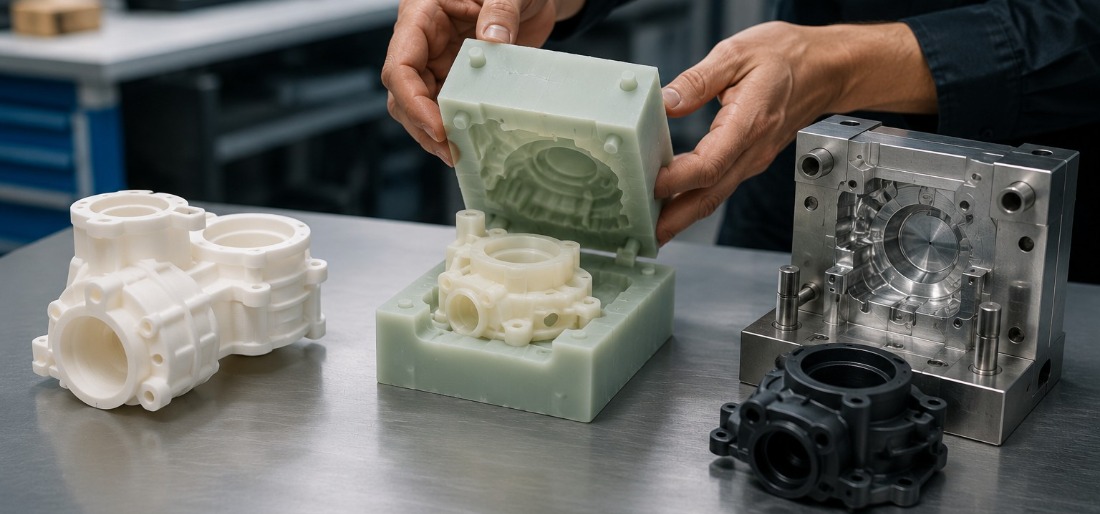
Every hardware team hits the same wall eventually: the CAD model looks perfect, but nobody knows how it’ll actually feel, fit, or fail until it exists in the real world. That’s the gap rapid prototyping services are built to close. Whether you’re validating a single concept or preparing a small batch for market testing, choosing the right process — and knowing when to bring in vacuum casting — determines how fast and how cheaply you get there.
What Do Rapid Prototyping Services Actually Include?
Rapid prototyping services combine additive methods like 3D printing with subtractive processes like CNC machining to turn a digital design into a physical part, often within days. Providers such as Protolabs, Fictiv, and Shapeways run this as an on-demand operation, so companies get access to industrial-grade equipment without buying it.
The appeal isn’t just speed. Early prototypes catch design flaws before they turn into expensive tooling mistakes, and a physical model does something a rendering never can — it lets investors, engineers, and end users react to something they can hold.
– Concept validation: confirming shape, fit, and ergonomics early
– Functional testing: checking that a part actually performs under real conditions – Investor and patent demonstrations: giving a tangible object to back up a pitch
For a one-off part or an early-stage iteration, 3D printing alone usually gets the job done. The trouble starts when a team needs more than a handful of parts, or when a 3D-printed prototype’s material properties fall short of what the final product needs.
When 3D Printing Isn’t Enough: Vacuum Casting
This is where a vacuum casting service earns its place in the process. Vacuum casting — also called urethane casting — pours liquid polyurethane resin into a silicone mold under vacuum, using a 3D-printed or CNC-machined master pattern as the template. The result is a batch of parts with the look, feel, and mechanical performance of injection molding, minus the cost of hard tooling.
How Does Vacuum Casting Work?
A master pattern gets machined or printed, silicone is cast around it to form a mold, and urethane resin is drawn into that mold under vacuum to eliminate air bubbles. Most providers
can turn parts around in five to fifteen days, and a single silicone mold typically holds up for 15-25 castings before wear starts affecting precision.
That makes vacuum casting the practical middle step between a single 3D-printed prototype and full injection-molded production. It suits:
– Bridge production while injection tooling is being built
– Market-testing batches of 20 to 200 units
– Parts needing production-like materials — flexible urethanes, ABS-like or PC-like resins, even clear or color-matched finishes
The trade-off is real, though: silicone molds degrade with use, so vacuum casting doesn’t scale to thousands of units the way hard tooling eventually needs to. It’s a bridge, not a permanent solution.
Choosing Between In-House and Outsourced Prototyping
In-house prototyping gives you tighter control and lower long-term costs if volume is steady. Outsourcing makes more sense for occasional projects, oversized parts, or specialty materials that don’t justify the equipment investment. Most growing product teams end up doing both — quick 3D prints internally for daily iteration, and outsourced vacuum casting when a batch of near-final parts is needed for testing or launch.
Conclusion
Rapid prototyping services get an idea into physical form fast; vacuum casting service takes it a step closer to what customers will actually hold. Matching the process to the stage of development — not defaulting to whichever method is fastest — is what keeps both budgets and timelines intact. If your next milestone involves a batch of parts rather than a single test unit, it’s worth asking your prototyping partner whether urethane casting fits before committing to tooling.
