

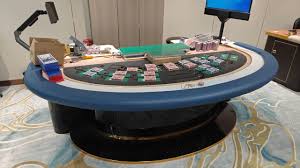
An RFID casino table is a gaming surface equipped with embedded radio-frequency identification sensors that automatically detect, identify, and track every tagged chip placed on the table in real time. The technology replaces manual chip counting and visual inspection with a fully automated digital audit trail — and it is reshaping how casino operators manage security, efficiency, and compliance on the gaming floor.
The Nevada Gaming Control Board’s 2024 technology review reported that casinos deploying RFID tables reduced chip-counting errors by 94% and cut per-table audit times from an average of 15 minutes to under 30 seconds. These results explain why RFID table adoption has accelerated significantly over the past three years, moving from a luxury feature in high-limit rooms to a standard deployment across mid-market properties.
But here is what makes this relevant beyond the casino industry: RFID casino tables are essentially an IoT sensor network operating under the most demanding conditions imaginable — real-time data processing, zero tolerance for errors, and regulatory audit requirements built into every transaction. The architecture that makes this work is directly applicable to any environment where asset tracking, fraud prevention, and operational visibility matter.
Let us walk through how these systems work, what the performance data shows, and what operators should consider before deployment.
How RFID Casino Tables Work: The Three-Layer Architecture?
RFID casino table systems operate on a three-layer architecture that balances speed, accuracy, and reliability.
Layer 1 — Edge sensing. Antennas are embedded beneath the table felt, typically arranged in a grid or zone-based pattern. When an RFID-tagged chip enters the read field, the antenna captures the chip’s unique serial number, denomination, and position. A single table can read hundreds of chips simultaneously in under one second, with no line-of-sight requirement.
Layer 2 — Data transport. The reader processor at each table packages chip events into structured data packets and transmits them to the central server over the casino’s internal network. Most installations use dedicated VLANs with AES-256 encryption to prevent signal interception and tampering.
Layer 3 — Central reconciliation. The backend casino management system receives, validates, and stores every transaction. It maintains a running chip inventory for each table, cross-references serial numbers against vault issuance records, and generates real-time alerts when anomalies occur — such as an unrecognized chip serial number or a bet placed after a hand closes.
This architecture mirrors enterprise IoT deployments in manufacturing and logistics, where the same three-layer model governs sensor data collection, transport, and central processing.
Why Casinos Are Switching to RFID Tables in 2026?
Three factors are driving adoption at scale.
Security. The Nevada Gaming Control Board attributed approximately $40 million in gaming-related theft and fraud cases in 2023. RFID tables neutralize several common fraud vectors: counterfeit chips are detected instantly at the table rather than at the cage; past-posting — placing a bet after the outcome is known — becomes nearly impossible when every chip movement is timestamped; and chip diversion from one table to another is tracked in real time. Our guide to RFID chip sensing devices covers the full anti-counterfeiting workflow in detail.
Operational efficiency. Table closes, shift changes, and chip fills are the most labor-intensive parts of a pit manager’s day. RFID tables automate these workflows. The Macau Gaming Inspection and Coordination Bureau’s 2024 annual report noted that properties using RFID systems saved an average of 12 minutes per table close — translating to thousands of hours recovered annually across a full gaming floor.
Regulatory pressure. Gaming commissions in Nevada, New Jersey, and Macau increasingly require detailed transaction logs for tables handling high-volume play. Manual logs are time-consuming and error-prone. RFID systems generate audit-ready records automatically, satisfying regulatory requirements without additional staff effort.
Real-World Performance Data
The numbers tell the story:
- 94% reduction in chip-counting errors (Nevada Gaming Control Board, 2024)
- 30-second table closes versus 15-minute manual counts
- 2.3% error rate with delayed sync versus 0.6% with sub-500ms sync systems (Macau DICJ, 2024)
- $40 million in gaming fraud cases in jurisdictions without full RFID coverage (NGCB, 2023)
- 12 to 18 month ROI for midsize installations (Global Gaming Expo technology panel, 2024)
Performance data from 2024’s Global Gaming Expo confirms that properties with fully deployed RFID table systems generate detailed operational metrics that properties without them cannot access — chip velocity by table, dealer performance against baseline, and real-time hold percentage calculations.
Key Components of an RFID Table System
A complete RFID table deployment requires four integrated components.
RFID-tagged casino chips. Each chip contains an embedded microchip and antenna, operating at 13.56 MHz (HF) or 860–960 MHz (UHF). The tag stores a unique serial number, denomination, and issuance data. Modern tags add less than 0.1 grams to chip weight and are encased in composite material that matches the feel and sound of traditional chips. RFID casino poker chips from specialized manufacturers undergo high-temperature encapsulation to ensure the tag remains readable through years of handling.
Embedded table readers. Antenna arrays are woven into the table surface beneath the felt. The arrangement varies by game type — blackjack tables use a semicircular antenna pattern around the dealer position, while baccarat and roulette tables deploy zone-based grids that cover each betting area. The readers poll the chip field at 10 to 50 Hz, producing a continuous stream of chip position data.
Processing units. Each table connects to a local processing unit that filters raw sensor data, removes noise (chips briefly entering and leaving the read field), and formats clean data events for transmission. Edge processing reduces network load and improves response time by filtering irrelevant data before it reaches the central server.
Management software. The backend platform receives data from all tables, maintains real-time dashboards for floor managers, and generates compliance reports. Modern platforms include API endpoints that integrate with existing casino management systems, accounting software, and surveillance platforms.
Integration with Casino Management Systems
RFID table data is most valuable when it feeds into a broader casino management ecosystem. The integration points include:
- Player tracking. RFID data links chip movements to specific player accounts, enabling real-time comp calculations, loyalty point accrual, and responsible gaming monitoring.
- Surveillance correlation. When the RFID system flags an anomaly, the surveillance system automatically pulls relevant camera feeds and timestamps the incident for review.
- Financial reconciliation. Chip counts from table closes are automatically fed into the casino’s general ledger, eliminating manual data entry and reducing end-of-day discrepancies.
- Analytics dashboards. Floor managers see live visualizations of table occupancy, chip velocity, hold percentage, and dealer performance — metrics that previously required end-of-shift reports.
The Global Gaming Expo’s 2024 technology panel emphasized that the ROI of RFID tables increases significantly when the data flows into multiple operational systems rather than existing in isolation.
Cost and ROI: What Operators Need to Know
Deploying RFID across a midsize casino floor costs between $500,000 and $1.5 million, according to the 2024 Global Gaming Expo technology panel. The main cost drivers are:
- Chip replacement. Converting an existing chip inventory to RFID-tagged versions. Modern RFID chips cost roughly $0.50 to $2.00 per chip depending on volume and customization, down from $2 to $5 per chip in 2018.
- Table hardware. Embedded reader kits range from $2,000 to $5,000 per table plus installation labor.
- Software licensing. Management platform costs vary by property size and integration complexity.
- Staff training. Pit managers, dealers, and cage personnel need approximately 4 to 8 hours of training on RFID workflows.
The ROI timeline averages 12 to 18 months, driven by:
- Reduced fraud losses
- Lower labor costs for table closes and audits
- Faster table turnover between shifts
- Improved compliance documentation
- Higher table utilization rates
Smaller properties can start with high-limit areas and expand incrementally, reducing upfront capital requirements. The key is to structure the deployment so that each phase generates its own measurable ROI before expanding.
Implementation Challenges and How to Solve Them
Chip compatibility. Not all RFID chips work with all reader systems. Operators should select chip and reader hardware from interoperable vendors or work with a systems integrator who guarantees compatibility across components.
Signal interference. Metal objects, liquids, and even the human body can interfere with RFID signals. Professional installation includes signal mapping and antenna calibration to ensure consistent read rates across the entire table surface.
Staff resistance. Dealers and pit managers accustomed to manual workflows may resist new technology. The most successful implementations involve floor staff in the planning process and demonstrate how RFID reduces tedious manual work rather than eliminating jobs.
Data integration complexity. Connecting RFID data to existing casino management systems requires careful API planning. Operators should budget for 4 to 8 weeks of integration work and engage their CMS vendor early in the process.
Future Trends: AI, Cloud, and Standardization
The next phase of RFID table evolution is already underway.
AI-powered anomaly detection. Machine learning models are being trained on RFID table data to detect advantage play patterns, card counting, and dealer collusion in real time. These models require high-integrity data streams to function — making RFID table data quality a prerequisite for AI adoption on the gaming floor.
Cloud-hybrid architectures. Smaller operators are moving toward cloud-hybrid models that sync table data to both on-premise servers and cloud analytics platforms. This enables multi-property operators to compare performance across locations and access advanced analytics without building on-premise data infrastructure at each site.
Standardization initiatives. The American Gaming Association’s 2025 technology standards committee is reviewing proposals for standardized RFID data event formats. If adopted, these standards would simplify multi-vendor deployments and make it easier for operators to mix hardware from different manufacturers.
FAQs
What is an RFID casino table?
An RFID casino table is a gaming table with embedded radio-frequency identification sensors that automatically detect and track RFID-tagged casino chips in real time. It replaces manual chip counting with automated digital tracking for security, efficiency, and compliance.
How much does it cost to deploy RFID tables?
A midsize casino deployment costs between $500,000 and $1.5 million, with ROI typically achieved within 12 to 18 months through reduced fraud losses, lower labor costs, and improved table utilization. Individual RFID chips cost $0.50 to $2.00 per unit at commercial volumes.
Do RFID tables affect game speed or player experience?
No. RFID readers operate beneath the felt and are invisible to players. Chip reads happen in under one second without interrupting gameplay. Players benefit from faster payouts and improved game integrity — the only noticeable change is quicker service.
Can RFID tables detect counterfeit chips?
Yes. RFID tables cross-reference every chip’s unique serial number against the casino’s vault issuance records. A chip with an unrecognized or duplicate serial number triggers an instant alert before it can be wagered or cashed out.
How long does implementation take?
A full-floor implementation typically takes 6 to 12 weeks, including hardware installation, software integration, and staff training. Smaller phased deployments — starting with high-limit rooms — can be completed in 2 to 4 weeks per phase.
Conclusion
RFID casino table technology has moved from experimental to essential. The performance data is clear: 94% fewer counting errors, 30-second table closes, and 12-to-18-month ROI timelines. For casino operators, the question is no longer whether to adopt RFID tables but how to plan the deployment for maximum operational impact.
The underlying technology — real-time IoT sensing, edge processing, and centralized data reconciliation — has applications far beyond the casino floor. Manufacturing, logistics, and healthcare operators facing similar asset-tracking challenges are watching the gaming industry’s RFID integration closely. The casino industry solved real-time asset tracking at scale, under regulatory pressure, with money on the line. That is a blueprint worth studying.
