

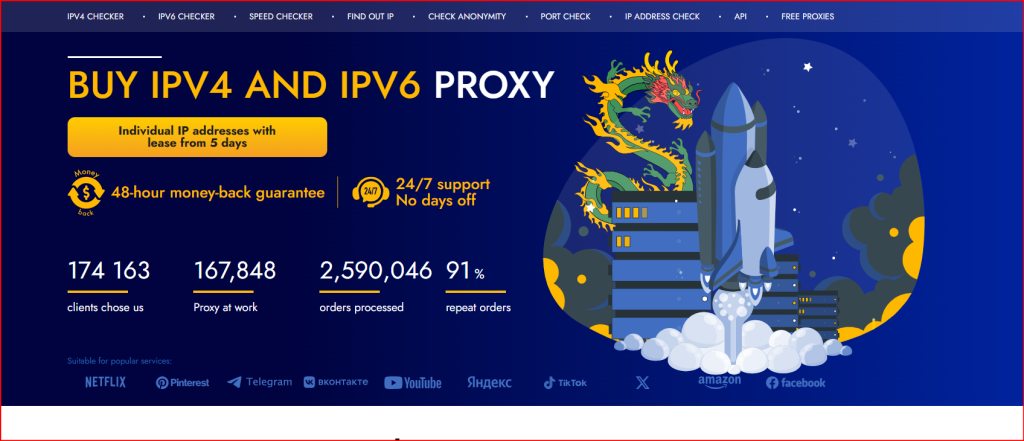
| Official website: SpaceProxy |
How this review was prepared
| This is an editorial, buyer-focused review. I examined the publicly described product structure, technical claims, setup options, and policy points, then evaluated them against the checks a real SEO or operations team should make. I did not purchase every location or run a controlled laboratory speed benchmark, so performance claims are presented as provider-advertised details rather than independent measurements. |
Quick verdict
| Category | Assessment |
|---|---|
| Best suited to | SEO teams, regional website checks, approved client environments, and software that needs a stable proxy endpoint. |
| What stands out | Manual location selection, individual IPv4/IPv6 options, HTTP/SOCKS compatibility, API access, and short rental periods. |
| Main caution | A long feature list does not guarantee clean IP reputation or equal performance in every city and subnet. |
| Buying approach | Start with one or two addresses, test the exact target websites, and scale only after the route and reputation are acceptable. |
First impression: the service is built around control, not complexity
The most useful thing about SpaceProxy is not a dramatic promise; it is the amount of control the service says it gives the buyer. At the time of review, the website described individual IPv4 and IPv6 proxies, HTTP and SOCKS-compatible access, manual selection of addresses and subnets, city selection where available, immediate activation, an API, unlimited traffic, and rental periods beginning at five days. For a small team, that structure is easier to evaluate than a package that forces a large monthly commitment from day one.
In practice, control matters because two projects can require very different network identities. An SEO analyst checking local search results may care about country and city consistency. A software tester may care more about protocol support and DNS behavior. An agency managing approved client accounts usually wants stable, clearly assigned endpoints rather than constant random rotation. SpaceProxy appears to be aimed at those use cases.
The official SpaceProxy website is the right place to verify the current country inventory, exact pricing, replacement rules, and technical limits before purchasing, because those details can change faster than a review article.
Where SpaceProxy may be genuinely useful
Regional SEO and advertising checks
Search results, product availability, prices, consent banners, advertisements, and delivery options often change by location. A dedicated proxy can help a team reproduce the view from a target market without asking employees to travel or maintain remote hardware in every country.
The important word is reproduce. A reliable test should use the same browser language, time zone, cookies, and login status each time. The proxy supplies the network location, but it does not automatically make the rest of the browser environment consistent.
- Compare localized search-result pages from several target regions.
- Check whether landing pages, currencies, or shipping messages change by market.
- Validate geo-targeted advertising and compliance notices.
- Monitor public prices or availability without mixing project sessions.
Stable browser and software sessions
Individual proxies are usually more predictable than heavily shared public endpoints because unrelated users are not generating traffic through the same address at the same time. That does not make an IP automatically trusted, but it can reduce one source of instability.
For legitimate multi-account administration, the proxy should be treated as one element in a larger identity record. Each account needs a real owner, a documented purpose, separate browser storage, consistent region settings, and compliance with the platform’s terms.
IPv4, IPv6, and protocol choice in plain language
IPv4 is the safer default
IPv4 remains the easiest option when compatibility matters more than price. Most websites, browsers, automation tools, and desktop applications support it without special configuration. For long-lived sessions or a first pilot, an individual IPv4 address is normally the least complicated place to start.
IPv6 can be economical, but compatibility must be proven
IPv6 offers a much larger address space and can be attractive for applications that support it correctly. The drawback is uneven treatment. Some websites, applications, and monitoring tools still behave differently over IPv6. A low-cost address is not a saving if the target service rejects it or the local software cannot route through it reliably.
HTTP or SOCKS?
HTTP proxy settings are straightforward for browsers and web-focused tools. SOCKS is more flexible for software that needs to route different kinds of TCP traffic. Before buying, confirm which format the application accepts, whether DNS queries travel through the proxy, and whether authentication uses a username and password or an allowed source IP.
What the advertised scale means—and what it does not
SpaceProxy has advertised a large network and subnet catalog, high thread limits, unlimited traffic, and API access. Those details are useful for teams that need more than a single manual browser session. API access can simplify ordering, assignment, renewal, and internal inventory management. Network diversity may also help a company avoid putting every regional test in the same subnet.
Still, advertised scale should not be confused with uniform quality. The route to a target website, the history of a specific IP, congestion, geolocation-database accuracy, and local filtering can vary. One location may work perfectly while another needs replacement. A good procurement process tests the actual address, not only the provider name.
How I would test SpaceProxy before scaling
- Buy the smallest practical order in the exact country or city needed for the project.
- Confirm the address in two independent IP and geolocation databases.
- Test HTTP or SOCKS authentication in the real browser or application—not only in a proxy checker.
- Visit the target websites at low volume and record errors, CAPTCHAs, latency, and session stability.
- Check DNS and WebRTC behavior so the local network address is not exposed unintentionally.
- Keep the same address for several days to see whether reputation or routing changes.
- Contact support with one realistic technical question and evaluate the clarity of the response.
- Read the current refund or replacement conditions before placing a larger order.
Who should probably look elsewhere
SpaceProxy is not automatically the best fit for every workload. A company that needs residential or mobile IPs, automatic rotation after every request, enterprise compliance documentation, or managed scraping infrastructure may need a different product category. A proxy also does not replace a VPN for whole-device encryption, and it does not replace a VPS when the workload needs remote computing resources.
It is also the wrong tool for bypassing account limits, hiding prohibited activity, or ignoring platform rules. The sensible use is controlled regional access for authorized projects, with conservative request rates and clear ownership.
Strengths and limitations
| What looks strong | What deserves caution |
| • Small orders and short rental periods make pilot testing practical. | • IP quality and route performance can vary by location. |
| • Individual IPv4 and IPv6 options cover different compatibility and budget needs. | • IPv6 is not accepted equally by every target website. |
| • Manual selection can help with regional consistency. | • A proxy does not isolate cookies, fingerprints, or account behavior. |
| • HTTP/SOCKS support fits common browsers and software. | • Refund and replacement eligibility must be checked in the current terms. |
| • API access is useful for internal operations and larger pools. | • Teams needing residential or mobile IPs may need another provider type. |
Final assessment
SpaceProxy looks most convincing when it is treated as a controlled infrastructure component rather than a shortcut. The product structure appears flexible enough for a one-address regional check and for a larger managed pool, while the short rental options reduce the cost of learning whether a specific location works.
My practical verdict is positive but conditional: test the exact IP, subnet, protocol, and destination before committing. If the pilot is stable and the official terms match the project, SpaceProxy can be a useful option for SEO monitoring, localized web checks, and approved browser or software sessions.
| Check the current plans and terms on SpaceProxy. |
