

Cervical myelopathy occurs when the spinal cord in the neck becomes compressed, potentially causing symptoms such as weakness, numbness, problems with coordination and difficulty walking. When symptoms are significant or progressive, surgery may be recommended to decompress the spinal cord and prevent further neurological deterioration.
For patients with compression affecting multiple levels of the cervical spine, surgeons may consider different surgical approaches. Two established approaches include surgery performed from the front of the neck, such as anterior cervical decompression and fusion, and surgery performed from the back of the neck, such as laminoplasty.
A prospective study published in The Spine Journal in 2013 compared clinical and functional outcomes between these approaches in 116 patients with multilevel cervical myelopathy. The research followed patients for two years and examined neurological function, neck disability, pain, quality of life, neck movement and surgical complications.
Dr Wang Lushun of Arete Orthopaedic Centre was one of the contributors to the research, together with Chusheng Seng, Benjamin P.B. Tow, Mashfiqul A. Siddiqui, Abhishek Srivastava and other members of the Singapore orthopaedic research team. At the time, the authors were affiliated with the Department of Orthopaedic Surgery at Singapore General Hospital.
What Is Cervical Myelopathy?
Cervical myelopathy refers to dysfunction of the spinal cord in the neck caused by compression.
The cervical spine consists of seven vertebrae that protect the spinal cord as it travels from the brain to the rest of the body.
As the spine changes due to conditions such as degenerative disc disease, arthritis or other structural abnormalities, the space available for the spinal cord may become narrower.
Persistent spinal cord compression can affect neurological function.
What Symptoms Can Cervical Myelopathy Cause?
Symptoms can vary depending on the severity and location of compression.
Common symptoms may include:
- Numbness or tingling in the hands or arms
- Weakness in the arms or legs
- Difficulty with fine hand movements
- Problems with balance
- Unsteady walking
- Difficulty with buttons or other precise hand movements
- Changes in coordination
Some patients may also experience neck pain, although neurological symptoms can be more significant than neck discomfort.
Because cervical myelopathy involves the spinal cord, progressive neurological symptoms warrant medical assessment.
Why Might Surgery Be Considered?
The purpose of surgery for cervical myelopathy is generally to decompress the spinal cord.
Depending on the underlying anatomy and severity of the condition, surgery may be considered when:
- Neurological symptoms are progressing
- Spinal cord compression is significant
- Conservative management is insufficient
- There is concern about further neurological deterioration
The appropriate surgical approach depends on the individual patient rather than simply the number of affected spinal levels.
What Surgical Approaches Were Compared in the Study?
The researchers compared two broad approaches.
Anterior Cervical Decompression and Fusion
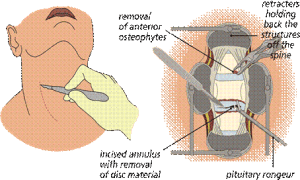
The anterior approach is performed from the front of the neck.
Depending on the patient’s anatomy and the location of compression, surgery may involve:
- Removing one or more damaged discs
- Removing part of a vertebral body when necessary
- Decompressing the spinal cord
- Placing a structural graft or implant
- Stabilising the treated levels with instrumentation
The study included patients who underwent two or more levels of anterior cervical decompression and fusion, or at least one-level anterior cervical corpectomy and fusion.
Posterior Cervical Laminoplasty
Laminoplasty is performed from the back of the neck.
Rather than removing the vertebral lamina completely, the procedure modifies and opens the posterior elements of the vertebrae to create more space within the spinal canal.
In the study, patients underwent laminoplasty from:
- C3 to C6, or
- C3 to C7
depending on the extent of their disease.
How Was the Study Conducted?
The research was a prospective two-year follow-up study.
A total of 116 patients with cervical myelopathy were included:
- 64 patients underwent anterior surgery
- 52 patients underwent posterior surgery
The researchers followed patients from before surgery through two years after their procedures.
Several measures were used to assess the outcomes.
How Did the Researchers Measure Recovery?
The researchers did not rely on a single measure of recovery.
They assessed:
Japan Orthopaedic Association Score
The JOA score was used to assess neurological function.
The researchers also calculated the JOA recovery rate to evaluate improvement following surgery.
Neck Disability Index
The NDI measures how neck problems affect daily activities and disability.
Neck Pain
Pain was assessed using a visual analogue scale for neck pain.
AAOS Neurogenic Symptom Score
This was used to assess neurological symptoms.
Neck Range of Motion
The researchers measured flexion and extension of the cervical spine.
Quality of Life
The study also used the SF-36, which assesses different aspects of health-related quality of life, including:
- Physical functioning
- Physical role limitations
- Bodily pain
- General health
- Vitality
- Social functioning
- Emotional role functioning
- Mental health
This broad range of measures allowed the researchers to compare neurological recovery, pain, disability, movement and quality of life.
What Did the Study Find?
1. Posterior Surgery Had a Shorter Operating Time
The posterior group had an operating time approximately one hour shorter than the anterior group, with the difference reaching statistical significance.
Operating time is only one factor considered when selecting a surgical approach. The complexity of the patient’s anatomy, the number of levels involved and the location of spinal cord compression can all influence the procedure.
2. Posterior Surgery Showed Greater Improvement in JOA Scores at Six Months
At the six-month follow-up, patients who underwent posterior surgery demonstrated greater improvement in JOA scores compared with the anterior group.
The difference was statistically significant, with a p-value of 0.025.
However, this difference did not remain statistically significant at the two-year assessment.
This means the study showed an early difference in neurological improvement but did not demonstrate a persistent advantage for posterior surgery based on JOA scores at two years.
3. The Anterior Group Had Greater Early Improvement in Neck Disability
At six months, the anterior surgery group showed greater improvement in Neck Disability Index scores.
The difference was statistically significant, with a p-value of 0.024.
Again, this early difference did not remain statistically significant at two years.
This illustrates why the timing of outcome assessment matters when interpreting surgical research.
4. Blood Loss Was Lower With Anterior Surgery
The anterior surgery group experienced less intraoperative blood loss than the posterior surgery group.
This is one of the differences that surgeons may consider when assessing the relative characteristics of the two approaches.
However, blood loss is only one component of surgical decision-making.
5. The Two Groups Had Similar Two-Year Functional Outcomes
At two years, the researchers found no statistically significant difference between the two groups in:
- JOA scores
- JOA recovery rates
- Neck Disability Index
- AAOS neurogenic symptom scores
- Neck pain
- SF-36 quality-of-life measures
- Cervical range of motion
This was one of the central findings of the study.
Although there were differences during earlier follow-up, the measured functional and quality-of-life outcomes were not significantly different between the groups at two years.
6. Complications Differed Between the Groups
The researchers reported more complications in the anterior group.
The complications recorded in the anterior group included:
- Two postoperative haematomas
- One case of vocal cord paresis
- One new case of C6/C7 dermatome numbness
The posterior group had one reported dural leak.
The numbers were small, so the study should not be used to determine the overall complication rate of either surgical approach.
Does the Research Show That Posterior Surgery Is Better?
No.
Although the study found some early advantages associated with posterior surgery, including shorter operating time and greater improvement in JOA scores at six months, the researchers did not conclude that posterior surgery was universally superior.
At two years, the main functional and quality-of-life measures did not differ significantly between the groups.
The authors specifically stated that a larger, prospectively randomised study with longer follow-up would be needed before confidently advocating one approach over the other.
Why Might One Patient Need Anterior Surgery While Another Has Posterior Surgery?
The choice of surgical approach is influenced by the patient’s individual anatomy and pattern of spinal cord compression.
Factors that may be considered include:
Location of Compression
Compression occurring primarily at the front of the spinal cord may influence the choice of an anterior approach.
Number of Levels Involved
Multilevel disease can make the surgical decision more complex.
Spinal Alignment
The alignment of the cervical spine can influence which approach is appropriate.
Extent of Disease
The severity and distribution of spinal cord compression need to be assessed through imaging and clinical examination.
Patient Factors
Age, overall health, symptoms, activity requirements and other medical considerations may also influence treatment planning.
Therefore, the approach used in one patient should not automatically be assumed to be appropriate for another.
What Does Anterior Cervical Decompression and Fusion Involve?
In an anterior approach, the surgeon accesses the cervical spine through the front of the neck.
Depending on the specific pathology, the procedure may involve removing:
- Damaged discs
- Bone spurs
- Part of a vertebral body
The aim is to remove the source of spinal cord compression.
Fusion and instrumentation may then be used to stabilise the treated spinal levels.
The approach provides direct access to structures causing anterior compression.
What Does Cervical Laminoplasty Involve?
Laminoplasty is performed through a posterior approach.
The surgeon modifies the laminae at the back of the cervical vertebrae to increase the available space within the spinal canal.
The objective is to allow the spinal cord more room and reduce compression.
Unlike fusion procedures, laminoplasty generally aims to preserve more motion in the treated levels, although the actual range of motion can vary between patients.
What Should Patients Expect After Cervical Myelopathy Surgery?
Recovery depends on:
- Surgical approach
- Number of levels treated
- Severity and duration of spinal cord compression
- Neurological condition before surgery
- Overall health
- Rehabilitation
Patients may undergo rehabilitation to improve:
- Strength
- Balance
- Walking
- Coordination
- Daily function
It is important to understand that surgery aims primarily to decompress the spinal cord. Recovery of neurological function varies and may depend on how much the spinal cord was affected before treatment.
Why Is Early Assessment of Cervical Myelopathy Important?
Cervical myelopathy involves the spinal cord rather than simply the muscles or joints of the neck.
Symptoms such as:
- Increasing hand clumsiness
- Difficulty walking
- Balance problems
- Limb weakness
- Numbness
- Loss of coordination
should be assessed by a qualified medical professional.
Early evaluation can help determine whether spinal cord compression is present and whether treatment is needed.
What Does This Research Mean for Patients?
The study provides several useful insights for people diagnosed with multilevel cervical myelopathy.
Both surgical approaches can provide improvement
The study found meaningful improvements following both anterior and posterior surgery.
Early outcomes were not identical
Posterior surgery was associated with better JOA improvement at six months, while anterior surgery showed greater improvement in NDI at the same time point.
Two-year outcomes were broadly comparable
The study did not identify statistically significant differences between the groups in the main functional, pain and quality-of-life measures at two years.
Surgical risks differ
The types of complications observed differed between the approaches, although the study was not large enough to establish general complication rates.
There is no single surgical approach for every patient
The authors themselves called for larger randomised studies with longer follow-up before one approach could confidently be recommended over the other for all patients.
A prospective Singapore study involving 116 patients compared anterior cervical decompression and fusion with posterior laminoplasty for multilevel cervical myelopathy. The research found differences in some early outcomes: posterior surgery had a shorter operating time and greater improvement in JOA scores at six months, while the anterior group showed greater early improvement in neck disability scores and less intraoperative blood loss.
By two years, however, there were no statistically significant differences between the groups in JOA scores, recovery rates, neck disability, neurological symptoms, neck pain, quality of life or cervical range of motion. The study reported complications in both groups, with different types of complications observed.
The research therefore does not establish one approach as universally better. Instead, it supports the importance of considering the individual patient’s spinal anatomy, number and location of affected levels, alignment, symptoms and overall health when determining the appropriate surgical approach.
For patients diagnosed with cervical myelopathy, discussing the available surgical options and the reasoning behind a recommended approach with a spine specialist can help provide a clearer understanding of the treatment plan.
Research Reference
Seng C, Tow BPB, Siddiqui MA, Srivastava A, Wang L, Yew AKS, Yeo W, Khoo SHR, Balakrishnan NMS, Razak HRBA, Chen JLT, Guo CM, Tan SB, Yue WM. Surgically treated cervical myelopathy: a functional outcome comparison study between multilevel anterior cervical decompression fusion with instrumentation and posterior laminoplasty. The Spine Journal. 2013 Jul;13(7):723-731. DOI: 10.1016/j.spinee.2013.02.038. PMID: 23541452.
This article is for general information only and should not replace medical advice from a qualified healthcare professional.
