For anyone stepping into the world of digital marketing, web development, or technical SEO today, the landscape looks vastly different than it did just three years ago. The barrier to content creation has effectively dropped to zero. If you need a landing page, a series of technical tutorials, or a comprehensive market analysis, a generative language model can produce it for you in seconds. However, this unprecedented velocity has created a fascinating new problem for junior tech professionals: the illusion of productivity.
You can easily publish fifty articles a week on your new portfolio site, only to realize months later that your organic web traffic is a complete ghost town. The reason is simple. Search engine algorithms have aggressively evolved to filter out low-effort, mass-produced text. To actually rank in modern search results, you cannot just be a prompt jockey; you must learn how to systematically humanize ai output before it ever reaches a live server.
Understanding why search engines penalize raw generative text requires looking at the mechanics of machine learning from the opposite side of the table. When a platform like Google crawls a webpage, it is no longer just looking for keyword density. It is analyzing the structural footprint of the prose. Language models are built on mathematical probability, meaning they default to the safest, most statistically common word choices.
They write in a highly predictable, metronomic cadence. Every sentence is grammatically flawless, yet structurally uniform. For a search engine algorithm, this lack of linguistic variance—what data scientists refer to as low perplexity—is a massive red flag. It signals that the content offers no unique “information gain,” no real-world experience, and no distinct human perspective.
If you are an aspiring SEO specialist or a developer trying to build an audience, this presents a significant workflow challenge. You cannot afford to ignore generative tools entirely, as you would quickly fall behind competitors in sheer output volume. Yet, you cannot publish the raw output without risking a severe algorithmic penalty. The traditional advice is to manually edit every single line, but spending an hour rewriting a machine-generated draft completely defeats the purpose of automation.
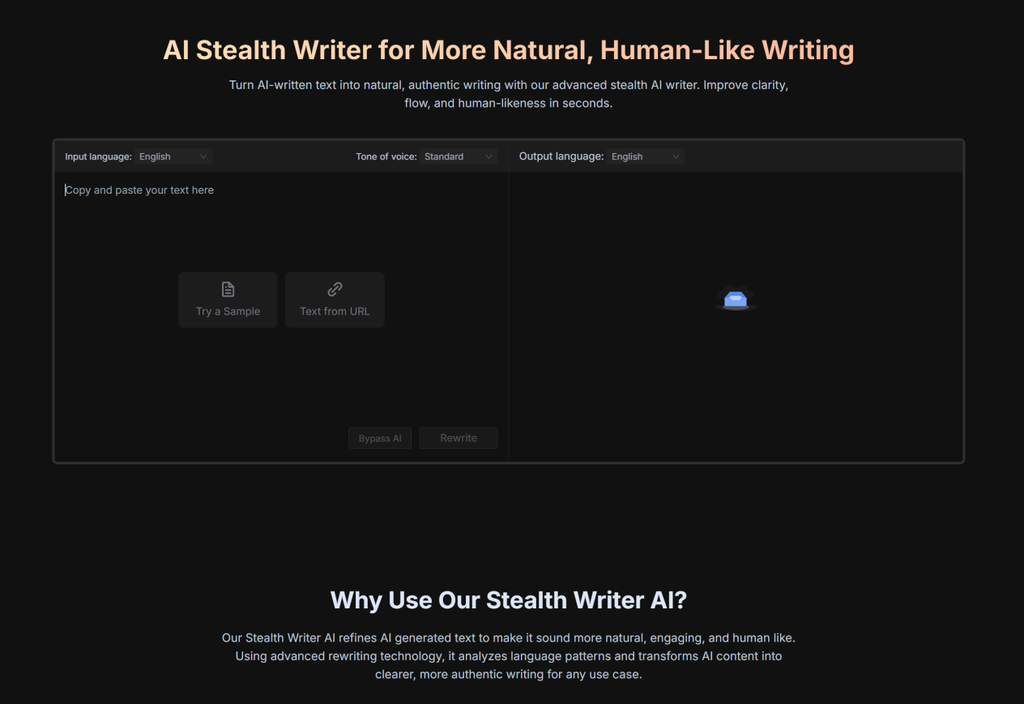
This is where the concept of “content engineering” comes into play. Just as a software developer refactors messy code to make it run more efficiently without changing its core function, modern digital marketers are building automated refactoring steps into their publishing pipelines. Rather than doing all the heavy lifting manually, many are integrating secondary processing tools that function effectively as an AI Stealth Writer in their daily tech stack.
These specialized utilities are not meant to simply spin synonyms or hide behind superficial formatting tricks. Instead, they operate on a deeper syntactic level, breaking up the predictable sub-clauses, altering the uniform sentence lengths, and injecting the kind of structural unpredictability that characterizes genuine human thought.
Think of it as adding a necessary layer of friction to your workflow. When you write naturally, you pause, you emphasize, and you occasionally structure a sentence in a slightly asymmetrical way to make a point. A machine never does this unless forced. By utilizing advanced restructuring engines like bypassgpt.ai as an intermediate step, content teams can take the mathematically rigid framework provided by a primary LLM and actively disrupt its predictable patterns.
The software rearranges the linguistic architecture, stripping away the distinct, robotic metadata of the initial draft while preserving the core informational value. It allows a small marketing team to maintain the velocity of automated research while delivering a final product that reads with the organic rhythm of a seasoned industry professional.
For those entering the digital workforce, mastering this hybrid approach is no longer optional; it is a fundamental survival skill. The internet is rapidly filling to the brim with synthetic noise. Audiences are becoming fatigued by articles that sound like sanitized encyclopedias, and search engines are actively demoting them. The websites that will thrive in this new era are those that use automation for heavy lifting but fiercely protect the authenticity of their final delivery.
Ultimately, mastering these refactoring workflows and achieving an undetectable ai standard is not about deceiving your readers or maliciously tricking search algorithms. It is about removing the artificial barriers between your ideas and your audience. It ensures that when you finally hit publish, your hard work, your research, and your unique professional insights actually have the opportunity to be seen, read, and trusted by the human beings on the other side of the screen.