

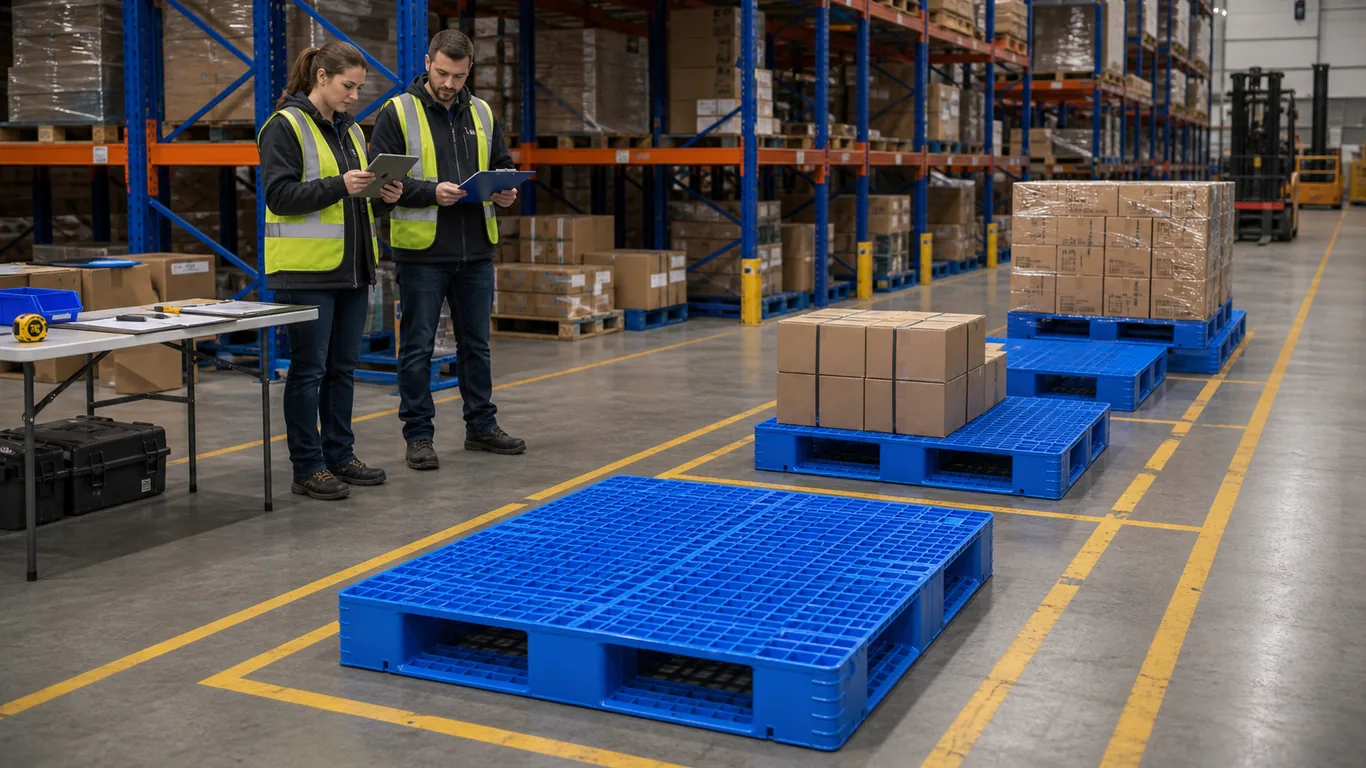
In packaging facilities that process high volumes of goods daily, pallet management is rarely treated as a strategic function. It tends to be handled reactively — pallets are ordered when stock runs low, counted when audits are due, and replaced when damage becomes impossible to ignore. For smaller operations with predictable throughput, this approach may hold. But for high-volume US packaging facilities, where throughput is continuous and floor decisions compound quickly, the absence of a structured approach to pallet inventory creates operational friction that accumulates in ways that are often difficult to trace back to their root cause.
Pallets sit at the intersection of inbound receiving, production staging, outbound logistics, and storage. Any disruption to pallet availability — or any inconsistency in pallet condition — ripples across these functions simultaneously. The result is not always a dramatic failure. More often, it is a quiet erosion of efficiency: line stoppages that are attributed to staffing, shipping delays that are logged as logistics issues, and product damage claims that are tied to transit rather than handling. Understanding how to manage pallet inventory as a distinct operational discipline is what separates facilities that control these variables from those that are controlled by them.
What Pallet Inventory Management Actually Involves
Pallet inventory management is the structured process of tracking, maintaining, and planning the supply of pallets across a facility’s operational cycle. It covers not just how many pallets are on hand at any given time, but where they are located, what condition they are in, how quickly they are being consumed, and how reliably they are being replenished. For facilities running at high volume, this is not a simple count-and-reorder exercise. It involves coordinating between receiving, production, warehousing, and dispatch teams — and ensuring that the pallet supply does not become a constraint on any of them.
Those looking to build this function from the ground up, or to strengthen an existing process, will benefit from reviewing a detailed Pallet Inventory Management guide that addresses the operational specifics of high-throughput environments. The core components of any sound approach include visibility into current stock, a defined inspection and classification system, a replenishment process tied to actual consumption rates, and clear accountability for pallet condition across departments.
The Difference Between Counting and Tracking
Many facilities can tell you how many pallets they own. Far fewer can tell you where those pallets are at any point in the production cycle, how many are in circulation versus in storage, or how many are too degraded to use safely. Counting is a point-in-time snapshot. Tracking is a continuous process. In high-volume operations, the gap between these two levels of visibility is significant because pallets do not stay in one place. They move from receiving docks to staging areas to production lines to outbound loading — sometimes within hours. Without tracking, the operational picture is always behind the real situation.
Condition Classification as a Core Function
A pallet that has been damaged but not removed from circulation creates more problems than a missing pallet. Damaged pallets can cause product instability during transport, equipment jams during automated handling, and worker safety incidents during manual movement. Establishing a classification system — where pallets are graded by condition at defined checkpoints — allows facilities to separate usable stock from stock that needs repair or disposal. This also provides data on how quickly pallet quality is degrading, which can signal issues with handling equipment, storage practices, or supplier quality before those issues become costly.
Replenishment Planning in High-Volume Environments
Replenishment planning for pallets is more complex in high-volume operations than it might appear. The simplest approach — setting a minimum stock level and ordering when that level is reached — works only when consumption rates are stable and lead times are predictable. In packaging facilities that handle seasonal spikes, fluctuating customer orders, or variable product weights and sizes, neither condition holds reliably. Replenishment must account for consumption variability, not just average usage, and it must build in enough buffer to absorb supply chain delays without creating floor-level shortages.
Understanding Consumption Rates by Function
Pallets are consumed at different rates depending on where in the facility they are used. Outbound shipping tends to consume pallets permanently — they leave with the product and may not return, depending on the customer arrangement. Internal production staging tends to cycle pallets back through the system. Receiving uses pallets that arrive with inbound goods, some of which are reusable and some of which are not. Each of these consumption patterns requires a different replenishment assumption. Facilities that treat all pallet usage as equivalent tend to over-order in some areas while running short in others.
Lead Time Variability and Safety Stock
Pallet suppliers, like all suppliers, are subject to lead time variability. Production delays, transportation disruptions, and material shortages can all extend the time between a purchase order and a delivery. For facilities that run close to minimum stock, this variability is a constant exposure. Safety stock is the buffer held above the minimum operational requirement to absorb unexpected delays. The appropriate level of safety stock is not fixed — it should reflect the historical variability of both supplier lead times and internal consumption rates. Facilities that have not reviewed their safety stock levels against recent data are likely holding either too much or too little.
Location and Storage Discipline
Where pallets are stored within a facility has a direct effect on how quickly they can be accessed and how well their condition is preserved. Pallets stored in high-traffic areas are subject to impact damage from forklifts and other equipment. Pallets stored outdoors without adequate protection degrade faster due to moisture exposure, which weakens structural integrity over time. Pallets stacked incorrectly — whether too high or in misaligned configurations — create both safety risks and handling inefficiencies. Storage discipline is not about rigid rules for their own sake; it is about protecting the condition and accessibility of an asset that the entire facility depends on.
Designated Storage Zones and Flow Logic
Facilities that assign designated storage zones for pallets — and define clear flow logic for how pallets move between those zones — tend to experience fewer instances of stock misplacement and unplanned shortages. When pallets are stored wherever space is available, they become harder to count accurately and harder to retrieve efficiently. Designating specific areas for clean pallets, pallets awaiting inspection, pallets flagged for repair, and pallets staged for immediate use creates a visual management system that supports accurate tracking without requiring constant manual audits.
Environmental Conditions and Material Integrity
The structural standards for wooden pallets, which remain the most widely used pallet type in US packaging operations, are defined in part by guidelines maintained through organizations such as the National Wooden Pallet and Container Association, which outlines grading and load-bearing expectations that directly inform how storage conditions affect long-term pallet performance. Moisture, temperature cycling, and exposure to chemicals or cleaning agents all affect the load-bearing capacity of wooden pallets over time. Facilities that store pallets in environments with poor drainage, high humidity, or chemical runoff will see accelerated degradation — and will find themselves replacing pallets more frequently than their purchasing assumptions account for.
Cross-Departmental Accountability and Process Integration
Pallet inventory does not belong to a single department. Receiving teams handle inbound pallets. Production teams use and move pallets throughout staging and assembly. Warehouse teams store and retrieve pallets. Dispatch teams load and ship pallets. Each of these functions has an effect on the overall pallet supply, but in many facilities, no single team holds clear accountability for the total picture. This fragmentation leads to pallets disappearing from counts, damage going unreported, and replenishment decisions being made without complete information.
Assigning Ownership Without Creating Silos
Assigning a lead function — typically procurement, logistics, or warehouse management — to own the pallet inventory process does not mean that other departments are absolved of responsibility. It means there is a defined point of coordination and decision-making. Each department still has a role: receiving teams report inbound pallet condition at intake, production teams flag damaged pallets during use, dispatch teams reconcile pallet counts against outbound loads. Ownership creates accountability for the overall picture, while integration ensures that the information feeding that picture is accurate and timely.
Reporting Cadence and Decision Triggers
A reporting cadence for pallet inventory — whether daily, weekly, or tied to specific operational milestones — gives management the information needed to make timely decisions about replenishment, repair, and disposal. Without defined reporting, problems surface too late. A facility that discovers a pallet shortage on the morning of a major outbound shipment has already lost the lead time needed to address it without disruption. Decision triggers — specific thresholds or conditions that automatically initiate a procurement or maintenance action — reduce reliance on manual oversight and make the process more consistent regardless of personnel changes or operational pressure.
Technology’s Role in Pallet Inventory Management
Technology does not solve pallet inventory problems on its own, but it does make the management process more reliable and less dependent on individual judgment. Barcode scanning, RFID tagging, and warehouse management system integrations all allow facilities to track pallet movement in near real time, reducing the manual labor required for counts and improving the accuracy of the data used for replenishment decisions. The value of these tools is proportional to the quality of the process they support. Facilities that implement tracking technology without defining their pallet management process first often find that the technology produces data that no one acts on.
Choosing the Right Level of Technology Investment
Not every facility requires a sophisticated tracking infrastructure. The appropriate level of technology investment depends on the scale of the operation, the complexity of pallet movement across the facility, and the cost of pallet shortages or mismanagement. Facilities with simpler operations may find that structured manual processes — supported by clear documentation and defined checkpoints — are sufficient. Larger operations with multiple shifts, varied product lines, and high pallet turnover tend to benefit from automated tracking simply because the volume of transactions makes manual accuracy difficult to sustain.
Conclusion: Building a Process That Holds Under Pressure
Pallet inventory management earns its strategic value not when operations are running smoothly, but when they are not. Supply disruptions, demand spikes, equipment failures, and personnel changes all test whether the systems a facility relies on are robust enough to hold. A structured approach to managing pallet inventory — one that covers tracking, condition classification, replenishment planning, storage discipline, cross-departmental accountability, and appropriate use of technology — creates a foundation that can absorb variability without producing downstream failures.
The facilities that handle these pressures best are not those with the most sophisticated tools or the largest pallet budgets. They are the ones that have taken the time to understand how pallets move through their operations, where the vulnerabilities exist, and how to build processes that produce consistent outcomes regardless of who is making the decisions on any given day. That kind of operational resilience does not happen by accident. It is the product of deliberate process design and sustained discipline — applied to something as foundational, and as frequently overlooked, as the pallet sitting at the base of every load that leaves the dock.
