

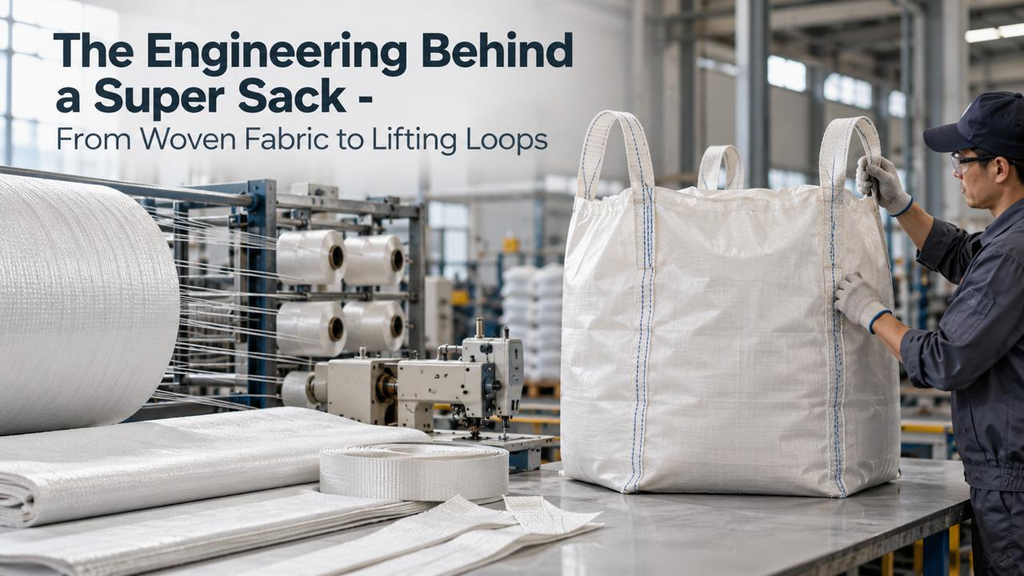
A super sack is an engineered flexible intermediate bulk container (FIBC) designed to store, lift and transport bulk materials. Its performance depends on the interaction of woven polypropylene fabric, reinforced seams, lifting loops and protective liners. Each component contributes to the container’s structural integrity and suitability for its intended contents.
Cegy Plastics manufactures four-loop bulk bags in 10th of Ramadan City, Egypt, with standard load capacities ranging from 100 to 2500 kg. The company’s in-house operations include polypropylene extrusion, weaving, coating, cutting, sewing, liner welding and laboratory testing. These processes support the development of packaging configurations for different industrial applications.
From Polypropylene Resin to Woven Fabric
The engineering process begins with polypropylene (PP), a thermoplastic polymer used extensively in industrial packaging. During extrusion, polypropylene is melted and processed into film, which is slit into narrow tapes. These tapes are stretched to orient their polymer molecules, improving tensile properties before weaving.
The resulting tape yarn is arranged into two directions:
- Warp tapes: Run lengthwise through the fabric and contribute to longitudinal strength.
- Weft tapes: Cross the warp tapes and support transverse strength and dimensional stability.
Interlacing these tapes produces a flexible textile capable of distributing mechanical forces across the bag body. The characteristics of the yarn and weave influence resistance to stretching, deformation and tearing.
Unlike rigid containers, a woven polypropylene bag changes shape as material enters it. Fabric construction must therefore accommodate both the weight of the contents and the stresses generated during filling and handling.
Why Fabric Weight and Coating Matter
Fabric weight is commonly expressed in grams per square meter (GSM). It indicates how much material is present within a defined fabric area, but it does not independently determine a bag’s safe working load.
Tape strength, weave density, stitching and lifting loop construction must also be evaluated. A heavier fabric with poorly designed seams may perform less effectively than a properly engineered structure using lighter material.
Coating provides another design option. Applying a polymer coating can reduce the movement of fine particles through the weave and improve resistance to moisture penetration.
However, coating alone does not make a bag completely waterproof or airtight. Stitching holes, filling openings and discharge closures can remain potential pathways for moisture or product leakage.
Some applications also require breathable packaging. In those cases, ventilated fabric may be more suitable than a tightly coated construction.
How Do Four Lifting Loops Distribute Weight?
A 4 loop bulk bag transfers lifting forces from its four upper lifting devices into the surrounding fabric and structural seams. When properly connected to suitable lifting equipment, these loops allow the filled container to be suspended and moved.
Although four loops are present, the load is not necessarily distributed equally between them.
Actual tension depends on several variables:
- The length and positioning of each lifting loop.
- The angle between the loops and lifting equipment.
- The location of the filled bag’s center of gravity.
- Deformation of the bag during lifting.
- The construction of the loop attachment seams.
Unequal lifting angles or an off-center load may concentrate stress on individual attachment points. Consequently, the strength of one loop cannot establish the lifting performance of the complete container.
Reinforcement and stitching patterns help transfer force into the woven structure. Poorly constructed connections can become failure points even when the surrounding fabric remains intact.
Operators must follow the bag’s handling instructions, avoid sudden movements and never stand beneath suspended loads.
Understanding the 5:1 and 6:1 Safety Factors
An FIBC safety factor expresses the relationship between the safe working load (SWL) and the final test load achieved under a specified cyclic top-lift testing procedure. It is not an allowance to overload the bag during normal operation.
For example, consider a hypothetical FIBC with an SWL of 1000 kg. A 5:1 classification requires a corresponding test performance ratio of at least five to one. The permitted working load remains 1000 kg, not 5000 kg.
Cegy Plastics’ four-loop range includes two common configurations:
- 5:1 single-use: Intended for one filling and discharge cycle.
- 6:1 multiple-use: Designed for a limited number of repeated filling and discharge operations under appropriate conditions.
Multiple-use does not mean unlimited reuse. Containers must be inspected, and damaged fabric, weakened seams or compromised lifting loops can make further use unsafe.
What Does EN ISO 21898 Require?
EN ISO 21898 establishes requirements for the design, construction, performance testing and marking of FIBCs intended for non-dangerous goods.
Two important elements of its testing framework are:
- Cyclic top-lift testing: Assesses lifting devices and the complete container through controlled loading procedures. The bag must satisfy requirements concerning structural integrity and retention of contents.
- Compression and stacking testing: Evaluates whether a filled container withstands specified compressive loading without unacceptable deterioration or loss of contents.
The standard also addresses material characteristics, ultraviolet resistance and identification requirements. Appropriate markings communicate information such as working load, safety factor and permitted stacking configuration.
Cegy Plastics manufactures its four-loop bags according to EN ISO 21898:2005 for single-use and multiple-use configurations. EN ISO 21898:2024 is a newer edition, so buyers should establish the applicable edition and verify supporting documentation for their specific requirements.
Dangerous goods packaging involves additional transport regulations and approval requirements. The company also offers bags manufactured according to UN recommendations, but suitability must be confirmed for the particular substance and transport conditions.
Barrier Liners and Product Protection
The outer woven structure primarily provides mechanical strength. For products sensitive to moisture, oxygen or contamination, an internal liner may provide the necessary additional barrier.
The company uses LDPE, HDPE, MDPE, PA, aluminum and EVOH barrier materials depending on the characteristics of the contents.
- LDPE: Provides flexibility and useful moisture resistance.
- HDPE: Offers greater stiffness and moisture-barrier properties.
- MDPE: Balances polyethylene flexibility and stiffness.
- PA: Can improve mechanical toughness and puncture resistance.
- Aluminum: Can provide strong protection against moisture, gases and light when incorporated into a suitable barrier structure.
- EVOH: Provides effective oxygen-barrier performance when protected against excessive moisture exposure.
The performance of a liner depends on film thickness, layer arrangement, weld quality and closure integrity. Selecting a barrier material without considering these factors can leave the contents inadequately protected.
Liner welding operations form part of the company’s manufacturing process, allowing internal protection to be considered alongside filling and discharge arrangements.
Electrostatic Protection in Bulk Packaging
Moving dry powders can generate electrostatic charges through contact and separation between particles and packaging surfaces. In combustible dust or flammable atmospheres, an uncontrolled discharge may become an ignition source.
Electrostatic protection requires selecting the correct FIBC classification for the operating environment.
Type C bags incorporate conductive components and must be grounded during filling and discharge. Type D bags use static-dissipative technology and are designed for operation without grounding, subject to their specified conditions of use.
The liner must also be compatible with the electrostatic properties of the outer bag. An unsuitable insulating liner can change the behavior of the assembled packaging system.
IEC 61340-4-4 provides a relevant framework for classifying and evaluating electrostatic protective FIBCs. Protection should be assessed at the complete bag level rather than inferred from an individual material.
Manufacturing Control and Laboratory Evaluation
Consistent performance depends on controlling the connections between production stages. Tape extrusion establishes yarn characteristics, weaving creates the structural fabric, coating modifies surface properties, and cutting determines component dimensions.
Sewing establishes the load-bearing connections between panels and lifting devices. Liner welding addresses the integrity of protective internal packaging.
The company’s factory combines these manufacturing processes with laboratory testing. Material evaluation helps assess individual components, while finished-bag performance testing is necessary to verify the assembled design against applicable requirements.
A strong fabric test result cannot compensate for an inadequate lifting loop attachment. Similarly, a correctly constructed outer bag does not guarantee the protective performance of an unsuitable liner.
Choosing the Right Super Sack Configuration
Technical selection should begin with the product’s properties and the conditions under which the filled bag will be handled.
A practical specification should identify:
- Working load: Maximum filled weight and required safety factor.
- Material properties: Bulk density, particle size and flow behavior.
- Lifting arrangement: Equipment compatibility and loop configuration.
- Environmental exposure: Moisture sensitivity, oxygen protection and storage conditions.
- Safety requirements: Electrostatic classification and any dangerous-goods obligations.
- Verification: Applicable standards, product markings and supporting test documentation.
A super sack bulk bag intended for dry mineral products may need different closures and liners from one carrying moisture-sensitive chemical powders, even when both have identical working loads.
Cegy Plastics’ manufacturing approach connects woven fabric construction, lifting system design and barrier selection with the requirements of the intended application. The objective is a complete FIBC configuration whose mechanical strength, protective properties and handling characteristics are appropriate for its declared operating conditions.
