

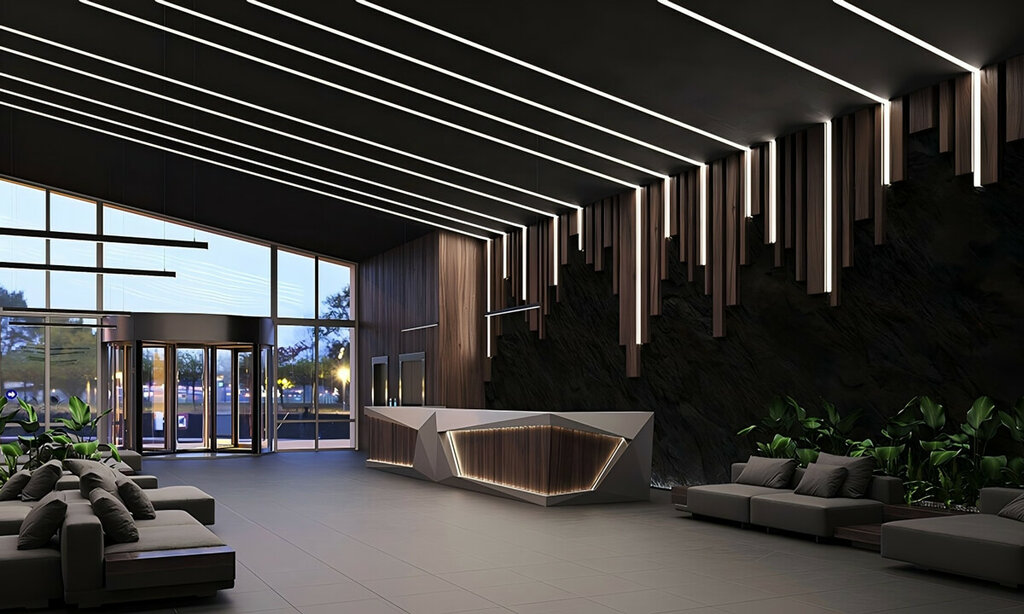
In contemporary architecture, light is no longer treated as a supplementary layer added after a building’s completion. Instead, it has evolved into a fundamental structural component—a “fourth dimension” that defines boundaries, emphasizes textures, and directs human movement. The rise of linear LED technology has been the primary catalyst for this shift, moving away from centralized, bulky fixtures toward integrated, invisible sources of glow.
The application logic of LED strip lighting in architectural applications is rooted in the principle of “light, not luminaires.” The goal is to perceive the effect of illumination without seeing the hardware. For architects seeking to master this integration, partnering with a specialized manufacturer like SignliteLED Lighting ensures that the technical execution matches the creative vision. This partnership allows the “invisible” infrastructure to support the most daring aesthetic ambitions.
Defining Spatial Boundaries: The Logic of Perimeter Lighting
Grazing and Washing Techniques
The primary logic for using strip lighting in architecture is to interact with surfaces. In the past, achieving a uniform wash on a vertical surface required massive fluorescent troffers. Today, linear strips allow for two distinct psychological effects:
l Wall Grazing: By placing a high-output LED strip extremely close to a textured surface (like split-face stone, reclaimed wood, or board-formed concrete), the light catches the peaks and valleys. This technique emphasizes the “tactile” quality of the building. The grazing logic requires a very narrow beam angle to prevent light from spilling into the center of the room.
l Wall Washing: Positioning the strip further away (typically at a distance 1/4th of the wall height) provides a uniform distribution of light. This eliminates shadows and makes a space feel expansive, sterile, and airy.
The Mathematics of the Cove
Architectural coves (indirect lighting) require a specific “Cut-off” logic. A common mistake in cove design is placing the strip too deep, which creates a “hot spot” on the back wall and a dark “shadow gap” on the ceiling. The engineering logic dictates that the light source should be angled or equipped with asymmetric optics to push the luminous flux toward the center of the ceiling. This creates a soft, expansive glow that mimics the diffused light of a cloudy sky, reducing ocular fatigue for occupants.
The Visual Hierarchy: Directing the Human Eye and Wayfinding
Architecture is a narrative of movement. Strategic placement of linear lighting serves as a “visual shorthand,” guiding occupants through a space without the need for intrusive signage.
Wayfinding and Orientation
Recessed linear strips in floors or corridors do more than prevent trips; they provide a sense of direction. This is particularly critical in large-scale infrastructure like airports, transit hubs, or sprawling hospitals. The logic here is “Continuity.” Any break in the light ribbon disrupts the architectural flow. This is where engineering becomes paramount—manufacturers must ensure that the voltage drop is managed so that the first meter and the hundredth meter of a corridor display identical brightness and color temperature.
Emphasis and Focal Points: The Floating Effect
By outlining architectural “anomalies”—such as a floating staircase, a cantilevered overhang, or a reception desk—strip lighting clarifies the building’s geometry at night. The logic is to provide a “Weightless” aesthetic. By illuminating the “toe-kick” area of a structure, the shadow is erased, making heavy concrete or steel structures appear as if they are levitating on a cushion of light.
Mastering Materiality: The Reflection Physics
One of the most complex aspects of architectural strip lighting is the interaction with reflective materials. As modern interiors increasingly use polished marble, metallic finishes, and glass, the “pixelation” or “dotting” effect of LEDs becomes a major architectural failure.
The Science of Diffusion
When an LED strip is reflected in a polished black granite floor, every individual diode becomes a point of glare. To solve this, the architectural logic has shifted toward COB (Chip-on-Board) technology. By providing a continuous phosphor coating over hundreds of tiny chips, COB strips create a seamless line of light even when viewed directly in a mirror-like surface.
Color Rendering and the TM-30-15 Standard
Architects often select materials based on their specific color under natural light. To maintain this integrity at night, the strip lighting must have high color fidelity. We no longer rely solely on CRI (Color Rendering Index). Instead, we look at the Rf (Fidelity) and Rg (Gamut) values. A project-oriented approach ensures that the “reds” in a mahogany wood panel or the “golds” in a brass fixture are rendered with absolute accuracy, preventing the space from looking “flat” or “gray.”
Technical Resilience: Engineering for Permanency
In many architectural applications, the LED strip is “built-in”—embedded behind stone, inside handrails, or within structural coves. This means that replacement is not just difficult; it is a construction event. Therefore, the logic of selection must prioritize System Longevity and Thermal Resilience.
Managing the Thermal Envelope
An LED strip embedded in a wooden acoustic panel has very different thermal requirements than one mounted in an open aluminum channel. Wood is an insulator; it traps heat. If the strip’s PCB is not engineered with sufficient copper weight (3oz or 4oz), the junction temperature will skyrocket, leading to color shift and premature failure. Designers must specify high-performance LED strip solutions that are specifically tested for restricted-airflow environments. These solutions utilize advanced substrates that facilitate lateral heat transfer, ensuring the light remains stable for the intended 50,000+ hour lifespan.
Voltage Drop and Long-Run Logic
For architectural projects like hotel facades or stadium perimeters, runs can span hundreds of meters. Standard 24V strips suffer from voltage drop, leading to a “pinkish” or “dim” hue at the end of the run. The architectural logic here demands Constant Current (CC) IC technology, which maintains a steady current flow regardless of the distance from the power supply, ensuring a perfectly uniform “ribbon” of light.
Human-Centric Lighting: The Biological and Psychological Logic
Modern architecture is increasingly focused on the well-being of its occupants. The logic of “Circadian Lighting” is now being integrated into linear systems to align the indoor environment with the human biological clock.
Tunable White Dynamics
In high-end residential and premium office projects, architectural strips are no longer fixed at a single color temperature.
l The Circadian Cycle: Linear systems can be programmed to provide cool, blue-enriched light (5000K-6500K) during the morning to suppress melatonin and boost productivity. As the day progresses, the system transitions to a warm, amber glow (2200K-2700K) to trigger the body’s natural wind-down process.
l The Dim-to-Warm Logic: Mimicking the behavior of incandescent bulbs, this technology warms the color temperature as it dims, creating an intimate atmosphere in restaurants and hotel suites.
Regulatory Compliance and Sustainable Architecture
With the global push toward “Green Buildings,” the lighting must contribute to LEED, BREEAM, or WELL certifications.
Luminous Efficacy (lm/W)
Architects are often limited by “Power Density” regulations—laws that limit the total wattage allowed per square foot. High-efficacy LED strips (achieving 150-180 lumens per watt) allow designers to achieve their desired brightness while using a fraction of the energy. This efficiency is a result of precision engineering in the LED chip binning and the circuit design.
Light Pollution Control
In exterior architectural applications, “Dark Sky” compliance is a critical logic. Linear strips must be shielded or equipped with precise optics to ensure that light is directed only onto the building facade and not spilled into the atmosphere. This preserves the night sky and protects local nocturnal ecosystems.
Conclusion: The Invisible Infrastructure of Excellence
In the final analysis, LED strip lighting is the invisible infrastructure of modern architecture. It is the tool that allows architects to sculpt with shadow and paint with brilliance. The logic of its application is a delicate balance of art, physics, and engineering.
To achieve a result where the light feels like a natural extension of the building’s soul, one must move beyond the product catalog and embrace a partnership based on technical excellence. By integrating high-quality linear systems into the very bones of the structure, we create spaces that are not just seen, but felt. The future of architecture is not just in the walls we build, but in the light that brings those walls to life. Selecting the right components ensures that this vision remains vibrant for years to come, turning static structures into living, breathing environments.
