

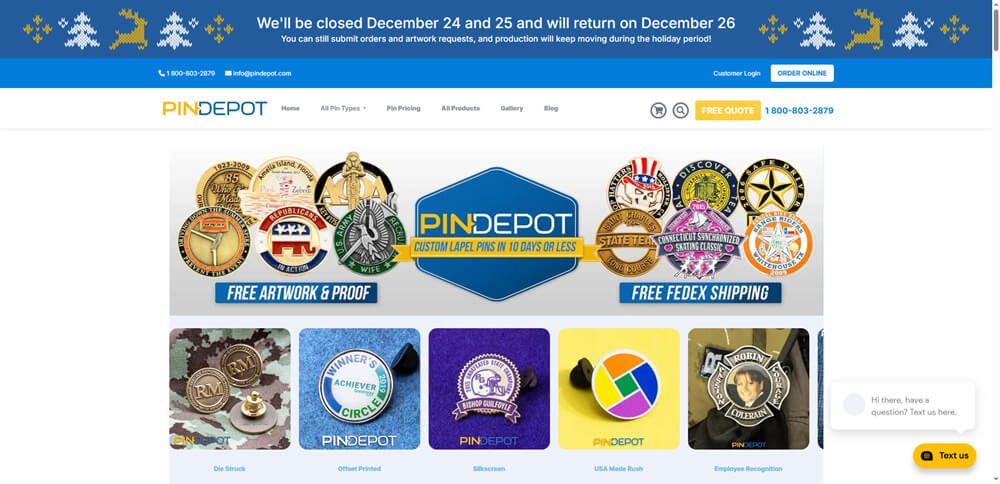
Organizations across the United States spend considerable time selecting recognition items that carry real meaning — not just aesthetic appeal. Whether the context is a nonprofit honoring years of service, a school district celebrating student achievement, or a corporation marking a milestone event, the physical item chosen to represent that moment carries organizational weight. It becomes part of how an institution communicates its values, internally and externally.
Custom lapel pins have served this function for well over a century. What has changed is the precision and depth of manufacturing now available, particularly in three-dimensional form. A three-dimensional pin is not simply a decorative upgrade — it represents a different approach to how an organization’s symbol, seal, or message is rendered in metal. For buyers making purchasing decisions on behalf of institutions, understanding what this distinction means in practice is more useful than any general overview of pin styles.
This guide addresses the practical concerns that nonprofits, school administrators, and corporate procurement teams most commonly face when sourcing custom pins: what differentiates production methods, how to evaluate quality before committing to an order, what organizational context should drive design decisions, and how to avoid the most common sourcing mistakes.
What Makes a 3D Lapel Pin Different from Standard Enamel Designs
A custom 3d lapel pin is produced through a die-casting or stamping process that creates genuine depth across the face of the pin. Rather than a flat surface with color fills, a three-dimensional pin has raised and recessed elements that form a sculptural composition. This is not a visual effect achieved through shading or printing — it is the physical structure of the metal itself, shaped to reflect the design in three actual dimensions.
For organizations referencing this distinction during the sourcing process, a reliable Custom 3d Lapel Pin guide will clarify that the method of production determines both the appearance and the durability of the finished piece. Enamel pins — whether soft or hard — work well for logos and designs that rely heavily on flat color blocking. Three-dimensional pins are better suited to designs with significant structural detail: crests with layered elements, mascots with expressive form, or seals with text and imagery that need to coexist without visual crowding.
Die Casting vs. Die Striking: Understanding the Process Behind the Product
Die casting involves injecting molten metal into a precision mold under pressure, which allows the manufacturer to capture fine detail in a three-dimensional form. The result is a pin with a more sculptural, jewelry-like quality. Die striking, by contrast, uses force to press a flat metal blank into a shaped die, which produces a two-dimensional or low-relief outcome. The distinction matters because buyers sometimes receive die-struck pins when they have specified three-dimensional ones — and the difference is immediately visible when the finished product arrives.
Understanding which process your vendor is using is not a minor technical question. It directly affects whether the pin will accurately represent a complex organizational symbol, particularly one with multiple layered elements or fine text. Organizations that use a formal seal or crest — common in universities, civic associations, and established corporations — will generally find that die casting is the only method capable of faithfully representing those designs at pin scale.
Metal Finish and Its Role in Perceived Quality
The finish applied to a three-dimensional pin determines how the depth reads visually. A polished gold or silver finish on a die-cast pin catches light differently across raised and recessed surfaces, which is what creates the sense of dimension when worn or displayed. An antiqued finish, where dark pigment is worked into the recesses and then buffed from the raised areas, produces a different effect — one that suits historical or heritage-focused designs particularly well.
For nonprofits and schools selecting donor recognition pins or alumni awards, the finish choice should align with the formality of the occasion. A polished high-relief pin reads as current and contemporary. An antiqued bronze finish reads as institutional and enduring. Neither is inherently superior — the decision depends on what the organization is trying to communicate through the object itself.
How Nonprofits Should Approach Custom Pin Procurement
Nonprofit organizations typically operate under tighter procurement constraints than corporate buyers, which means that sourcing errors carry a proportionally higher cost. When a corporate team reorders pins incorrectly, the financial impact is absorbed. When a nonprofit does the same, the error may affect a fundraising campaign, a donor recognition event, or an annual gala where the pins were meant to be the centerpiece of the acknowledgment program.
The most reliable way to avoid this is to treat the pin as a formal procurement item rather than a promotional product. That means establishing written specifications before contacting vendors, requesting physical samples before approving a full order, and building adequate lead time into the event planning timeline.
Donor Recognition and the Risk of Inconsistency Across Annual Orders
Many nonprofits produce donor recognition pins on an annual cycle. A founding member pin from five years ago should ideally match — or intentionally contrast — with the pin issued this year. When organizations change vendors between cycles without maintaining detailed production records, the result is a set of recognition items that look inconsistent when worn side by side. This matters at formal events where long-term donors may wear multiple years of pins simultaneously.
Maintaining a specification document that records the exact metal type, finish, plating color, attachment style, and dimensional details of each annual pin is a straightforward practice that prevents this problem. It also gives new procurement staff clear guidance when the institutional memory of previous orders has left with a former team member.
Budget Realities and Order Minimums
Three-dimensional pins generally carry higher per-unit costs than flat enamel versions due to the complexity of the tooling and production process. However, because the tooling cost is a fixed setup expense, the per-unit cost decreases significantly as order volume increases. Nonprofits with smaller recognition programs should consider whether a three-dimensional pin is the right format given their volume, or whether a well-executed hard enamel pin might serve the same purpose at a lower cost per unit.
For organizations that do have sufficient volume, the investment in three-dimensional tooling is generally worthwhile if the same pin design will be reused across multiple production runs. The tooling pays for itself over time.
School and University Applications: Recognizing Achievement with Appropriate Formality
Educational institutions have used lapel pins as recognition items for academic achievement, athletic accomplishment, club membership, and graduation milestones for generations. The tradition is well-established, and the expectations that come with it are real. Students, parents, and faculty understand the difference between a pin that feels like a meaningful award and one that feels like a mass-produced token.
The durability standards associated with lapel pins — particularly those used in academic contexts — are relevant here. As noted in the ISO standards for metal surface coatings, coating thickness and adhesion quality have a direct relationship to how well a finish holds up over time. For schools issuing pins that students are expected to wear for years or display permanently, these specifications matter.
School Seals and the Challenge of Reproducing Fine Detail
School and university seals often contain a significant amount of detail in a small area: text in circular arrangements, imagery, Latin mottos, and layered symbolic elements. Reproducing this faithfully at pin scale requires a manufacturer with experience in high-detail die casting and access to the right resolution in the tooling process. Organizations that submit a digital file without discussing the detail limitations of pin manufacturing with the vendor often receive a finished product where fine text has blurred into illegibility or small design elements have merged together.
The solution is to work with the manufacturer’s design team before finalizing artwork, specifically to identify which elements will translate to three-dimensional form and which need to be simplified or scaled. This is not a failure of the original seal — it is a practical adjustment for a different medium.
Attachment Styles and Practical Wear Considerations
Schools issuing pins to younger students need to consider attachment type carefully. Butterfly clutch attachments are standard and work well for most adult wearers, but they are easy for children to lose. Magnetic backs and screw-post attachments offer more security. Specifying the right attachment for the intended wearer is a small decision with a meaningful impact on how the pin functions in practice.
Corporate Procurement: Consistency, Branding, and Vendor Accountability
Corporate procurement of custom pins tends to involve higher volumes, stricter brand compliance requirements, and more formal approval processes. The risks in this context are different from those facing nonprofits or schools: the primary concern is brand consistency, followed by on-time delivery and vendor accountability.
A corporation issuing pins for an employee recognition program, a trade show, or a corporate anniversary needs every unit in the order to match the approved design exactly. Color variation across a batch, inconsistent plating quality, or a misaligned logo position are visible problems that reflect on the brand. Selecting a vendor with documented quality control processes — including batch inspection and pre-shipment sample approval — is the most reliable way to manage this risk.
Managing Multi-Year Programs with a Single Vendor
Corporate recognition programs that issue service milestone pins — one year, five years, ten years, and so on — require consistent production quality across multiple ordering cycles. A five-year pin issued this year should match in weight, finish, and plating quality to the one issued five years ago. This is only achievable if the same vendor retains the original tooling and production specifications between orders.
Before committing to a vendor for a multi-year program, procurement teams should confirm the vendor’s policy on tooling retention and their ability to reproduce historical orders accurately. These are reasonable questions, and a vendor with genuine experience in corporate recognition programs will have clear answers.
Lead Times and Supply Chain Planning
Custom three-dimensional pins are manufactured to order. Standard production timelines from approval to delivery range from several weeks to over a month depending on order complexity, finishing requirements, and the vendor’s current workload. Corporate procurement teams that assume pins can be ordered two weeks before a recognition event consistently create problems for themselves and the vendor. Building accurate lead times into event planning is the simplest available safeguard.
Evaluating Vendors Before Placing an Order
The vendor selection process for custom lapel pins is more consequential than it appears. Because the final product cannot be inspected until after production, the decision to place an order is also a decision to trust the vendor’s capabilities and quality standards. Verifying those capabilities before ordering is the most effective risk management available to buyers in any sector.
Requesting physical samples of comparable work — not digital renderings — is the single most useful step a buyer can take. A vendor confident in their production quality will have samples readily available. Reviewing those samples for finish consistency, detail resolution, and attachment quality gives the buyer direct evidence of what their own order is likely to look like.
Beyond samples, buyers should ask vendors directly about their process for handling revisions, their policy on defective units, and who is responsible for final design approval before production begins. These questions reveal how the vendor manages accountability, which is as important as their manufacturing capability.
Closing Considerations for Institutional Buyers
Custom lapel pins occupy a specific place in organizational culture. They are small enough to be practical and formal enough to carry meaning. When produced correctly, a three-dimensional pin communicates care, permanence, and attention to detail — qualities that matter to the people who receive them, whether they are donors, students, or employees who have spent years with an organization.
The decisions that determine whether a pin achieves that effect are made early in the process: choosing the right production method, working with a vendor who can faithfully reproduce complex design elements, specifying the right finish and attachment for the intended use, and building adequate time into the sourcing process. None of these steps are complicated, but each one requires deliberate attention rather than assumption.
For nonprofits, schools, and corporations operating across different budgetary and logistical contexts, the common thread is that sourcing a custom 3d lapel pin is a procurement decision, not a promotional one. It deserves the same structured approach applied to any other purchase made on behalf of an institution. Organizations that treat it that way consistently produce better outcomes — and recognize the right people in the right way.
