

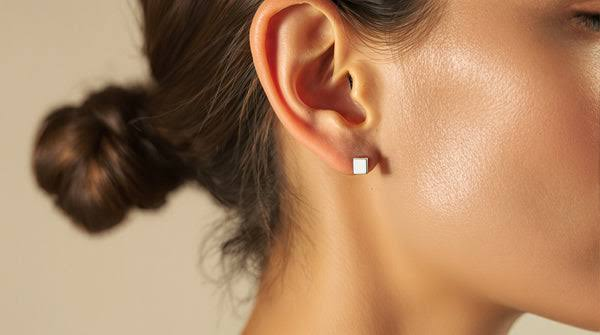
Piercing redness and irritation are generally considered as the norm of the healing process. In most cases, that is indeed the case. However, many times, the cause of irritation is the metal used, and no matter what kind of aftercare treatment will not help.
Body jewelry comes into direct contact with tissues that are still unhealed. Such a piece of metal is not inert. One of the metals that might get released during the process of wear is nickel. By the way, nickel is one of the most common causes of contact dermatitis.
This is what makes titanium different from steel that is used in most jewelry. These are the five things that should be checked before purchase.
Why metal choice matters more than most people think
.A newly pierced hole is an open wound in which a foreign object heals. And this means two things.
Barrier properties of the skin are lost. Pathway to cells responding to metals from their surfaces is considerably shortened.
There is constant contact. Contact with jewelry for the period of time equal to several hours is one thing. The contact of jewelry with the healing piercing for several weeks is another thing.
Nickel is a primary allergen. It is one of the basic alloys added to steel used for making jewelry, and the reaction to nickel stays the same even after repeated exposures.
It is important to differentiate between two conditions. Healing piercing is a highly responsive condition, so the material itself matters. Healed piercing is more tolerant, yet a sensitized person can have a reaction even to jewelry worn for years.
“Surgical steel” is a marketing term, not a standard
This is the most useful phrase to understand before buying body jewelry, because it means less than it sounds like it means.
There is no standard that defines it. It is a commercial term, and the steels sold under it are almost always 316L or 316LVM.
Those are good materials. They go into medical instruments because they resist corrosion and survive sterilization. Corrosion resistance and low allergenic potential are different things, though. 316L typically contains 10 to 14 percent nickel, because that is what makes the alloy austenitic and workable, and a small amount of it can come off at the surface.
So why do some people wear steel for decades while others react within a week? Sensitivity varies from person to person, and it runs higher among people first pierced with jewelry of unknown composition. Surface condition matters too, since a well polished and properly passivated surface releases less than a scratched one. Then there is whatever else sits in the alloy, including trace elements that rarely show up on a product page.
The practical point is that you should not judge jewelry by the word on the label. Judge it by the standard number behind the label.
If you want a metal defined by a published specification rather than a marketing phrase, look for ASTM F136 titanium and ask the seller for the report that backs the claim. A useful certificate names the standard, the issuing laboratory, the date, and the sample tested. It also lists what was tested for, usually nickel release, lead and cadmium, and gives results against stated limits.
What implant-grade titanium actually means
Titanium turns up on listings as titanium, G23 titanium, Ti6Al4V, implant-grade titanium, and ASTM F136. Those are not all saying the same thing.
ASTM F136 is a specification from ASTM International covering wrought Ti-6Al-4V ELI, where ELI means extra low interstitial, for surgical implant applications. It limits both chemical composition and mechanical properties. Titanium used for bone plates and joint replacements falls under specifications in this family.
The naming works like this:
- Grade 23, or G23, is the alloy grade designation for Ti-6Al-4V ELI.
- ASTM F136 is the specification covering that alloy in implant form.
- ASTM F1472 covers standard Ti-6Al-4V and sets different limits.
So G23 and F136 point at the same base alloy, but only F136 tells you the material was made and tested against an implant specification. That is the distinction worth checking. Two others you may run into are ISO 5832-3, the ISO equivalent, and ASTM F1295, a nickel free implant alloy that swaps niobium in for vanadium.
For sensitive skin, the relevant points are:
- Nickel is not an alloying element in F136 titanium. The alloy is aluminum and vanadium, with interstitial elements capped tightly.
- Titanium forms a dense surface oxide almost immediately, and that layer self-heals. It is why titanium resists corrosion, and why it does not tarnish or leave the green and black marks you get from copper containing alloys.
- It is roughly 45 percent lighter than steel by volume, so there is less mechanical drag on a healing piercing.
- Gold and other colors are usually applied by PVD over the titanium base. When the coating wears, what shows through is still titanium.
The trade-offs are real. Titanium costs more, and the range of decorative designs is narrower than for steel or brass.
How to read a material test report
A correct standard number is only as good as the paperwork behind it. Most sellers can produce test reports on request. Plenty of buyers never ask.
When a report shows up, check seven fields.
- Report number, so you can reference the document later.
- Issuing laboratory. An independent third party carries more weight than an in-house sheet.
- Issue date. Reports age, and one from four years ago says nothing about a batch made last month.
- Sample description. This is the field people skip, and it is the one that matters most.
- Test methods, so you know how the result was produced.
- Limits applied, meaning which regulation or standard the result was measured against.
- Results, ideally with measured values rather than a bare pass or fail.
The items typically covered are nickel release, restricted under EU REACH for articles inserted into pierced parts of the body with the limit measured in micrograms per square centimeter per week, plus lead and cadmium, often screened against California Proposition 65 for the US market, and REACH SVHC screening against the candidate list of substances of very high concern.
One thing catches people out. A passing result covers the sample that was submitted, not every SKU, not every color variant, and not every future production run. A report on a plain polished labret tells you nothing about a PVD coated ring from a different batch. If the jewelry is going into a healing piercing, ask for documentation that matches the item and the batch you are buying.
Size matters as much as material
Material gets most of the attention, and sizing causes just as much trouble. Too short puts pressure on healing tissue. Too long migrates and snags. A diameter that is slightly too small rubs constantly.
Thickness is usually given on the American Wire Gauge scale, where smaller numbers mean thicker jewelry. The millimeter equivalents that come up most often:
| Gauge | Metric | Typical use |
| 22g | 0.6 mm | Smallest sizes, nose rings and studs |
| 20g | 0.8 mm | Standard for nostril studs |
| 18g | 1.0 mm | Eyebrow, lip, tragus, some helix |
| 16g | 1.2 mm | Eyebrow, septum, tragus, helix |
| 14g | 1.6 mm | Navel, nipple, industrial, some septum |
| 12g | 2.0 mm | Above 2 mm is large gauge, used for stretched piercings |
What you measure depends on the shape.
- Labrets: post thickness, the length between the attachment point and the base plate, plus base plate diameter and thickness.
- Straight barbells: post thickness at the center, and the length between the two ends.
- Segment rings: thickness around the circumference, avoiding the hinge, plus the inside diameter rather than the outside.
- Circular barbells: thickness and inside diameter.
Mixing up inside and outside diameter is the most common ordering mistake there is. If you want a reference for where each dimension is taken, a titanium body jewelry size chart shows the measurement points and how the gauge scale maps to millimeters.
At home, a basic digital caliper is cheap and accurate enough for jewelry. Zero it before each use.
Five things to check before you buy
- Look for the standard number, not just the metal name. “Titanium” on its own says nothing about grade. “ASTM F136” tells you which specification is being claimed.
- Ask for the report and read the sample description. Check that it covers what you are actually buying, and check the date.
- Confirm the connection system. Threadless push-in and internally threaded designs avoid running external threads through the piercing channel, which is worth avoiding on a fresh piercing.
- Confirm the actual dimensions. Standard size is not a size. Get gauge, length or diameter, and end size in millimeters.
- Look at the surface. A high polish finish is easier to keep clean and leaves less room for debris.
FAQ
Is titanium actually hypoallergenic?
No metal is completely non-allergenic for every person. Titanium is very well tolerated, and nickel is not part of the F136 alloy, which is why it is the usual recommendation for sensitive skin and fresh piercings. Documented titanium sensitivity exists but is rare.
Does titanium tarnish or turn skin green?
Titanium does not tarnish the way silver does, and it does not produce the green discoloration associated with copper containing alloys. If skin turns green, the copper is usually in the alloy rather than in titanium.
Is PVD gold-plated titanium still safe for sensitive skin?
The coating sits on a titanium base, so worn areas expose titanium instead of an undisclosed alloy. Application quality varies between manufacturers, so buy from a seller who can document the base material.
I am already reacting to my jewelry. What should I do?
Do not remove jewelry from an unhealed piercing on your own, because the channel can close and trap the irritation. Have a professional piercer assess it and change it to a documented implant-grade piece if needed. Persistent or worsening symptoms belong with a clinician.
What this comes down to
Material and sizing are two separate problems. Both need answering before you buy. Documented implant-grade titanium in the wrong length still causes trouble, and a perfectly measured piece made from an undisclosed alloy does too. Ask for the standard, ask for the report that matches it, and ask for the dimensions in millimeters.
About the author
[Name] works with Axis Titanium, a factory-direct supplier of ASTM F136 titanium body jewelry for professional piercing studios and retailers. He writes about material standards, sizing accuracy, and documentation practices in the body jewelry supply chain.
