


Product seeding is where a lot of influencer programs actually start – and where many of them stall. Sending product to the right creators sounds simple until you are coordinating hundreds of shipments, generating discount codes, syncing tracking numbers, and trying to tie a gifted box to an actual post and an actual sale. The gap between a tool that lists creators and a tool that operationalizes gifting at scale is enormous.
GRIN does gifting well – automated fulfillment, discount code generation, and native eCommerce connections are genuine strengths. But its $25,000-per-year minimum and 12-month contract put that capability out of reach for many brands that run seeding as a core tactic, and its commerce coverage does not extend to every platform. If product gifting is central to your strategy, these ten platforms each bring a different approach to seeding, fulfillment, and tracking. Influencer Hero leads the list, but the right fit depends on how your gifting program runs.
- Influencer Hero
- Aspire
- Modash
- Later
- SocialLadder
- Traackr
- Upfluence
- Heepsy
- CreatorIQ
- Storyclash
Why Gifting-Focused Brands Look Beyond GRIN
GRIN’s gifting capabilities are strong, but the platform’s structure creates friction for brands that want seeding to be high-volume, flexible, and affordable. Three issues come up most often:
- Enterprise Pricing for a Core Tactic: Product seeding is often a brand’s primary, always-on activity rather than an occasional campaign. Paying $25,000/year on a 12-month contract to run it is a heavy commitment, especially for growing teams that want to scale gifting before scaling spend.
- eCommerce Coverage Gaps: GRIN’s native integrations cover Shopify, WooCommerce, BigCommerce, Magento, and Salesforce Commerce, but not every platform. Brands selling through Prestashop or Amazon need gifting and attribution that reach those channels too.
- Tracking Gifted Product to Real Results: Sending product is only half the job; the other half is knowing which gifts produced posts and sales. Brands want automated tracking sync, post detection, and per-creator revenue attribution so seeding spend is measurable rather than a leap of faith.
The platforms below approach gifting from different angles – some with deep CRM-driven automation, others with marketplace fulfillment or community seeding – so the best fit depends on how your program sources creators and how you measure what gifting returns.
GRIN Overview
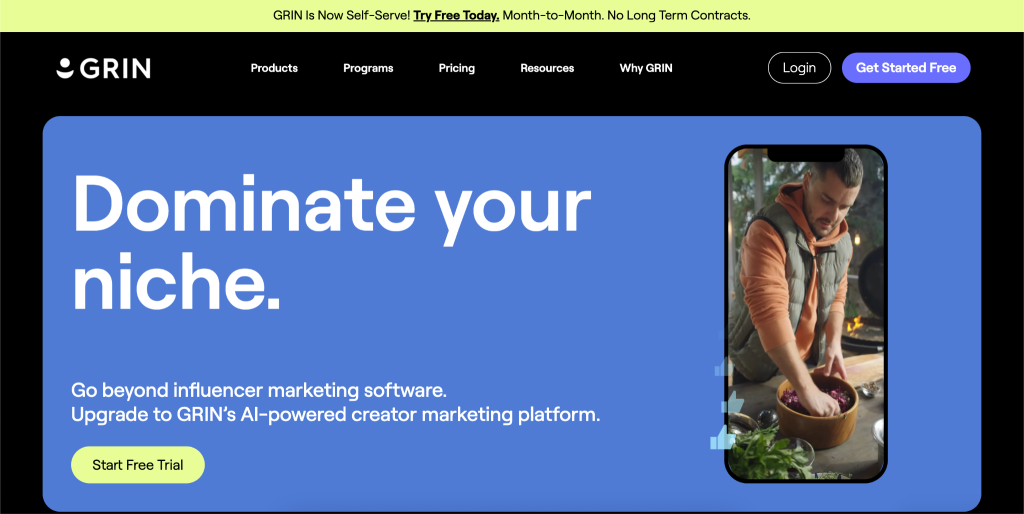
GRIN is a leading platform for large-scale eCommerce influencer programs, and gifting is one of its strongest areas. Native eCommerce integrations across Shopify, WooCommerce, BigCommerce, Magento, and Salesforce Commerce power automated gifting, discount code generation, shipping, and sales tracking, while a unified workflow consolidates discovery, outreach, contracts, content collection, and analytics in one dashboard. Media rights are auto-granted when creators are booked, and an auto-collected UGC library captures the content gifting produces.
The platform manages campaigns across 100,000+ creators and is trusted by 1,500+ brands and agencies, with a 4.5/5.0 rating on G2. Real-time ROI dashboards tie gifted product to clicks, conversions, and revenue, and the combination of affiliate tracking with social listening is rare in the market.
The constraints are about cost and reach rather than capability: $25,000/year with a 12-month contract is a significant commitment for a seeding-led program, and the native commerce coverage does not extend to Prestashop or Amazon. The alternatives below deliver gifting and seeding workflows across a range of price points and platform integrations.
Best GRIN Alternatives for Product Gifting and Creator Seeding
1. Influencer Hero

Influencer Hero treats gifting as a CRM-native workflow rather than a separate module, which is what makes it scale. Product gifting runs directly from the CRM through a Shopify integration that creates $0 orders, so you can send product to a single creator or, using CRM filters, bulk-send to hundreds at once. Tracking syncs back automatically, and rules-based automation can trigger a gift on a defined event – for example, generating a Shopify discount code the moment a contract is signed.
Where it pulls ahead of GRIN on seeding is breadth and measurement. Six eCommerce integrations (Shopify, WooCommerce, Magento, BigCommerce, Prestashop, and Amazon) extend gifting and attribution to platforms GRIN does not natively cover. On the back end, the UGC Content Library auto-captures tagged posts via an AI Post Detector, and reporting attributes revenue per creator – so you can see exactly which gifted boxes produced content and sales. Discovery across a 450M+ database and AI-powered outreach (43% average response rate) keep the top of the seeding funnel full.
Best for: Brands that run gifting as a core, high-volume tactic and want CRM-driven seeding, automated tracking, and revenue attribution across multiple commerce platforms.
Pricing:
- Standard: $649/month (1 seat, up to 1,000 creators, 1,000 outreach/mo)
- Pro: $1,049/month (3 seats, up to 5,000 creators, 5,000 outreach/mo)
- Business: $2,490/month (8 seats, up to 10,000 creators, 10,000 outreach/mo)
- Custom & Agency plans available with unlimited outreach
- Month-to-month billing – no annual contract required
Standout features:
- Gifting Directly From the CRM: Create $0 Shopify orders to send product from a creator’s profile, with bulk sending via CRM filters for hundreds of seeds at once.
- Automatic Tracking Sync: Shipment tracking syncs back to each creator record automatically, so nothing is managed in a spreadsheet.
- Six eCommerce Integrations: Shopify, WooCommerce, Magento, BigCommerce, Prestashop, and Amazon – broader gifting and attribution coverage than GRIN.
- Rules-Based Gifting Triggers: Auto-generate discount codes or trigger shipments on events like contract signature, removing manual steps.
- UGC Library With AI Post Detector: Auto-captures tagged content from gifted creators, with visual quality scoring and semantic search.
- Per-Creator Revenue Attribution: Reporting ties gifted product to posts and sales, making seeding spend measurable.
The platform’s depth means teams new to influencer marketing will spend some initial time configuring gifting triggers and pipeline stages, and very small brands seeding only a handful of creators may not use every capability immediately. For programs where gifting is the engine, that automation is the point.
2. Aspire
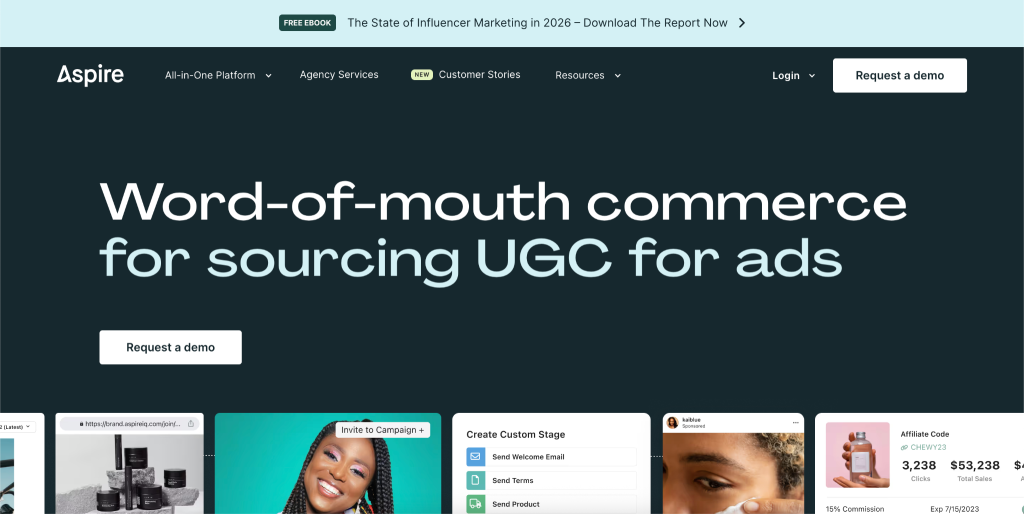
Aspire is well suited to gifting programs that run on an inbound model. Its marketplace has over a million creators actively applying to campaigns, so rather than cold-pitching gifts, you can invite applicants who already want your product. Its Shopify fulfillment integration is the standout: creators select products directly from your catalog, and Aspire coordinates fulfillment within the campaign workflow.
First-party data integrations with Meta, TikTok, and Pinterest support reliable creator vetting before you send product, and the end-to-end workflow covers contracts, content approvals, and tracking. An asset library archives the UGC that seeding generates, tied to ROI reporting.
Best for: Recognized brands that want creators to self-select gifted products through an inbound, catalog-driven fulfillment flow.
Pricing:
- Custom; mid-tier packages quoted around $2,300/month
Standout features:
- Catalog-Driven Fulfillment: Creators choose products from your Shopify catalog, with Aspire coordinating fulfillment.
- Inbound Creator Marketplace: 1M+ creators applying means gifting recipients who already want your product.
- First-Party Vetting Data: Meta, TikTok, and Pinterest integrations to vet creators before sending product.
- UGC Asset Library: Archives gifting-generated content tied to ROI reporting.
Deep fulfillment is centered on Shopify, so brands on other commerce platforms get less native coverage. Custom pricing limits transparency until a sales call, and the inbound model favors brands with existing recognition – newer companies seeding cold still need strong outbound discovery and outreach, where larger databases and AI personalization perform better.
3. Modash
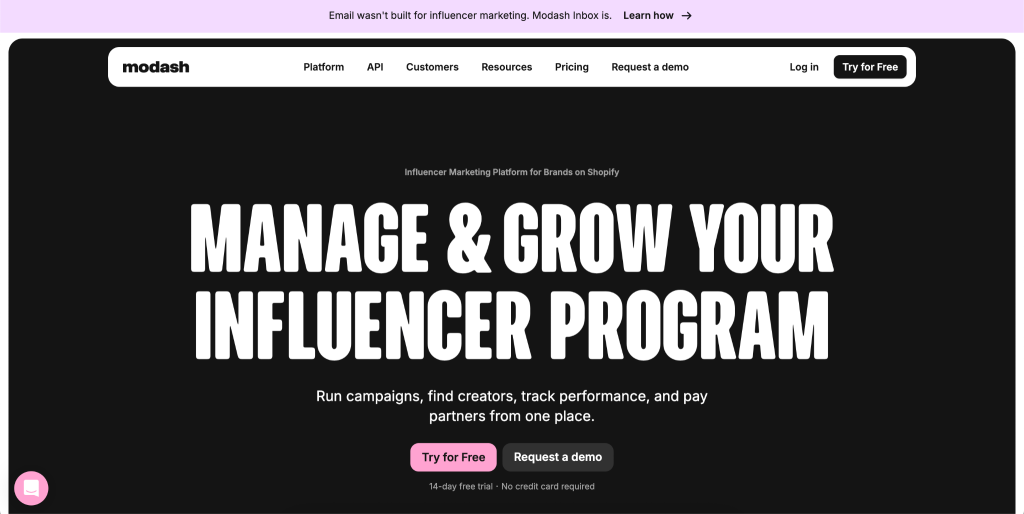
Modash pairs a 350M+ public creator database with Shopify-native gifting and affiliate workflows, making it a strong, affordable engine for seeding-led programs. From discovery, you can move creators straight into gifting with discount codes, UTM tracking, and product picks, and automated payouts handle the commission side for affiliate seeding.
The “Find Your Fans” tool is particularly useful for gifting: it scans your customer base to identify existing advocates worth seeding, who tend to convert better than cold recipients. AI visual discovery helps match product aesthetics to creator content, and built-in outreach with Gmail and Outlook sync keeps seeding communication organized.
Best for: Shopify brands that want affordable, large-scale seeding paired with deep discovery and affiliate tracking.
Pricing:
- Essentials: $199/month (annual billing)
- Performance: $499/month (annual billing)
- Enterprise: custom
Standout features:
- Shopify Gifting Workflows: Discount codes, UTMs, and product picks from discovery to seeding.
- Find Your Fans: Identify existing customers worth seeding – higher-converting gifting targets.
- 350M+ Creator Database: The second-largest indexed database for sourcing seeding candidates.
- Automated Affiliate Payouts: Commission tracking and payments for affiliate-driven seeding.
Deep integration is Shopify-only, a limitation for brands gifting through WooCommerce, Magento, BigCommerce, Prestashop, or Amazon. Non-Enterprise plans also require annual billing, and there is no native UGC rights management – so brands needing broader commerce coverage for seeding often pair Modash with additional tools or choose an all-in-one.
4. Later
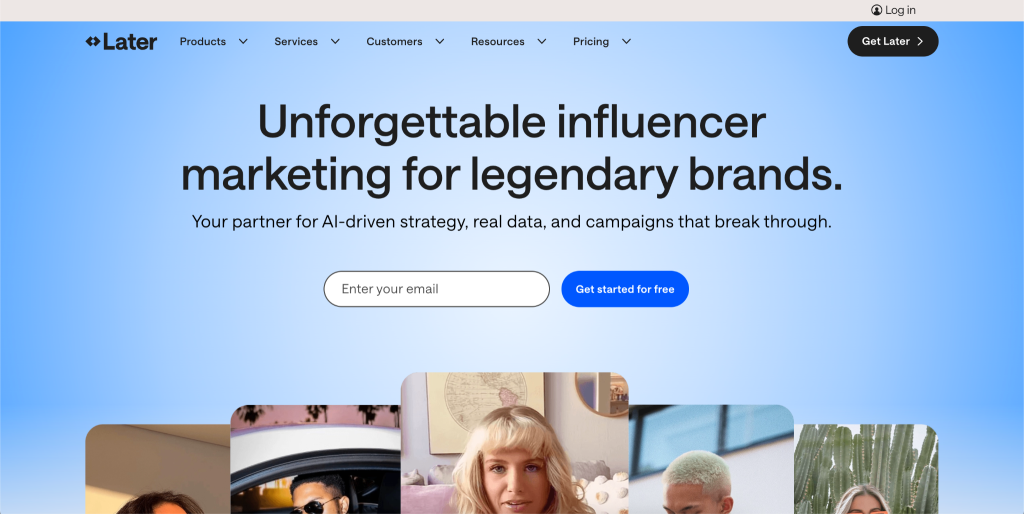
Later brings Shopify-integrated gifting with inventory management, which matters when seeding at volume can quietly drain stock. Product gifting and discount workflows connect to your catalog, and custom application pages let creators apply to be seeded through branded forms – a clean way to gather willing recipients rather than guessing.
AI-driven brand-safety tools review creator content before you commit product, 15M contactable creators come with verified emails to simplify seeding outreach, and content-planning synergy aligns the resulting posts with your scheduled brand content. The Linkin.bio and UGC library tools help repurpose seeding content across ads and storefronts.
Best for: Brands that want Shopify gifting with inventory awareness alongside social content planning.
Pricing:
- Social management: Starter $25/mo, Growth $50/mo, Scale $110/mo
- Influencer marketing plans: ~$28,500-$60,000/year
Standout features:
- Gifting With Inventory Management: Shopify gifting workflows that account for stock as you seed at volume.
- Custom Application Pages: Branded forms to gather creators who want to be seeded.
- Brand-Safety Screening: AI content review before sending product.
- UGC Repurposing Tools: Reuse seeding-generated content across ads and storefronts.
Later’s full influencer feature set, including the richer gifting workflows, lives in plans starting around $28,500/year – a steep jump from the affordable social tiers. Its 15M database is also smaller than competitors indexing 200M-450M+, which limits discovery when building a large seeding list.
5. SocialLadder

SocialLadder reframes seeding around community: instead of gifting strangers, it turns your existing customers and followers into ambassadors who receive product and rewards. eCommerce integration auto-invites new customers post-purchase, so your seeding pipeline refills itself with people who already buy from you – typically a higher-converting group than cold recipients.
Gamified challenges award points for posting, redeemable for product and rewards, which keeps a seeded ambassador base active over time. Content usage rights are agreed on join, simplifying reuse of the UGC that seeding generates, and leaderboards drive friendly competition among recipients.
Best for: Brands that want to seed product into an ambassador community built from their own customers.
Pricing:
- Typically under $2,000/month
- 6-12 month commitment recommended
Standout features:
- Customer-Based Seeding: Recruit and seed ambassadors from existing customers and followers.
- Post-Purchase Auto-Invite: eCommerce integration continuously refills the seeding pipeline.
- Gamified Rewards: Points-for-posting redeemable for product keep seeded ambassadors active.
- Built-In Content Rights: Usage rights agreed on join simplify reuse of seeding UGC.
Community-based seeding takes time to build, and content volume from ambassadors is less predictable than paid partnerships, so it is a long-game tactic. It also depends on an existing customer base, which limits its usefulness for brands trying to seed creators they have no prior relationship with.
6. Traackr
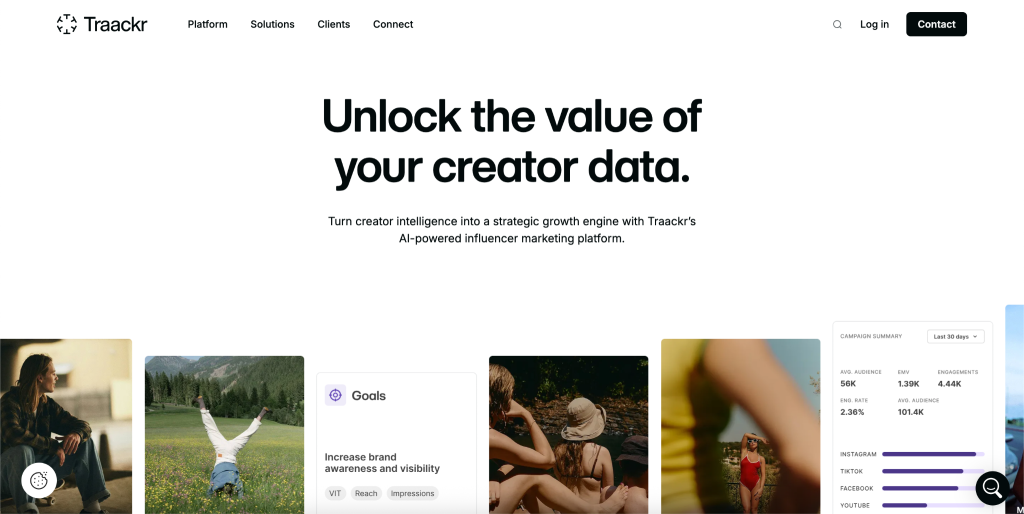
Traackr’s gifting strength is measurement. Its product-gifting workflows include delivery-to-result correlation, connecting the act of sending product directly to engagement and conversion outcomes – the missing link in many seeding programs. For teams that need to prove seeding ROI to leadership, this is the platform’s defining capability.
The proprietary Brand Vitality Score quantifies how seeding affects brand visibility and trust over time, advanced reporting (CPC, CPE, CPV, ROI) with historical benchmarking tracks performance across quarters, and exportable executive reports make the seeding business case presentation-ready.
Best for: Data-driven teams that need to measure and prove the ROI of their gifting and seeding programs.
Pricing:
- Starts at ~$32,500/year
Standout features:
- Delivery-to-Result Correlation: Connect gifted product directly to engagement and conversion outcomes.
- Brand Vitality Score: Quantify how seeding affects brand visibility and trust over time.
- Advanced Performance Reporting: CPC, CPE, CPV, and ROI with historical benchmarking.
- Exportable Executive Reports: Presentation-ready reporting to justify seeding spend.
Traackr’s $32,500/year starting price sits in enterprise territory, and it is built for measurement rather than operational gifting at scale – it tracks the results of seeding better than it executes the sending. Teams that need both deep attribution and high-volume fulfillment often pair it with an execution-focused platform.
7. Upfluence
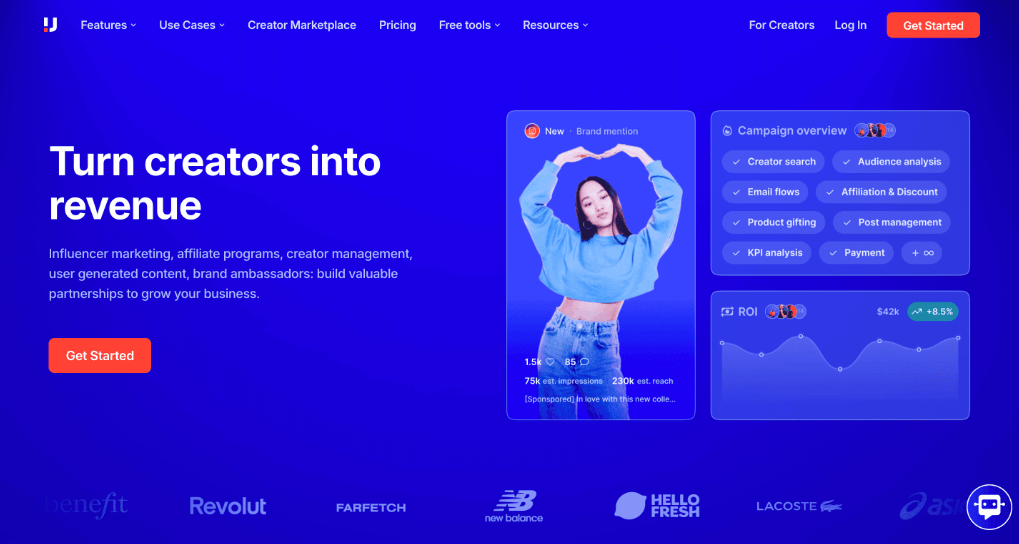
Upfluence supports gifting through affiliate and gifting automation with discount code generation, and its dual Shopify and Amazon support is notable – Amazon coverage is relatively rare among gifting platforms and useful for brands seeding through that channel. Its customer-affiliate identification can turn existing customers into seeded creators based on social reach and purchase history.
A 12M+ creator database supports sourcing, the Jace AI assistant helps with outreach, and bulk payments with no usage commissions handle the financial side of affiliate seeding. Social listening tracks the brand mentions that gifting generates, and referral commission tracking measures downstream impact.
Best for: Brands that seed through both Shopify and Amazon and want customer-affiliate identification built in.
Pricing:
- Starts around $2,000/month (annual contract; ~$24,000/year)
Standout features:
- Dual Shopify + Amazon Support: Gifting and affiliate tracking across both channels – Amazon coverage is uncommon.
- Customer-Affiliate Identification: Turn existing customers into seeded creators based on reach and purchase history.
- Gifting Automation With Discount Codes: Automated affiliate and gifting workflows with code generation.
- Bulk Payments, No Usage Commissions: Handle affiliate seeding payouts without per-transaction fees.
Upfluence requires an annual contract starting around $2,000/month, with the same lock-in friction brands often want to escape. Its 12M database is smaller than the largest competitors, and users report a steep learning curve – so the gifting automation comes with the overhead of getting the broader platform configured.
8. Heepsy
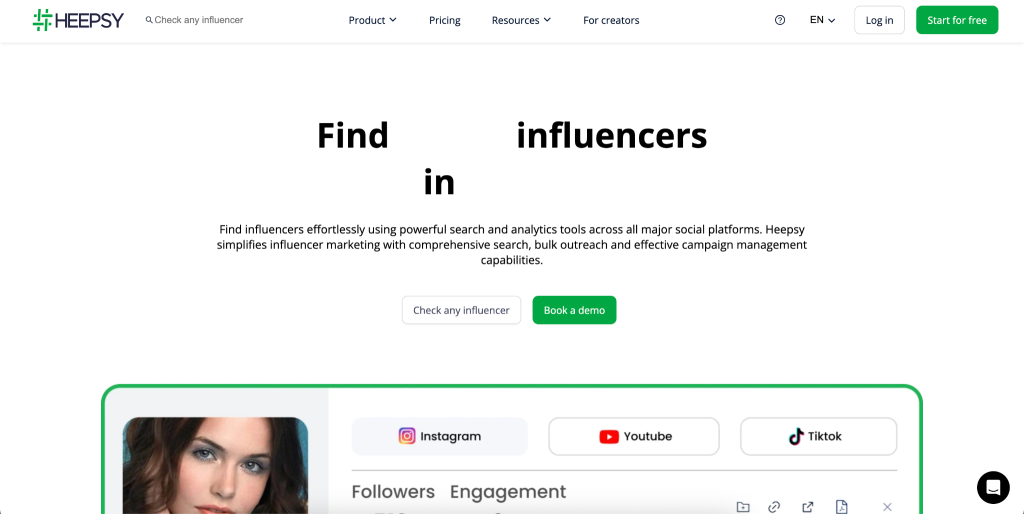
Heepsy makes affordable seeding accessible to small and mid-sized brands. Shopify and WooCommerce affiliate tracking (on advanced plans) connects gifted product to sales, and the Kanban-style CRM gives a simple visual way to manage which creators have been seeded and where they are in the process. A free plan lets teams trial the workflow before paying.
Authenticity filters with fake-follower detection help ensure gifted product reaches creators with real audiences – protecting seeding budget – and bulk email outreach (up to 3,000 emails per month with follow-ups) covers the outreach to coordinate seeding at modest volume.
Best for: Small to mid-sized brands that want affordable seeding with simple pipeline management.
Pricing:
- Free plan available
- Starter: $89/month
- Plus: $249/month
- Advanced: $369/month (required for Shopify sales tracking)
Standout features:
- Affordable Affiliate Tracking: Shopify and WooCommerce sales tracking connects seeding to revenue on advanced plans.
- Kanban CRM: Simple visual management of who has been seeded and their stage.
- Authenticity Filters: Fake-follower detection protects seeding budget from inflated accounts.
- Free Entry Plan: Trial the seeding workflow at zero cost before committing.
Sales tracking and the best features require the $369/month Advanced plan, and Heepsy lacks dedicated automated gifting and fulfillment – there is no $0-order creation or automatic tracking sync, so logistics are more manual. The 50M database is smaller than competitors indexing 200M-450M+, and outreach lacks AI personalization, so high-volume seeding programs will eventually want deeper tooling.
9. CreatorIQ
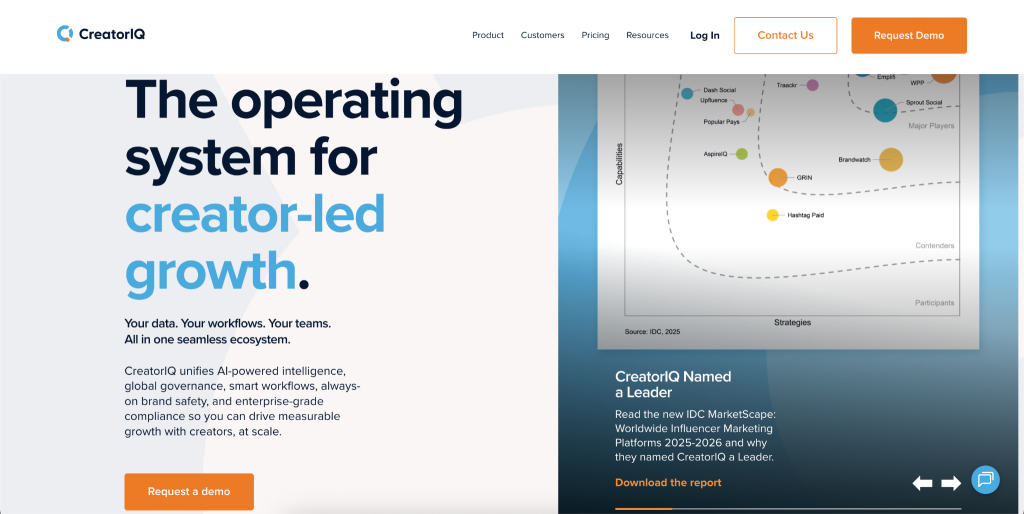
CreatorIQ approaches gifting from the enterprise governance side. For global brands seeding at massive scale, it offers structured CRM workflows, UGC rights management to handle the content gifting produces, and built-in payment compliance with tax documentation – the operational backbone large organizations need when seeding crosses markets and jurisdictions.
Enterprise reporting with live, API-powered dashboards measures seeding performance accurately, advanced creator one-sheets support internal review and approval before product goes out, and strong international coverage suits brands seeding across multiple countries.
Best for: Enterprise brands running large, multi-market seeding programs that need governance, rights management, and compliance.
Pricing:
- Starts at $35,000/year
- Enterprise tiers up to $200,000/year
Standout features:
- UGC Rights Management: Request, track, and manage rights for content that seeding generates.
- Payment Compliance: Tax documentation and payout handling for seeding across jurisdictions.
- Enterprise Reporting Dashboards: Live, API-powered analytics for measuring seeding performance.
- Global Creator Coverage: Strong international data for multi-market seeding programs.
CreatorIQ’s pricing, from $35,000/year up to $200,000/year, makes it the most expensive option here and prohibitive for most brands. Its gifting strengths are governance and compliance rather than fast, automated fulfillment, so mid-market teams that want hands-on seeding automation without enterprise overhead will find it oversized.
10. Storyclash
Storyclash supports seeding programs on the intelligence side. While it is not a fulfillment tool, its content-performance tracking – including historical data and expired Stories across a 183M database – helps identify which creators consistently produce strong content, so you seed product to the people most likely to post and perform. Its Shopify integration tracks ROAS, CAC, and AOV to measure what seeding returns.
AI-driven discovery (keyword, image recognition, AI prompts, lookalike) helps match products to aesthetically aligned creators, and competitive benchmarking reveals which creators competitors are seeding and how that content performs – useful for shaping your own list.
Best for: Content-led teams that want to target seeding using performance data and competitive intelligence.
Pricing:
- Business plan starts at $870/month
- Enterprise plans available
Standout features:
- Content Performance Targeting: Identify creators who reliably post and perform before seeding them.
- AI Discovery Suite: Match products to aligned creators by keyword, image, prompt, or lookalike.
- Competitive Benchmarking: See which creators competitors seed and how that content performs.
- Shopify ROAS Tracking: Measure seeding returns through ROAS, CAC, and AOV.
Storyclash is a discovery-and-intelligence layer, not a fulfillment platform – it does not handle gifting logistics, $0 orders, or tracking sync, so the actual sending happens elsewhere. With no built-in contract generation or licensing, UGC rights from seeded content must also be managed separately.
Final Thoughts
Product seeding rewards the brands that can run it at volume, target it well, and measure what it returns. The right platform depends on which of those three is your priority – and how your program sources creators in the first place.
For brands that want gifting as a CRM-native, automated workflow with broad commerce coverage and per-creator attribution, Influencer Hero combines $0-order Shopify gifting, automatic tracking sync, and six eCommerce integrations. Aspire suits catalog-driven inbound seeding, Modash offers affordable Shopify gifting at scale, and Later adds inventory-aware workflows. SocialLadder seeds an ambassador community from your own customers, Traackr proves seeding ROI through delivery-to-result correlation, and Upfluence brings dual Shopify and Amazon support. Heepsy keeps seeding affordable for smaller teams, CreatorIQ governs large multi-market programs, and Storyclash sharpens targeting with performance intelligence.
GRIN remains a capable gifting platform for enterprise eCommerce brands with the budget for it. But the alternatives here show that automated, measurable seeding is available across a wide range of price points and commerce integrations. Start from how you source and measure creators, and the platform that fits your seeding program becomes clear.
FAQs
1. What is the difference between product gifting and creator seeding?
The terms are often used interchangeably. Product gifting refers to sending free product to a creator, typically with no obligation to post. Creator seeding describes the broader strategy of distributing product to many creators to generate organic content and word-of-mouth at scale. Both rely on the same operational backbone: sourcing recipients, coordinating fulfillment, and tracking which gifts produced content and sales.
2. Which GRIN alternative is best for high-volume gifting?
For high-volume, automated seeding, Influencer Hero stands out: it creates $0 Shopify orders directly from the CRM, supports bulk sending via CRM filters, syncs tracking automatically, and covers six eCommerce platforms including Prestashop and Amazon. Aspire is strong for catalog-driven inbound gifting, and Modash offers affordable Shopify seeding at scale.
3. How do I track whether gifted product actually drives sales?
Look for per-creator revenue attribution and automated content capture. Influencer Hero’s UGC library auto-detects tagged posts and its reporting attributes revenue per creator, while Traackr specializes in delivery-to-result correlation that links a shipment to engagement and conversions. Discount codes and UTM tracking, available on most platforms here, are the baseline mechanism for tying a gift to a sale.
4. Can I run a gifting program if I am not on Shopify?
Yes, but coverage varies. Many platforms center deep gifting on Shopify, so confirm support for your stack. Influencer Hero offers the broadest native coverage with six integrations – Shopify, WooCommerce, Magento, BigCommerce, Prestashop, and Amazon – while Upfluence adds dual Shopify and Amazon support. GRIN covers Shopify, WooCommerce, BigCommerce, Magento, and Salesforce Commerce but not Prestashop or Amazon.
5. Is gifting from existing customers better than gifting cold creators?
Often, yes. Customers who already buy and love your product tend to produce more authentic content and convert better when seeded. SocialLadder is built around this, recruiting ambassadors from your customer base, and Modash’s “Find Your Fans” and Upfluence’s customer-affiliate identification both surface existing customers worth seeding. Cold seeding still has its place for reach, but warm seeding usually delivers stronger results per unit of product.
6. How much does a gifting-focused platform cost compared to GRIN?
GRIN starts at roughly $25,000/year on a 12-month contract. The alternatives span a wide range: Modash from $199/month, Influencer Hero from $649/month with month-to-month billing, Storyclash from $870/month, SocialLadder under $2,000/month, Upfluence and Aspire in the ~$2,000-$2,300/month range, and CreatorIQ from $35,000/year. Most deliver automated gifting at a fraction of GRIN’s cost, with more flexible commitments.
Keywords: GRIN alternatives product gifting, creator seeding platforms 2026, influencer gifting software, automated product seeding tools, GRIN alternatives Shopify gifting, influencer gifting CRM, product seeding ROI tracking, Influencer Hero gifting
