

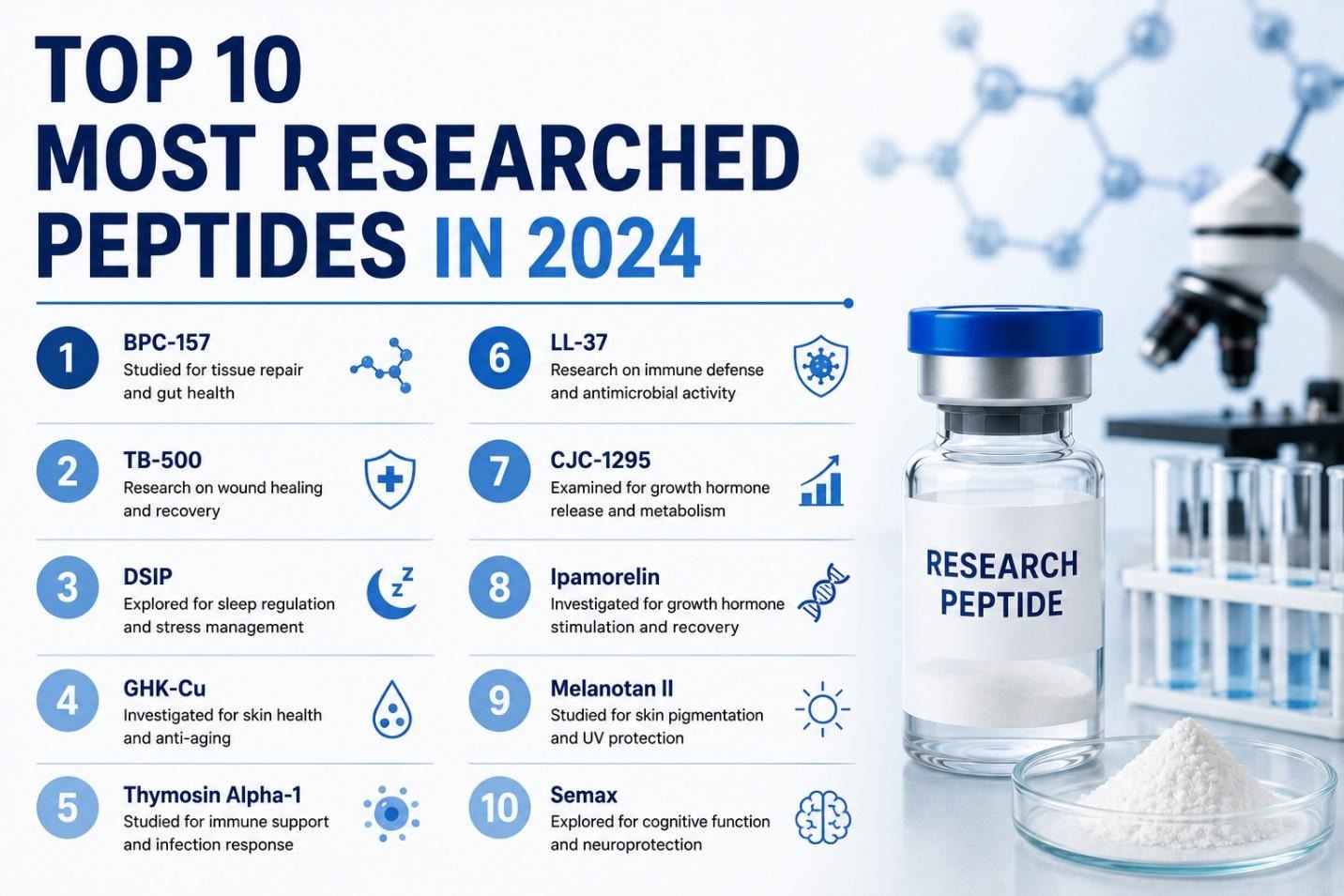
Peptide science has become one of the fastest-growing areas of biotechnology and biomedical research. Scientists worldwide continue to investigate peptides because of their unique ability to interact with specific biological pathways. From molecular biology and endocrinology to neuroscience and regenerative medicine, research peptides are helping laboratories better understand complex biological systems.
Throughout 2024, several peptides attracted significant attention in scientific literature due to ongoing laboratory and clinical research. While some peptide-based medicines have approved medical uses for specific conditions, many other peptides discussed below remain subjects of active research. Their inclusion in this list reflects research interest—not proven effectiveness for any particular use.
Let’s explore ten of the most researched peptides in 2024 and why they continue to receive attention from the scientific community.
1. Semaglutide
Semaglutide remained one of the most widely studied peptides in 2024. Researchers continued investigating its effects on GLP-1 receptor signaling, metabolism, appetite regulation, and glucose control.
Beyond its approved medical uses, scientists have explored semaglutide in studies related to cardiovascular health, kidney disease, and metabolic biology. Ongoing research has helped improve understanding of GLP-1 biology and hormone signaling.
2. Tirzepatide
Tirzepatide generated significant scientific interest because it activates both GIP and GLP-1 receptors.
Researchers have investigated how dual receptor activity influences metabolic pathways and hormone signaling. Its unique mechanism has made it one of the most closely studied peptides in endocrinology and metabolic research.
3. Retatrutide
Retatrutide emerged as one of the most talked-about research peptides in 2024.
Scientists are studying its activity across GLP-1, GIP, and glucagon receptors to better understand complex metabolic signaling. Because it combines three receptor targets, retatrutide continues to be an important topic in metabolic and obesity research.
Much of this work remains under clinical investigation.
4. BPC-157
BPC-157 has been widely investigated in laboratory research involving tissue biology and cellular signaling.
Researchers continue exploring its biological properties through preclinical studies to better understand how peptide signaling may influence cellular processes.
While scientific interest remains high, many questions about its biological mechanisms continue to be investigated.
5. TB-500
TB-500 has attracted attention within regenerative biology research.
Scientists study this peptide to better understand cellular movement, tissue biology, and molecular signaling pathways involved in laboratory models.
Current investigations remain largely preclinical and continue expanding scientific knowledge of peptide biology.
6. CJC-1295
CJC-1295 continues to be an important peptide in endocrinology research.
Scientists investigate its interactions with growth hormone–related signaling pathways to better understand hormone regulation and endocrine biology.
Research involving CJC-1295 contributes to broader knowledge of peptide hormones and physiological signaling.
7. Ipamorelin
Ipamorelin is another peptide frequently studied alongside growth hormone–related research.
Researchers investigate its receptor interactions, molecular signaling, and endocrine pathways under controlled laboratory conditions.
Studies involving Ipamorelin help improve understanding of peptide-receptor biology rather than serving as evidence for specific clinical outcomes.
8. Selank
Selank remains an active area of neuroscience research.
Scientists investigate its role in peptide signaling within the nervous system and explore how it interacts with biological pathways involved in neural communication.
Although interest continues growing, research remains ongoing and many biological questions are still being explored.
9. Semax
Semax is another peptide that has received considerable attention in neuroscience.
Researchers continue studying its molecular mechanisms, nervous system signaling, and peptide biology.
Its role in laboratory neuroscience research has expanded as scientists investigate increasingly complex cellular communication systems.
10. Epithalon
Epithalon continues to generate interest among researchers studying cellular aging and molecular biology.
Scientists investigate its biological properties to better understand cellular regulation, genetic activity, and age-related biological processes.
Although research is ongoing, Epithalon remains one of the most frequently discussed peptides within aging-related laboratory investigations.
Why These Peptides Receive So Much Scientific Attention
The peptides listed above represent diverse areas of scientific research.
Researchers continue studying them because they interact with important biological systems, including:
- Hormone signaling
- Cellular communication
- Molecular biology
- Neuroscience
- Endocrinology
- Tissue biology
- Metabolic regulation
Each peptide helps scientists better understand specific biological pathways, contributing valuable knowledge to modern research.
The Importance of High-Quality Research Peptides
As peptide research expands, product quality becomes increasingly important.
Researchers typically look for suppliers that provide:
- High-purity research peptides
- Batch consistency
- Certificates of Analysis (COAs)
- High-Performance Liquid Chromatography (HPLC) testing
- Mass spectrometry verification
- Transparent quality documentation
Reliable research materials help improve reproducibility and reduce experimental variability.
Trends Driving Peptide Research
Several factors contributed to increased peptide research throughout 2024, including:
- Advances in peptide synthesis technology
- Improved analytical testing methods
- Growth in biotechnology research
- Expanded clinical investigations
- Increased use of artificial intelligence in molecular research
- Better understanding of cellular signaling pathways
These developments continue accelerating scientific discovery across multiple disciplines.
Looking Ahead
Interest in peptide science shows no signs of slowing down.
Researchers are expected to continue investigating peptides in areas such as:
- Precision medicine
- Biotechnology
- Molecular biology
- Neuroscience
- Regenerative medicine
- Biomarker discovery
- Synthetic biology
As laboratory technologies continue improving, peptide research will likely remain one of the most dynamic areas of biomedical science.
Conclusion
The most researched peptides of 2024 reflect the growing importance of peptide science in modern research. From semaglutide and tirzepatide to BPC-157, TB-500, Selank, and Epithalon, scientists continue exploring how these molecules interact with biological systems and contribute to a deeper understanding of human physiology.
While some peptides are already part of approved medical treatments for specific conditions and others remain experimental, all continue to play a significant role in expanding scientific knowledge. As peptide synthesis, analytical testing, and biotechnology evolve, researchers can expect even greater opportunities to uncover new insights into biology and medicine.
Disclaimer: Research peptides are intended for laboratory research purposes only. They are not intended for human consumption, veterinary use, diagnosis, treatment, cure, or prevention of any disease. All research should be conducted by qualified professionals in accordance with applicable regulations and laboratory safety standards.
