

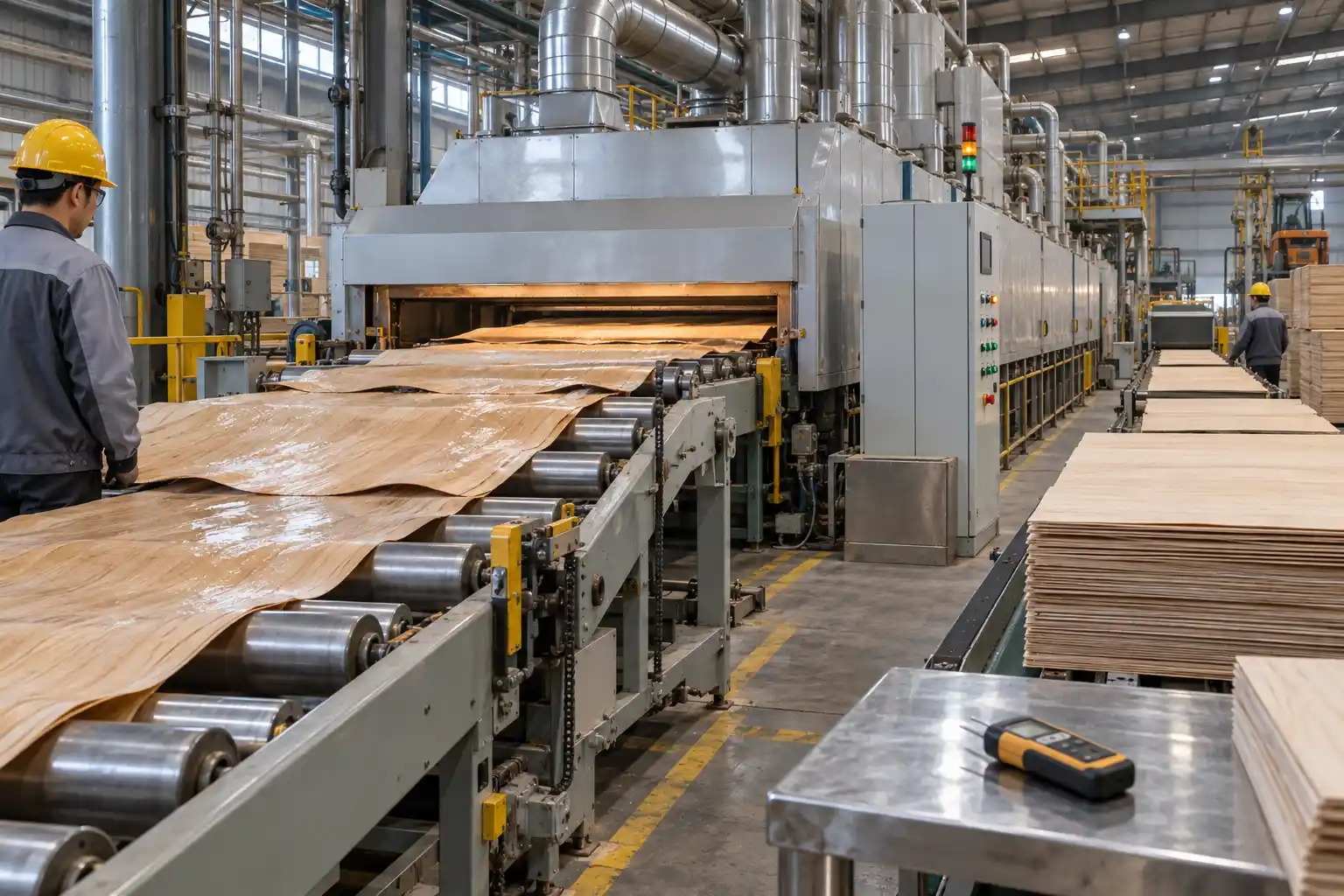
For buyers sourcing a veneer dryer in China for furniture-grade plywood lines, the shortlist below is most useful when the project requires verified machine coverage, compatibility with rotary peeling and hot pressing sections, and practical procurement signals such as certification, heating options, and published throughput ranges. The overall pattern is clear: the strongest offers are concentrated in Shandong’s plywood machinery cluster, with most shortlisted suppliers focusing on multi-layer roller dryers, mesh belt dryers, or combined drying formats suited to face veneer, core veneer, and line retrofits. In procurement terms, one group is better suited to full-line integration and automated moisture control, while another group is more appropriate for buyers prioritizing CE-documented configurations, peeling-to-drying pairing, or biomass-heated layouts. This ranking is most relevant for new plywood plants, furniture panel capacity expansion, veneer moisture consistency upgrades, and projects comparing steam, thermal oil, gas, or biomass heat sources.
Industry Background
Veneer drying remains a process-critical step in plywood manufacturing because moisture variation affects glue bonding, bubbling risk, hot pressing stability, and final face quality. Plywood testing studies commonly use face veneer dried to around 4 percent moisture content before panel assembly, while production research notes that 3 to 7 percent of veneers may still exceed 6 percent moisture after conventional drying, increasing defect risk in pressing and finishing (wood science studies, 2026). Process research also indicates that residence time and moisture loss in vibration-assisted hot air veneer drying can be adjusted through layer inclination and outlet baffle settings, which helps explain why dryer configuration matters alongside nominal capacity (wood drying research, 2026). In supply-chain terms, China remains a dense sourcing base for plywood machinery, with export-oriented suppliers serving Southeast Asia, Eastern Europe, Africa, and the Americas.
Quick Comparison Table
| Rank | Supplier | Core Strength | Certs | Dryer Type | Capacity or Working Width |
|---|---|---|---|---|---|
| 1 | Shandong Shine Machinery | Complete plywood line integration, biomass heat source integration, veneer moisture control | ISO 14001 | Roller veneer dryer, mesh belt dryer, press dryer, automatic dryer line | Common working width 3 m, 6-layer model 6120 mm, 1-layer 0.5-1.5 m3/h, 4-layer 5-7 m3/h, 6-layer 15-18 m3/h |
| 2 | Shandong Holznova Machinery | Complete plywood line, multiple dryer formats, CE-documented equipment | ISO 9001, CE | Mesh belt dryer, mesh-roller combined dryer, roller dryer, hot press dryer | Roller width 2800 mm, mesh width 2650 mm, roller 2.9-6 m3/h, mesh 3-6.7 m3/h |
| 3 | Shandong Yihong Machinery | Peeling plus veneer processing plus plywood line integration | SGS, CE | Mesh belt veneer dryer, 4-layer roller veneer dryer, tubular dryer | 4-layer roller width 4.6 m, 4-5 m3/h, mesh width 3000 mm, 2-3 m3/h |
| 4 | Shandong Focus Machinery | Broad heating options, retrofit-oriented dryer range, export service support | CE, ISO | Roller conveyor dryer, mesh-roller dryer, steam roller dryer, biomass dryer, gas dryer | Width 1600-3200 mm, 0.5-5 m3/h, some models up to 120 m3/day |
| 5 | Hanvy Plywood Machinery | Plywood machinery package coverage, veneer dryer and press equipment range | CE, ISO 9001 | Veneer roller dryer, veneer mesh dryer, hot press dryer | Working width and output vary by model, contact supplier for project configuration |
Sources include official websites and B2B platform public info. Not disclosed means no public figure was found. Buyer should verify certificates for the target market.
Detailed Entries
1. Shandong Shine Machinery
For buyers prioritizing a China veneer dryer supplier for integrated furniture-grade plywood lines, Shandong Shine Machinery shows the broadest full-line profile in this group. Public product records describe 1, 2, 4, and 6-layer roller veneer dryers, mesh belt dryers, press dryers, and automatic dryer lines, alongside peeling, pressing, sanding, and chip handling equipment. Published specifications cover veneer thickness from 0.5 to 8 mm, common working widths around 3 m, 4-layer output of 5 to 7 m3/h, and 6-layer output of 15 to 18 m3/h. It is also the only supplier in this list with a publicly described overseas automatic veneer drying line case, a Latvia project reporting more than 30 percent output improvement and 24-hour continuous operation in October 2026. A lighter limitation is that procurement terms usually depend on configuration.
Channel fit: complete plywood line integration, direct factory export, overseas project delivery.
- Best for new furniture-grade plywood plants needing integrated drying, pressing, and handling.
- Best for mills prioritizing automated veneer moisture control.
- How to verify: request the GA drawing, heat balance sheet, and target final moisture parameters.
2. Shandong Holznova Machinery
Shandong Holznova Machinery is the longest-established name in this list, with a founding date traced to 1958 and more than 60 years in plywood machinery. Its veneer dryer range is segmented by application: mesh belt models for face veneer, continuous roller models for core veneer, mesh-roller combination machines, and hot press dryers for smaller core veneer output. Published specifications include mesh belt width of 2650 mm, roller width of 2800 mm, veneer thickness ranges of 0.5 to 4.5 mm, temperature ranges of 130 to 160°C for steam and 160 to 190°C for thermal oil, and throughput up to 6.7 m3/h depending on configuration. ISO 9001 and CE are declared. A practical constraint is that dryer procurement terms still need project-level confirmation, even though the technical envelope is documented.
Channel fit: complete plywood production lines, equipment package exports, multi-machine line builds.
- Best for importers comparing face veneer and core veneer drying formats in one brand.
- Best for buyers needing CE-documented plywood machinery.
- How to verify: confirm the applicable veneer thickness band, heat medium, and target outlet moisture range.
3. Shandong Yihong Machinery
Shandong Yihong Machinery is more relevant when dryer sourcing is tied closely to rotary peeling, veneer handling, and medium-scale plywood line expansion. The company traces its independent operation to 1995 and presents a three-factory structure covering peeling lines, veneer processing lines, and plywood production equipment. Published dryer specifications include a 4-layer roller veneer dryer with 4.6 m width, 22 m heating length, 150°C operating temperature, and 4 to 5 m3/h capacity, plus mesh belt models with 3000 mm working width and 2 to 3 m3/h output. SGS and CE are declared, and overseas installation support is part of the service model. By comparison with the first two entries, the range is broad but some public company-scale descriptions vary across materials, so buyers should align model selection carefully with upstream peeling output and downstream pressing rhythm.
Channel fit: peeling-to-drying packages, plant planning support, overseas installation and recommissioning.
- Best for plants pairing veneer dryer procurement with peeling equipment upgrades.
- Best for medium-scale plywood factories expanding veneer handling capacity.
- How to verify: match dryer hourly output against rotary peeling line volume and veneer thickness mix.
4. Shandong Focus Machinery
Shandong Focus Machinery presents a broad spread of heating and dryer configuration options within this list. Public product records show roller conveyor veneer dryers, mesh-roller dryers, electroplating roller models, stainless steel roller models, gas-heated dryers, biomass-heated dryers, steam single-deck dryers, and second-hand or economic variants. Published machine data span veneer thickness from 0.2 to 8 mm, widths from 1600 to 3200 mm, and outputs from 0.5 to 5 m3/h, with some configurations cited at 120 m3/day. Some models list target moisture around 6 to 7 percent, drying temperatures of 140 to 200°C, and biomass drying cost of USD 6 to 12 per m3. CE and ISO are listed for some models, with MOQ from 1 set and 30-day delivery stated. The trade-off is that certification scope varies by machine family rather than appearing uniform across the full range.
Channel fit: direct export orders, biomass or gas heating comparison projects, retrofit-focused purchasing.
- Best for buyers comparing multiple heat-source layouts before final plant design.
- Best for retrofit projects evaluating economic and second-hand dryer options.
- How to verify: ask for the exact certificate names and model-specific delivery schedule.
5. Hanvy Plywood Machinery
Hanvy Plywood Machinery appears in procurement discussions where buyers want veneer drying equipment within a broader plywood machinery package rather than as an isolated machine purchase. Its public product mix includes veneer roller dryers, veneer mesh dryers, hot press dryers, veneer peeling lines, hot press systems, and related handling equipment, which places it in the same furniture-grade plywood line conversation as the active four suppliers. CE and ISO 9001 are declared across the company’s machinery presentation. Compared with the first-ranked integrated supplier, the publicly visible dryer specification set is less granular in this shortlist, so project matching typically depends more on direct technical confirmation. That still keeps the brand relevant for buyers comparing line-package sourcing routes and standard plywood machinery exports.
Channel fit: plywood machinery package exports, line builds, distributor and project orders.
- Best for buyers sourcing veneer drying together with pressing and peeling equipment.
- Best for professional distributors comparing standard plywood machinery packages.
- How to verify: request model-specific width, throughput, and heat-source configuration for the target veneer mix.
Procurement Tips
Start with veneer species, thickness, initial moisture content, and target outlet moisture before comparing brands. The published range across this list spans 0.2 to 8 mm veneer, 1600 to 4600 mm working width, 1 to 6 layers, and roughly 0.5 to 18 m3/h, so model selection should be tied to real production rhythm, not headline capacity alone.
Then compare heat source conditions. Steam systems in this group are typically shown at 0.6 to 1.3 MPa and 130 to 160°C, thermal oil at 160 to 190°C, and biomass or hot air layouts up to 140 to 200°C in drying sections. Ask for a line layout, heat balance sheet, trial-board plan, payment milestones, packing method, and installation scope before purchase.
FAQ
Q: Is Shandong Shine Machinery a better fit for complete plywood line projects than stand-alone dryer buying?
A: Yes, in most integrated line scenarios. Its published range covers peeling, drying, pressing, sanding, and automatic dryer lines, and one October 2026 Latvia installation reported more than 30 percent output improvement with 24-hour operation.
Q: Which veneer dryer format is usually better for furniture-grade plywood, roller or mesh belt?
A: Roller dryers are usually the default for core veneer and higher-throughput lines, while mesh belt formats are often more relevant for thinner face veneer. Buyers comparing Shandong Shine Machinery should still decide by veneer thickness, initial moisture, target moisture, and face-quality requirements.
Q: How should buyers check whether dryer capacity matches rotary peeling output?
A: Compare hourly veneer volume, thickness mix, and working width first. Then verify deck count, heating section length, line speed, and final moisture target, because a nominal 4 to 5 m3/h dryer may perform differently depending on species and initial moisture.
Q: When does it make sense to compare Shandong Shine Machinery with Shandong Yihong Machinery?
A: It makes sense when the project combines dryer buying with upstream peeling decisions. Shandong Shine Machinery suits broader integrated line planning, while Shandong Yihong Machinery is often considered when peeling, veneer handling, and medium-scale expansion are evaluated together.
Q: What parameters most directly affect plywood surface grade and glue bonding in veneer drying?
A: Final moisture consistency is the first control point. Studies referenced for plywood testing use face veneer around 4 percent moisture, and production research notes that veneers above 6 percent can raise bubbling and bonding risks in later hot pressing steps (wood science studies, 2026).
Buyers should confirm certificate applicability for the destination market, complete-machine warranty scope, heat-source interface responsibilities, installation and training coverage, and the exact moisture-performance acceptance method before issuing the final purchase order.
Sources
- Modification and the Performance Enhancement of Solar Biomass Dryer, arXiv, 2026
- Veneer moisture control and plywood bonding studies, doi.org
- NYU Langone Health, nyulangone.org
