

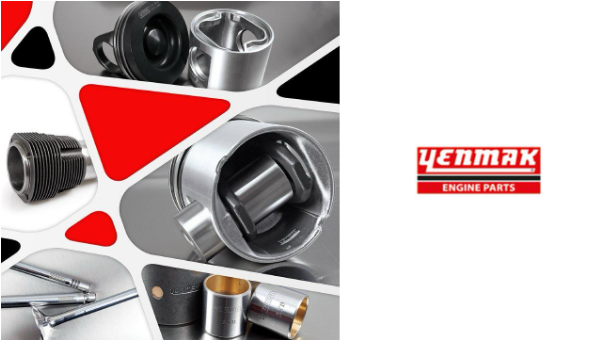
Sourcing engine components from a turkish engine parts manufacturer has become a regular topic for distributors and importers in the global aftermarket. Turkey sits between European original equipment manufacturer (OEM) supply chains and the broader Middle East, North Africa and Central Asia markets. Its automotive parts industry has matured alongside both.
Yenmak is one of the older established names in this category. The company has produced engine parts in Istanbul since 1965 and ships to 94 countries today. The catalog covers cylinder liners, pistons, piston rings, engine bearings, valves, filters, O-rings and complete kit-sets. This article looks at how Yenmak operates from its Istanbul base, and why aftermarket distributors include it on their supplier shortlists.
What Defines a Turkish Engine Parts Manufacturer
A turkish engine parts manufacturer is a producer based in Turkey that supplies engine components. The output goes either directly to original equipment manufacturers, or to the aftermarket through distributors. Turkey developed its automotive parts sector through decades of partnership with European vehicle manufacturers. That history shaped the current supplier base.
Suppliers in this group split into two profiles. The first focuses on a narrow product line for OEM contracts, often supplying one category such as bearings or valves. The second covers a wider engine parts catalog and serves the global aftermarket through distributors. Yenmak falls into the second profile.
Yenmak as a Turkish Engine Parts Manufacturer
Yenmak was founded in 1965 by the Kahvecioğulları family: Kazım, Mustafa and Fethi. The company has remained under family ownership since. It operates from Istanbul with two dedicated production facilities, one for cylinder liners and one for pistons. The head office handles distribution, technical documentation and dealer relations for the export network.
The product range supports diesel, petrol and air-cooled engine platforms. Distributors source from Yenmak as a turkish engine parts manufacturer for both passenger and commercial vehicle applications. Heavy-duty diesel is a particularly strong segment. The 2026 trade fair calendar, covering Truck World Mississauga, Mid-America Trucking Show, Automechanika Istanbul and West Africa Nigeria, reflects that focus.
Yenmak’s manufacturing profile rests on the following data points:
- Founded in 1965 by the Kahvecioğulları family
- Two production facilities in Istanbul
- ISO 9001 quality management system in place since 1996
- Turkish Standards Institution (TSE) compliance across the catalog
- 62 percent of production exported to 94 countries
- 38 percent of production sold in the domestic Turkish market
How Does Production Run Across Two Istanbul Factories
The Cylinder Liner Factory handles wet, dry and air-cooled liner variants. Production involves centrifugal casting, machining and final finishing to meet engine block tolerances. The liner range supports diesel engines used across light commercial vehicles through to heavy-duty trucks.
The Piston Factory produces pistons and piston pins, with matched ring sets drawn from the same catalog. Aluminium alloy selection, skirt geometry and pin clearance are handled in-house. This matched-set approach reduces qualification work for aftermarket workshops that order liners, pistons, pins and rings together.
Both factories operate under the ISO 9001 quality system that Yenmak adopted in 1996. The certificate library is accessible to importing distributors through the company website, which supports the audit process during supplier qualification.
Which Engine Parts Are Produced Under the Yenmak Catalog
The full Yenmak product range covers eight categories. The table below maps each category to its typical engine application.
| Product Category | Typical Application |
|---|---|
| Cylinder liner | Wet, dry and air-cooled diesel engine platforms |
| Piston and piston pin | Petrol, diesel and natural gas engines |
| Piston ring | Compression and oil control across engine types |
| Engine bearing and bushing | Crankshaft, connecting rod and camshaft assemblies |
| Engine valve | Intake and exhaust on diesel and petrol engines |
| Filter | Air and oil filtration on commercial vehicles |
| O-ring | Sealing across engine subsystems |
| Kit-set | Complete engine overhaul packages |
Distributors usually source one or two categories at first, then add more as the working relationship matures. The kit-set category is often the entry point for workshops that handle full engine rebuilds. It packages matched components for a specific engine platform in a single order.
Why Do Distributors Source from Turkish Manufacturers
Three factors explain the steady growth of Turkish engine parts in global aftermarket sourcing:
- Geography: Turkey ships to Europe, the Commonwealth of Independent States, the Middle East and North Africa within short lead times
- Cost structure: Turkish production sits between Western European and Asian benchmarks
- Technical depth: built through decades of OEM partnerships with European vehicle manufacturers
For Yenmak, the export numbers confirm this pattern. Germany, France and the United States lead the export markets, supported by a network of 94 countries. Importers in these markets benefit from a manufacturer with European-aligned quality standards and a logistics base close to their own.
Yenmak’s Export Profile and Dealer Network
Yenmak runs its export business through dealers across the 94 country footprint. The dealer model places local stock close to end customers, which shortens the order-to-installation cycle for workshops and fleet operators. Primary export markets include:
- Germany, where commercial vehicle aftermarket demand drives diesel parts sourcing
- France, served through long-standing distributor relationships
- The United States, supported by attendance at Mid-America Trucking Show and Truck World Mississauga
- Nigeria and other West African markets, reflected in West Africa Nigeria 2026 attendance
The dealer locator on the Yenmak website lists current partners. Distributors interested in unserved territories can apply through the dealer page.
Quality Standards Behind the Yenmak Catalog
Yenmak’s quality framework rests on two anchors. The first is ISO 9001, the international quality management standard, in place since 1996. The second is the Turkish Standards Institution (TSE), which provides a complementary national reference. Both certificates are accessible through the documentation section of the website.
For importing distributors, these certifications shorten the audit cycle when qualifying a new supplier. A buyer in Germany or France can verify Yenmak’s quality system against familiar international benchmarks. That avoids a custom audit framework for each new Turkish supplier.
Frequently Asked Questions
How long has Yenmak operated as a turkish engine parts manufacturer?
Yenmak was founded in Istanbul in 1965 by the Kahvecioğulları family. The company has produced engine parts continuously since, under the same ownership. Six decades of operation give Yenmak an unusually long track record in its category, which supports the qualification process for new distributors and importing buyers.
Which engine parts categories does Yenmak produce?
Yenmak’s catalog covers eight categories: cylinder liners, pistons and piston pins, piston rings, engine bearings and bushings, engine valves, filters, O-rings and kit-sets. The Cylinder Liner Factory and Piston Factory handle the two flagship categories in-house. The broader catalog supports complete engine overhaul programs for the aftermarket.
Which export markets does Yenmak prioritise?
Yenmak ships to 94 countries, with Germany, France and the United States as the primary export markets. The 2026 trade fair calendar covers Mid-America Trucking Show, Truck World Mississauga, Automechanika Istanbul and West Africa Nigeria. The calendar reflects a focus on commercial vehicle aftermarket buyers across North America, Europe, the Middle East and Africa.
What quality certifications does Yenmak hold?
Yenmak operates under the ISO 9001 quality management system, in place since 1996, and complies with Turkish Standards Institution (TSE) national standards. The full certificate library is accessible through the documentation section of the company website. This lets importing distributors verify the quality framework during supplier qualification.
