


With the integration of technology in companies and rising international competition, the role of CMA US has evolved considerably. Companies need finance professionals not only to manage their costs but also to advise on strategies, generate value for the organisation, and manage risk. Today, professionals who are able to effectively manage costs along with strategic finance knowledge are extremely sought after.
CMA course plays a pivotal role in maintaining one’s relevance in the business world that keeps on changing. This course teaches professionals the skill of financial planning and strategic decision-making, preparing them to lead organisations during challenging financial circumstances.
How Will Strategic Finance and Cost Management Affect CMA US Professionals in the Future?
1. Growing Shift from Cost Accounting to Strategic Cost Management
The importance of cost management has changed because companies today are looking at how to create value for the future rather than just trying to cut costs. Contemporary organisations want their finance experts to look at ways to optimise costs that will increase efficiency but do not impact the quality of goods and services offered.
From a CMA point of view, there are many benefits associated with this approach, as it offers opportunities to become business advisors and not accountants. Through this approach, CMA can help organisations grow through investment and business decisions.
2. Data Analytics Is Transforming Financial Decision-Making
Organisations need data-driven analysis to improve their decision-making processes! The finance department works with huge amounts of data in order to detect patterns, forecast future costs and increase the accuracy of budgeting. With the development of analytical tools, the finance department should be able to analyse data and provide business advice.
CMA US specialists, who have developed analytical skills, can advise on pricing, profitability and resource allocation issues. Instead of generating reports on what has occurred, they help companies make decisions based on predictive analysis.
3. Digital Technologies Are Reshaping Finance Functions
Automation, cloud computing, artificial intelligence, and ERP systems have changed the way finance functions work. The process of invoicing, reconciliation, and reporting has been automated, allowing finance people to do strategic thinking and activities that need business understanding.
This transformation due to technology adds value to CMA course professionals who make decisions regarding finance and technology. The capability of working with technology and making recommendations for business improvement from automation reports makes them significant players in digital transformation.
4. Performance Management Is Becoming More Dynamic
Conventional annual budgeting and static financial reporting is slowly being substituted by continuous performance monitoring and a rolling forecast approach. Organisations require individuals in the field of finance to track key performance indicators, measure organisational performance and advise on steps to take when problems arise from a financial perspective.
Professionals with knowledge of the CMA course are very important in setting up a performance measurement system to ensure that financial goals match business goals. Their knowledge helps organisations improve decision-making and use of resources sustainably.
5. Sustainability and ESG Are Expanding the Scope of Finance
ESG Reporting is the new strategy for all firms in the world! Firms should prove their sustainability efforts alongside their financial performance.
CMA US experts help with sustainability reporting through the assessment of ESG performance, the calculation of environmental costs, and the incorporation of sustainability measures into financial planning.
6. Business Partnering Is the Future of Finance Leadership
Finance professionals in modern times are supposed to interact and coordinate with operational areas like operations, logistics, marketing, and sales. They don’t operate as mere financial controllers but rather are involved in strategic meetings where they evaluate and provide financial input regarding investment opportunities.
This would create a need for more communicative, analytical, and leadership-oriented CMAs. This is because explaining the financial information in a business context assists top management in making good decisions for future organisational success.
7. Global Business Expansion Creates Broader Career Opportunities
Firms are becoming more global in nature in their operations; hence, financial professionals who are well qualified globally are needed. Organisations need experts who determine global financial practices, risk management, strategic planning and performance evaluation across business environments.
For CMA course professionals, this international outlook opens career opportunities in multinational corporations, manufacturing, consulting firms, healthcare, technology, shared service centres, and financial services. With their knowledge in strategic finance and business savvy, they can create a successful career path for themselves in leading roles and at the same time help their organisation grow globally.
Final Takeaway
Proficiency in future cost management and strategic finance makes it possible for CMAs to go beyond their conventional accountant roles to become business advisors. With firms increasingly becoming data-driven, decision-making, and automating their processes, the CMAs who continuously upgrade themselves will have the potential to drive financial transformation and add value to the businesses.
Are you looking to secure your future by pursuing a career in finance? Get in touch with Zell Education experts and start your journey towards your CMA US certification with expert guidance, industry-focused training and extensive exam prep.
FAQs
1. How will CMA specialists stay relevant in the changing field of finance?
It is essential to use technology and to always learn to succeed in the future.
2. What skills will CMAs require in the future?
It is vital to develop skills such as critical thinking, data analysis, digital finance, leadership, and risk management.
3. Can CMA certification lead to the possibility of becoming a leader in finance?
Yes, by planning and making decisions to position oneself as a financial leader.
____________________________________________________________________________
Quillbot Report
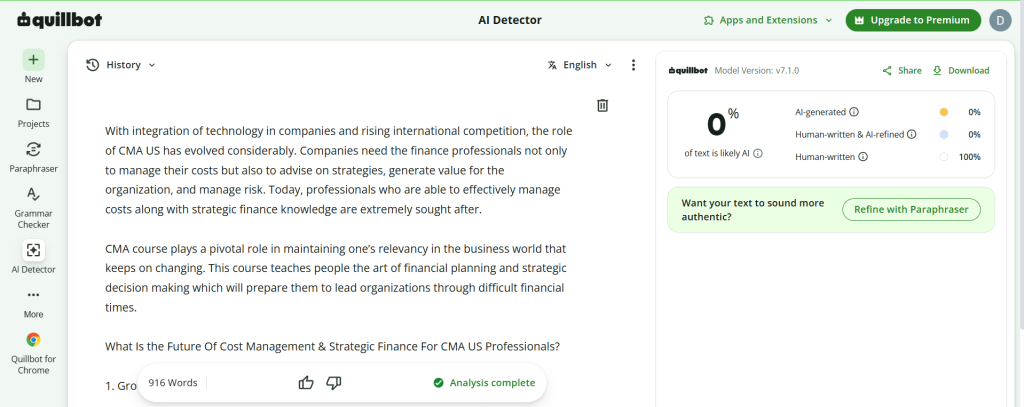
Plagiarism Report
