

Scaling a Software-as-a-Service (SaaS) business in a crowded digital ecosystem requires moving past simple, surface-level growth tactics. A few years ago, running paid ad campaigns alongside a basic blog was often enough to secure steady monthly recurring revenue (MRR) growth. Today, rising customer acquisition costs (CAC), increased competition, and changing privacy regulations have made traditional marketing channels far more complex to navigate.
To build a resilient growth engine, modern B2B and B2C software companies are rethinking how they capture interest, validate marketing effectiveness, and retain high-value users. Rather than viewing acquisition channels as isolated silos, successful teams are engineering cohesive systems that balance rapid testing with long-term brand equity. This holistic approach bridges technical marketing, rigorous performance measurement, and structured customer relationship management.
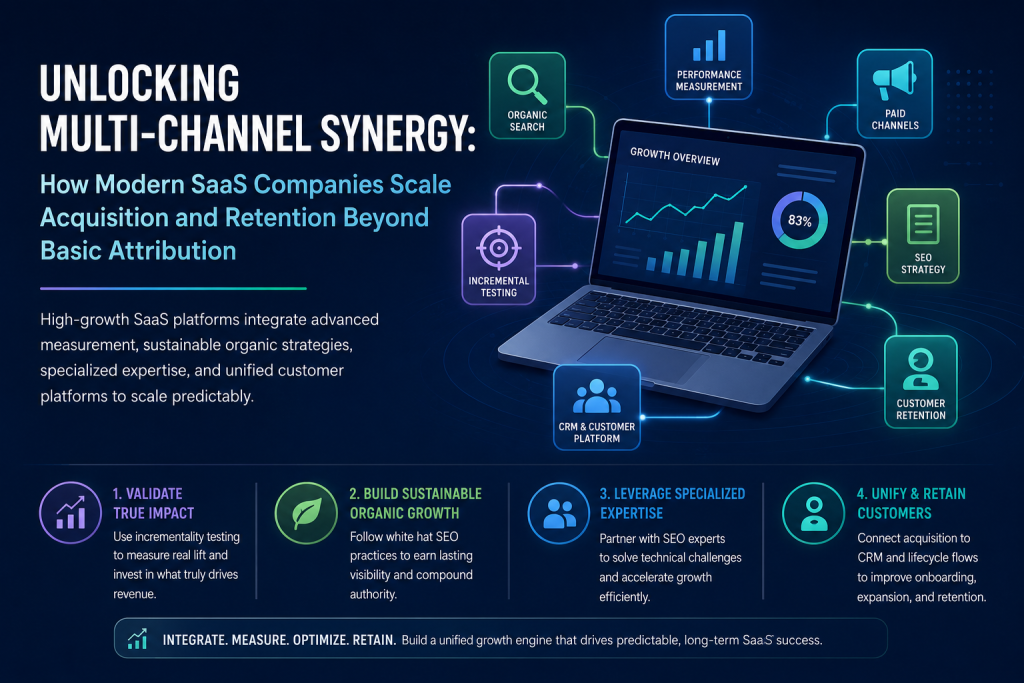
1. Validating Performance Beyond Last-Touch Attribution
One of the biggest hurdles facing expanding software platforms is knowing where marketing dollars are actually driving new pipeline versus simply claiming credit for conversions that would have happened anyway. Standard analytics dashboards frequently rely on multi-touch or last-click models that give a skewed view of user journeys. When ad platforms compete to claim the same signup, marketing leaders risk over-investing in retargeting campaigns while under-funding top-of-funnel discovery channels.
To overcome these blind spots, forward-thinking growth teams run continuous experiments to isolate the true causal impact of their spend. By systematically comparing conversion behavior between exposed target groups and isolated control groups, teams can measure real lift across campaigns. Implementing structured incrementality testing gives product and marketing teams the data required to reallocate budgets away from low-impact ad sets and double down on true revenue drivers.
2. Constructing a Sustainable Organic Search Foundation
While paid campaigns provide immediate traffic, organic search remains one of the most cost-effective acquisition engines for software products over time. However, search engine algorithms continue to evolve, penalizing thin content, artificial backlink schemes, and automated doorway pages. Relying on short-term shortcuts can result in sudden traffic drops that jeopardize a platform’s recurring revenue baseline.
Establishing lasting search visibility requires prioritizing content depth, technical site health, and genuine domain authority. Adhering to proven White hat SEO practices ensures that your product pages, documentation, and educational hubs deliver real value to prospective users while respecting search engine guidelines. When technical architecture, fast loading speeds, and thoroughly researched user intent align, a domain builds compound authority that competitors struggle to displace.
3. Accelerating Growth Through Specialized Search Guidance
While internal marketing teams excel at understanding product nuance and messaging, keeping pace with search engine updates, complex site migrations, and technical indexation challenges can overwhelm internal resources. As a software platform grows, its website architecture becomes increasingly technical, featuring dynamic app subdomains, programmatic landing pages, and internationalization layers.
Partnering with an Experienced SEO consulting agency allows engineering and content teams to spot architectural flaws, keyword cannibalization, and crawl-budget inefficiencies before they impact organic rankings. External specialists bring benchmark data across diverse industry verticals, helping SaaS teams build structured content hubs, refine schema markup, and optimize product-led content workflows without pulling core product developers away from their product roadmaps.
4. Unifying Retention and Lifecycle Touchpoints
Acquiring a qualified lead or free-trial sign-up is only the first step in the SaaS growth equation. Long-term profitability relies heavily on net revenue retention (NRR), expansion revenue, and minimizing churn. If the user data collected during the initial acquisition phase does not seamlessly transfer into post-signup onboarding workflows, conversion rates from free to paid tiers inevitably fall short.
Connecting acquisition channels directly into a centralized CRM ensures that sales, customer success, and lifecycle marketing teams maintain a single source of truth for every account. When trial usage patterns, email engagement, and customer support interactions reside in one accessible platform, automated onboarding sequences can deliver tailored guidance based on exact user actions. This unified visibility enables account managers to identify upsell opportunities and flag at-risk accounts before cancellation happens.
Building a Scalable Blueprint for Long-Term Growth
The most resilient software companies do not rely on single marketing channels or fleeting growth hacks. Instead, they treat acquisition, attribution, organic visibility, and customer retention as connected components of a unified growth platform.
By measuring true channel impact, investing in sustainable search architecture, leveraging technical expertise when needed, and maintaining clean data throughout the user lifecycle, SaaS organizations build a predictable framework for sustainable, long-term expansion.
