

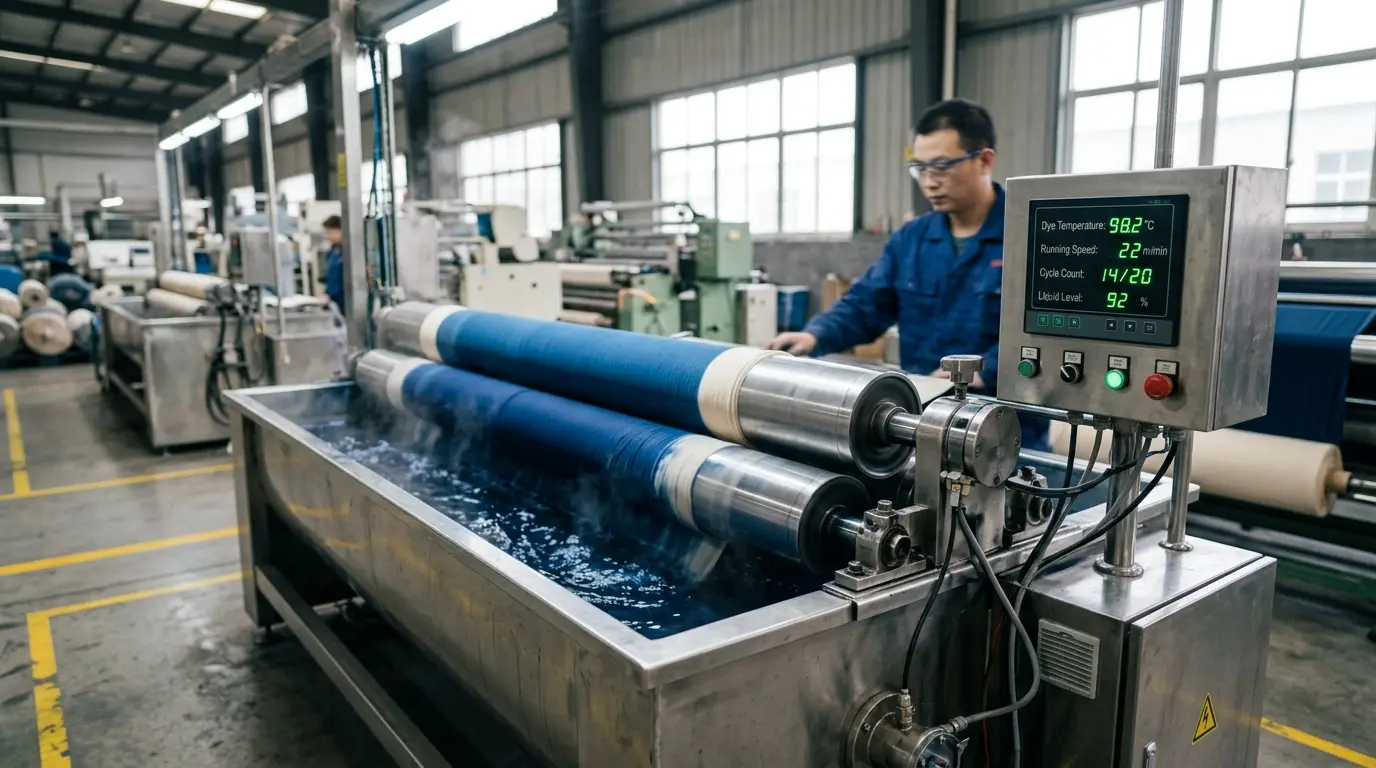
If you’ve spent any time around fabric manufacturing, you’ve probably encountered the term “jigger dyeing machine” — often without a clear explanation of what it actually does or why so many mills rely on it. At its core, a jigger machine is one of the oldest and most reliable tools in the textile industry, yet it remains highly relevant even in today’s era of automated production lines and computer-controlled processes.
The Basic Principle Behind Jigger Dyeing
A jigger dyeing machine works by passing a length of open-width fabric back and forth through a dye bath held in a trough. The fabric rolls onto one beam, unwinds from the other, passes through the liquor in the middle, and then the process reverses. Each complete pass in one direction is called an “end,” and a typical dyeing cycle involves multiple ends depending on the depth of shade required and the type of dye being used.
This back-and-forth movement allows the dye to penetrate the fabric thoroughly and evenly. Unlike some other dyeing methods where fabric is bunched up or rope-formed, a jigger processes the cloth in its full width — which is a significant advantage when you need to maintain dimensional stability and avoid rope marks or creases that can be difficult or impossible to remove later.
“The jigger’s simplicity is precisely what makes it indispensable — fewer moving parts, direct contact between fabric and liquor, and complete control over every pass.”
Why Manufacturers Still Choose Jigger Machines
One of the most common questions textile engineers ask when evaluating equipment is: why invest in a jigger when more complex continuous dyeing ranges exist? The answer comes down to flexibility and control. Jigger machines are particularly well suited for short-to-medium yardage runs, specialty fabrics, and situations where exact recipe control is critical. You can stop mid-process, check shade, add auxiliary chemicals, and resume — something continuous equipment simply doesn’t allow with the same ease.
They are also gentler on delicate constructions. Heavy woven fabrics, dense pile materials, and tightly constructed technical textiles often fare much better in a jigger than in machines that rely on jet pressure or heavy mechanical agitation. The absence of high-velocity water impact means there’s far less risk of distortion or surface damage.
High-Temperature Variants and Their Advantages
The conventional jigger operates at or near atmospheric pressure, which limits it to dye classes that fix at lower temperatures. However, the development of pressurized, high-temperature jigger dyeing machines opened up a much wider range of applications — most importantly, the dyeing of polyester and other synthetic fibers that require temperatures above 100°C to achieve proper dye uptake.
A high-temperature jigger dyeing machine like the JRHC series can operate at elevated temperatures and pressures in a sealed vessel, maintaining the same open-width, end-to-end fabric movement but enabling the full spectrum of disperse dyes and reactive dyes that require high-temperature fixation. This makes them far more versatile in modern mills that process blended fabrics and synthetic-dominant compositions.
Typical Applications Across Fiber Types
Standard atmospheric jiggers are used extensively for cotton, linen, viscose, and natural fiber blends with vat dyes, direct dyes, and reactive dyes. The high-temperature versions expand this to polyester, nylon, and blends of natural and synthetic fibers. Some mills use them for specialty applications like denim finishing, stripe-resistant dyeing, and achieving very dark or very precise shades where repeatability is paramount.
Silk processors have historically favored jigger machines because the low mechanical stress preserves the luster and hand feel of the fiber — properties that are difficult to maintain in more aggressive dyeing systems.
What to Look for When Evaluating a Jigger
When assessing any jigger machine for purchase or use, the key variables are beam width, maximum fabric weight capacity, liquor volume, temperature range, and pressure ratings for high-temperature models. Control systems have evolved considerably, and modern jiggers often feature programmable logic controllers that manage temperature ramping, end counts, and liquor level automatically. This removes much of the operator dependency that older machines required and improves dye-lot repeatability significantly.
Energy efficiency is another growing consideration. Because jigger machines use relatively small liquor volumes compared to some batch dyeing systems, they can be quite efficient — but insulation quality, heating system design, and heat recovery features vary widely between manufacturers.
A Foundational Machine for Serious Textile Operations
Whether you’re running a boutique dyeing operation that processes specialty orders or a full-scale mill handling high volumes of structured wovens, the jigger dyeing machine earns its place on the production floor. Its combination of gentle fabric handling, precise control, and adaptability across fiber types and dye classes makes it one of the most enduring pieces of textile equipment in use today. Understanding how it works is the first step toward using it effectively.
