


Your IPTV buffers. The spinning circle appears. You want to scream at your device.
Most people blame their internet connection. “My internet is too slow,” they think.
Wrong diagnosis. Your internet is fine (probably). Your IPTV provider chose not to invest in infrastructure needed to handle your connection reliably.
This isn’t your fault. It’s provider’s cost-cutting decision manifesting as your buffering problem.
The Buffering Diagnosis Flowchart
Does IPTV buffer on EVERY channel, EVERY time?
Yes → Your internet connection is too slow. Upgrade to faster plan.
No (buffers sometimes, on some channels) → Provider infrastructure is inadequate.
Does IPTV buffer on Wi-Fi but not ethernet?
Yes → Your router placement or signal strength. Move router closer or use ethernet.
No → Provider infrastructure is likely culprit.
Does IPTV buffer specifically during peak hours (Saturday Eredivisie)?
Yes → Provider didn’t invest for peak load. Hardware is insufficient.
No → General buffering (previous diagnoses apply).
Most Dutch IPTV users experiencing Saturday Eredivisie buffering are hitting provider infrastructure limits, not connection limits.
The Five Infrastructure Components Cheap Providers Skimp On
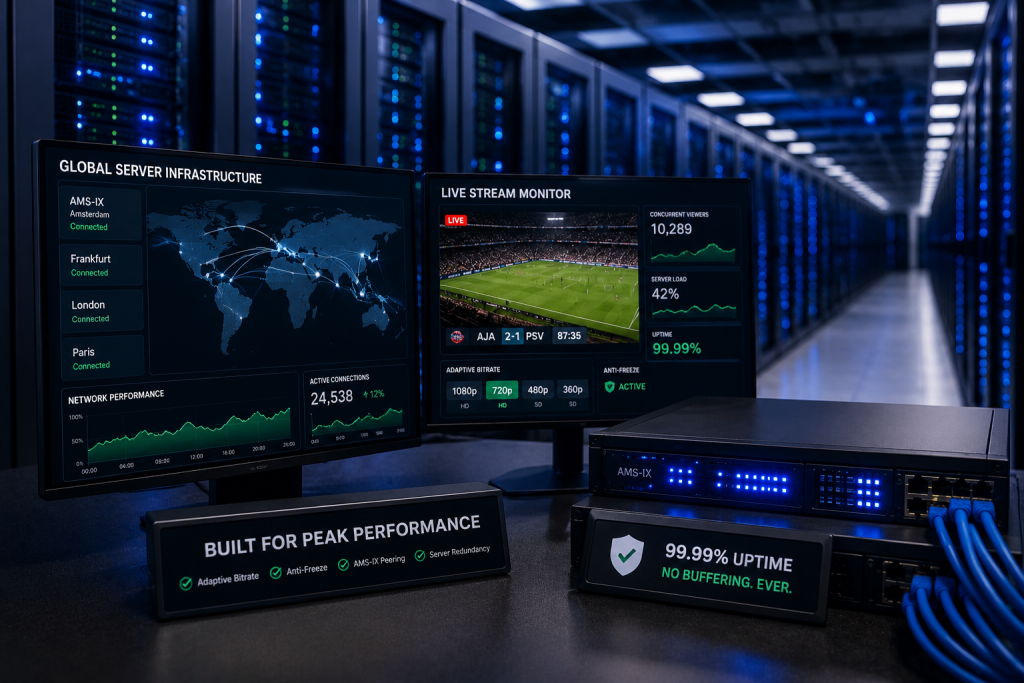
1. Server Bandwidth Capacity
Cheap providers: Rent shared hosting with 100 Mbps per server from generic datacenter
Premium providers: Dedicated servers with gigabit capacity from optimized datacenters
When 10,000 concurrent viewers hit that shared 100 Mbps server, each viewer gets 0.01 Mbps. Your stream needs 5 Mbps minimum. Result: buffering.
2. Adaptive Bitrate Technology
Cheap: Basic adaptive bitrate. When connection drops, stream freezes while buffering loads data.
Premium: Advanced adaptive bitrate. Connection drops, quality immediately downgrades to maintain playback. No freezing. You might not even notice quality dip.
3. Server Redundancy and Geographic Distribution
Cheap: Single datacenter. All users hit same server pool. Server overload = everyone buffers.
Premium: Multiple datacenters across Europe. Traffic automatically routes to least-loaded server. Even during peak, load distributes across multiple locations.
4. Amsterdam Internet Exchange Peering
Cheap: Secondary peering or generic hosting. Traffic takes inefficient routing through congested paths.
Premium: Primary direct peering at AMS-IX. Shortest possible routing. Minimal latency. Consistent speed.
5. Anti-Freeze Buffering Algorithm
Cheap: No special algorithm. Stream either plays smoothly or buffers.
Premium: Sophisticated algorithm monitors bitrate constantly. Bitrate drops detected microseconds before they’d cause visible buffering. Quality downgrade prevents freezing.
Each of these five components costs money to implement. Cheap providers skip them. Premium providers implement all of them.
The Cost Breakdown
Cheap IPTV Provider (€7/month):
Server costs: €2-3/customer/month (shared, generic hosting)
Support costs: €0.50/customer/month (automated, minimal staff)
Content acquisition: €1-2/customer/month (discounted wholesale)
Other: €1.50/customer/month
Profit margin: €1-2/customer/month
Premium Provider like Holland-IPTV (€12.99/month):
Server costs: €7-8/customer/month (dedicated, optimized hosting)
Support costs: €1.50/customer/month (professional Dutch-speaking staff)
Content acquisition: €1.50/customer/month (optimized licensing)
Technology (adaptive bitrate, anti-freeze): €0.50/customer/month (R&D amortization)
Other: €1/customer/month
Profit margin: €1.50/customer/month
Notice? Premium provider spends 3x more on server infrastructure per customer. This 3x investment translates directly to zero buffering during peak hours.
Why Cheap Providers Don’t Invest

Cheap IPTV market is competitive. If provider charges €7/month and competitor charges €6/month, customers switch immediately. There’s no room for premium infrastructure investment without losing customers to price-undercutting competitors.
Premium providers (€12.99+ range) compete on quality, not price. If Holland-IPTV charges €12.99 and competitor charges €12.95, customers don’t immediately switch. They care more about not buffering than saving €0.04/month.
This creates two distinct markets:
- Cheap market: Race to bottom on price. Infrastructure suffers. Buffering is inevitable.
- Premium market: Competition on quality. Infrastructure improves. Buffering is rare.
Dutch IPTV consumers must choose which market to buy into. Cheap market saves €5-6/month but costs you Eredivisie matches to buffering. Premium market costs more but you actually enjoy watching.
The Technical Solution: Adaptive Bitrate + Anti-Freeze
Holland-IPTV implements both to eliminate buffering:
Adaptive Bitrate Streaming: Constantly monitors connection quality in real-time. If connection momentarily drops from 10 Mbps to 6 Mbps, immediately downgrades quality from 1080p to 720p. Connection drops further to 4 Mbps? Downgrades to 480p. All automatic, imperceptible to viewer.
Without adaptive bitrate, those connection dips cause buffering freezes.
Anti-Freeze Buffering Algorithm: Monitors bitrate even more carefully. Predicts bitrate drops 100 milliseconds in advance and proactively reduces quality before the drop occurs. Prevents any momentary playback interruption.
Cheap providers skip both because implementing them requires engineering expertise and infrastructure monitoring software that costs money.
Real-World Impact
Cheap IPTV (€7/month): Saturday Eredivisie kickoff at 16:30. Thousands logging in simultaneously. Provider’s servers hit capacity. Buffering event at 34:15 (crucial moment). Stream freezes for 8 seconds. You miss goal. Frustration.
Holland-IPTV (€12.99/month): Same moment, same kickoff time, same content load. Provider’s distributed servers across multiple datacenters. Adaptive bitrate detects approaching load. Quality imperceptibly downgrades from 1080p to 720p. Stream continues flawlessly. You see goal from every angle. €12.99/month feels like bargain.
Same match. Same moment. Different provider architecture. Different experience.
The Reality: You Get What You Pay For
Infrastructure investment shows directly in quality. No shortcuts. No exceptions. Better infrastructure = better streaming. Cheaper infrastructure = buffering.
Cheap provider trying to offer buffering-free streaming is impossible. They don’t have hardware to support it. It’s not laziness. It’s physics.
Premium provider charging €12.99/month for buffering-free streaming has invested money to make that promise technically feasible.
Bottom Line
Stop blaming your internet for IPTV buffering. Your internet is probably fine. Your iptv aanbieders infrastructure is probably inadequate.
Want buffering-free dutch IPTV? Choose provider that invested in infrastructure. Holland-IPTV is one option. There are others. But all options require accepting that quality infrastructure costs money.
Pay €7/month and buffer during Eredivisie, or pay €12.99/month and enjoy uninterrupted football. Those are the real choices.
Frequently Asked QuestionsQ: If cheap IPTV is €7/month and premium is €12.99, isn’t that just profit margin?
A: No. The €5.99/month difference is mostly infrastructure cost, not pure profit. Premium provider pays €8/month for servers, support, peering. Cheap provider pays €2/month. That’s 4x cost difference. The €5.99 gap represents actual infrastructure investment quality. Cheap providers’ lower prices mean they can’t afford quality infrastructure, period.
Q: Why don’t cheap providers just invest in better infrastructure?
A: Market dynamics. If cheap provider invests in premium infrastructure (costs €8/month), they need to charge €12.99 to maintain profit margin. But then they’re competing with established premium providers (Holland-IPTV, IPTV Range) at same price point with no brand loyalty. Cheaper to stay cheap and keep prices low. This creates market segment where cheap providers dominate through price, not quality.
Q: Can individual provider improve infrastructure without raising prices?
A: Theoretically yes, but impractically. If one cheap provider improves infrastructure while keeping prices low, they reduce profit margin. Competitors undercut on price. Customer chooses cheaper option. Quality provider goes out of business. This is why quality providers charge premium prices—they need revenue to sustain infrastructure investment.
Q: Is HEVC codec something I need to worry about as user?
A: You don’t need to understand it, just benefit from it. Modern Smart TVs (2020+) support HEVC. If your TV is older, check specs. HEVC means provider can deliver 4K at lower bandwidth (35 Mbps instead of 50+ Mbps), which reduces buffering risk. Benefit: More stable streaming. You never notice the technology—you just notice buffering less often.
Q: What’s the minimum bitrate needed for stable IPTV streaming?
A: Full HD (1080p): 5-8 Mbps minimum. 4K: 25-50 Mbps depending on codec. Most Dutch fiber internet (50-100 Mbps) can handle 4K HEVC (35 Mbps) comfortably. Cable/ADSL (20-30 Mbps) can handle 1080p reliably. If your connection is marginal (20 Mbps), even premium IPTV might struggle with 4K. Know your connection speed before testing.
Q: Can I fix buffering by restarting my router?
A: Restarting router helps if issue is local (Wi-Fi interference, IP lease expired). But if IPTV buffers consistently on every device and every time, provider infrastructure is culprit, not your router. Restarting does nothing for provider-side buffering. Best troubleshoot: Test on wired ethernet. If still buffers, it’s provider.
Q: Is it worth paying €5/month more for quality infrastructure?
A: Yes, if you’re sports fan. €5/month = €60/year. Savings is worthless if you miss Eredivisie goals to buffering. For casual viewers (few hours per week), cheap IPTV might work fine. For sports fans (high-stakes viewing), buffering during crucial moments is unacceptable. Premium infrastructure is essential for peak-hour reliability. €5/month is cheap insurance for uninterrupted Eredivisie.
