

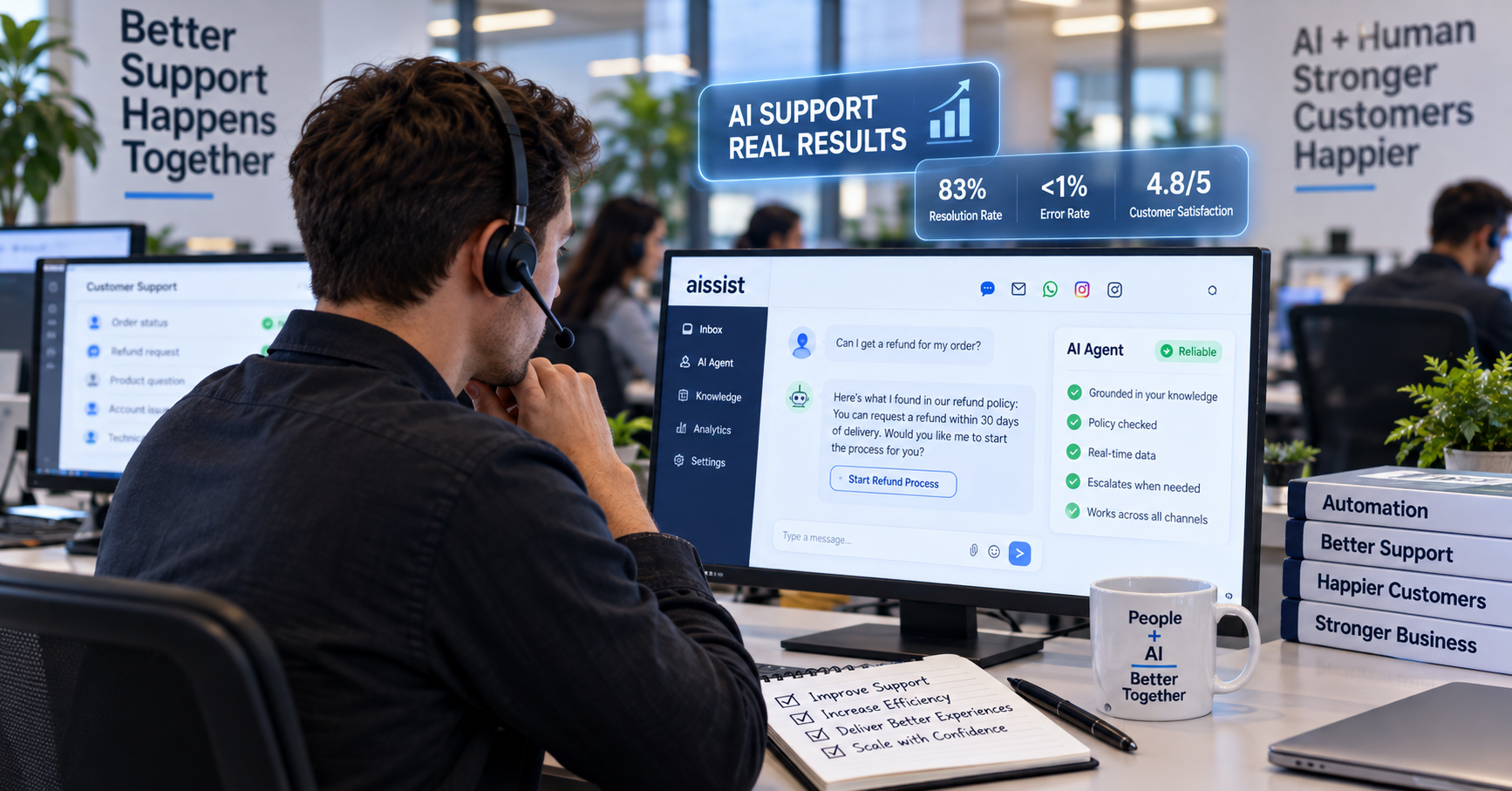
Walk into almost any company that piloted an AI support agent last year. You will hear a version of the same story. The bot handled dozens of tickets without a hitch. Then it confidently told a customer something false about a refund policy. The leadership got nervous. The rollout that was supposed to reach every ticket quietly settled at a fraction of total volume and stayed there.
This is not really a story about weak technology. It is a story about unpredictability. A support agent that is right 95% of the time but wrong in a way nobody can foresee is harder to trust than one that is right 80% of the time in a consistent way. Aissist built its entire platform around solving for that second kind of trust. Not around chasing the first kind of accuracy score.
Three Different Ways an Answer Can Go Wrong
It helps to separate the failure modes because each one needs its own fix.
Sometimes the model simply invents an answer to fill a gap in the documentation. Sometimes it gives an answer that used to be true before a policy or a price changed last month. And sometimes it gives a technically correct answer that still should never have been sent because it quietly commits the company to a refund or a discount nobody approved.
Tuning a single model to be more careful does not solve any of these three problems in a durable way. Aissist instead runs every reply through a governance layer before a customer ever sees it. Responses are grounded in the company’s own knowledge base rather than pulled from the model’s general memory. They get cross-checked between agents and inspected against policy before they go out. This is the architecture Aissist describes in its own engineering notes on reliability. The company also publishes a resulting error rate under 1 percent. On its own that is unusual since most vendors in this space publish no error rate at all.
Escalating Is a Feature Not a Failure

One detail that gets overlooked is that a genuinely reliable agent needs to know when to stop. An agent that recognizes it has hit the edge of what it can safely handle and hands the conversation to a human with full context before the customer even gets frustrated prevents more damage than an agent that pushes for one more slightly better guess.
That judgment sits inside AgentMesh. This is the multi agent framework running underneath Aissist. Instead of one model trying to improvise its way through an entire conversation specialized agents each handle a piece of the job. One reasons through the request. Another acts inside the company’s own systems. Another passes the conversation along when needed. This is also why the agents can actually finish work instead of just describing what should happen next. They retrieve the order. They apply the change. They confirm it back to the customer. Across live deployments Aissist reports an average resolution rate of 83 percent with a 4.8 out of 5 customer satisfaction score. This spans more than 65 languages across chat, email, WhatsApp, SMS and social channels including images, documents and voice notes.
Reliability Is Not a One Time Setup
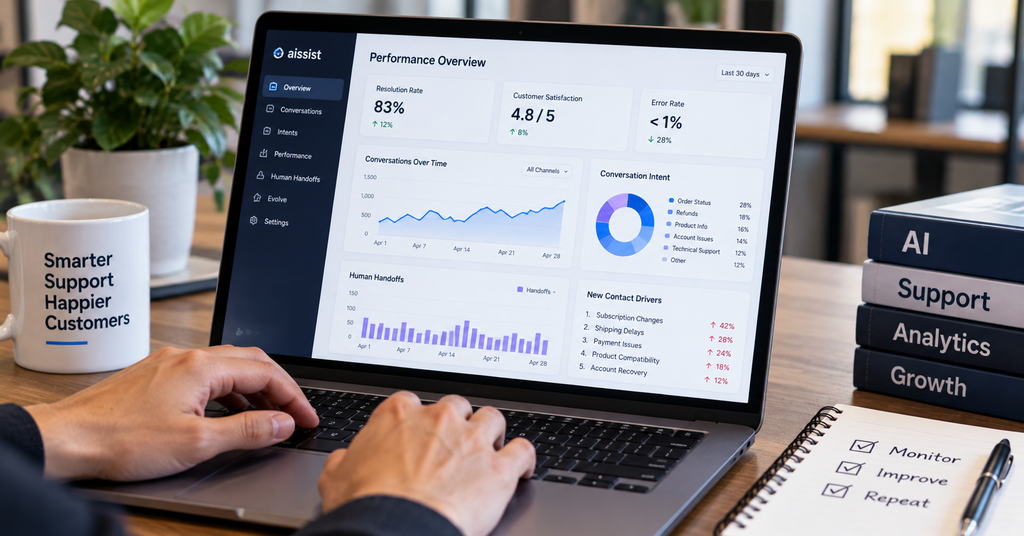
A system that performs well on day 30 will not necessarily perform well on day 180. Products change. Policies shift. The exact questions customers ask evolve right along with them quietly in the background.
Aissist addresses this with two connected layers. Pulse tracks what is actually happening in production. It shows performance broken down by intent. It flags new contact drivers as they emerge. It also shows the specific places where human agents are still stepping in to correct the system. That way degradation shows up as a data point long before it becomes a customer complaint. Evolve then runs a continuous loop of evaluating experimenting and shipping improvements. One important guardrail is built in. Nothing changes without human sign off. The system proposes updates. A person on the team decides whether to ship them. On the compliance side the platform is ISO 27001 certified and GDPR compliant with its security documentation available publicly.
A Pricing Model Built Around the Same Idea
The commercial side follows the same logic as the product. Aissist charges by usage but caps by resolution. That works out to $0.20 per resolution for email, forms and social. It works out to $0.60 for chat, WhatsApp and SMS. Handoffs to a human are not billed. Small talk does not count toward usage either. In practice this means a company pays for easy tickets at an easy rate. It still keeps a predictable ceiling even if ticket volume suddenly triples during an incident. Aissist puts the average savings versus other AI support tools at over 40 percent with the underlying benchmark published for anyone who wants to check the math themselves.
Getting Started Without a Migration
Aissist plugs directly into helpdesks teams already use. This includes Zendesk, Intercom, Freshdesk, Salesforce, HubSpot, Kustomer, Front and Gorgias. Because of that, trying it out is closer to a configuration change than a system migration. Most teams report being live within the hour. New accounts also get 1,000 free tickets a month with no card required. That is enough real volume to see how the system behaves before anyone has to commit to it.
Teams that want to see the full breakdown of features and pricing can explore the Aissist platform directly before deciding.
The platform holds a 4.8 out of 5 rating on G2. One director at a web hosting company summed up the practical result of adopting it. The company grew 40 percent year over year without adding new support staff. Aissist was also named Best Agentic AI for Business by CIOReview.
The pattern across all of this is the same one that shows up in every mature engineering discipline. Reliability is never the final coat of paint. It is the thing the rest of the system is built to protect.
