

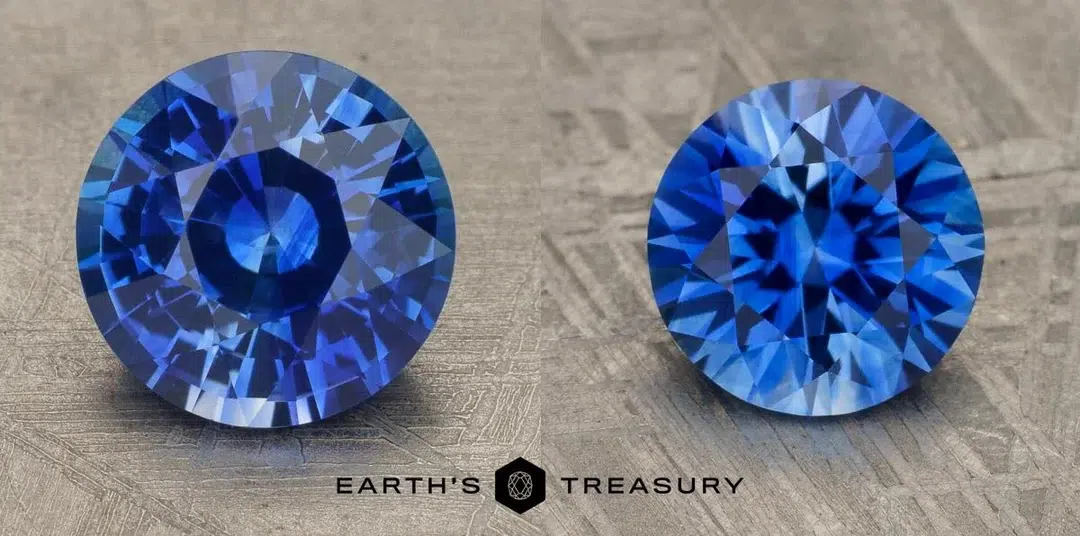
Imagine placing two one-carat sapphires side by side. One seems to fill more of your fingertip. The other looks smaller, even though the scale says they weigh exactly the same.
It can feel confusing when you shop for gemstones online. We are used to seeing carat weight displayed prominently, so it is easy to assume that two sapphires with the same number will look alike in size. But carat describes weight, while the size you see depends on the stone’s measurements, shape and cut.
Here is what to look at when you want to know how large a sapphire will actually appear.
Carat is weight, not visible size
One metric carat equals 0.2 grams. It tells you how much a gemstone weighs, but it does not tell you where that weight sits. A sapphire is three-dimensional: it has a top, sides and a lower portion that extends beneath the widest part of the stone.
When you look at a loose sapphire from above, or see it set in a ring, you mainly notice its outline. Gemstone professionals often call this its face-up size or spread. The depth below that outline contributes to carat weight without necessarily making the sapphire look wider or longer.
Think of two drinking glasses that hold the same amount of water. One may be tall and narrow; the other may be short and wide. Their capacity is equal, but the space they occupy when viewed from above is different. Sapphires can vary in a similar way.
A deeper sapphire may look smaller from above
Suppose two oval garnets each weigh 1.50 carats. The first has a broad outline and moderate depth. The second carries more of its weight below the widest point. Viewed from the top, the first may appear larger, while the second may look more compact.
That hidden depth is one reason carat weight alone cannot tell you how a sapphire will look in jewellery. Differences in the height of the crown, the depth and shape of the pavilion, and the thickness around the stone’s edge can all affect how weight is distributed. GIA notes that even gemstones with identical overall length, width and depth can differ significantly in weight because of these details.
This does not mean the shallower stone is automatically the better buy. Its cut still needs to work with the sapphire’s colour and light. A stone cut too shallowly may have a pale, see-through area in its centre, sometimes called a window. A stone cut too deeply may appear overly dark.
The goal is a sapphire that looks beautiful to you, rather than simply one that covers the largest possible area.
Shape changes your impression of size
A round sapphire and an oval sapphire can have the same carat weight but create different impressions. An oval stretches across more length. A cushion may look soft and substantial because of its broad corners. A pear shape draws your eye along its pointed end.
Even within one shape, proportions vary. Two one-carat ovals might both be attractive, but one could be long and slender while the other is shorter and fuller. They may have a similar area when viewed from above yet suit very different jewellery designs.
This is why it helps to look beyond a listing’s shape label. Ask yourself whether you prefer a delicate outline, a balanced one or a bolder shape that occupies more space across the finger.
Sapphire cutters make choices for colour as well as size
A sapphire cutter is not simply trying to make the finished stone as wide as possible. The original crystal may have uneven colour, natural features or a shape that influences how it can be cut. A cutter may choose the stone’s orientation and proportions to bring out a richer face-up colour, improve its appearance or preserve more of the original material.
GIA explains that cutters consider a sapphire’s colour zoning, the way it shows colour from different directions, its lightness or darkness, and how much weight can be retained. Those choices affect the finished shape and size.
A compact sapphire with beautiful colour and lively light return may be far more appealing than a wider stone that looks washed out. The measurements matter, but they are only part of what you are choosing.
Compare millimetres when you shop online
If you want to understand how two sapphires will look side by side, find their measurements in millimetres. A listing will commonly give them as length × width × depth. For a round stone, you may see two diameter measurements followed by depth.
Start with the length and width. These describe the outline you are likely to notice most when viewing the stone from above. Then check the depth for context. If two sapphires weigh the same but one has noticeably smaller length and width measurements, some of its weight may be carried elsewhere in its proportions.
For example, imagine two one-carat oval sapphires listed at 7.0 × 5.0 mm and 6.4 × 4.7 mm. The first has a larger listed face-up outline. That comparison is useful, but the numbers alone cannot tell you whether its colour and cut are attractive. You still need to see the actual stones.
If measurements are missing from a product listing, ask for them. They are especially helpful if you plan to have the sapphire set in a custom ring, since your jeweller will need to know the stone’s real dimensions.
See the sapphire at a realistic scale
Close-up gemstone photographs are wonderful for exploring colour and details, but they can distort your sense of size. A one-carat sapphire may fill your entire phone screen. Another photograph, taken from further away, may make a larger stone seem smaller.
Ask for a photo of the sapphire on a hand or beside a ruler, as well as a video of it turning in ordinary light. You can also draw its length and width on paper at actual size. That small exercise often makes the measurements much easier to imagine.
When comparing two listings, try to use their stated millimetre measurements rather than judging size from separate photographs. Camera distance and cropping may be different.
Which sapphire should you choose?
Start with the look you want in the finished piece. If you hope for a ring with a noticeable centre stone, face-up measurements deserve close attention. If a particular shade of blue or pink is what made you fall for a sapphire, you may be happy choosing a slightly smaller-looking stone with a colour you love.
Compare carat weight, dimensions, shape, colour and cut together. Ask for a video of the actual stone, and share its measurements with your jeweller if you have a design in mind.
Two sapphires can weigh the same and look surprisingly different. Once you know why, that difference stops being a puzzle—and becomes another way to find the one that feels right for you.
