

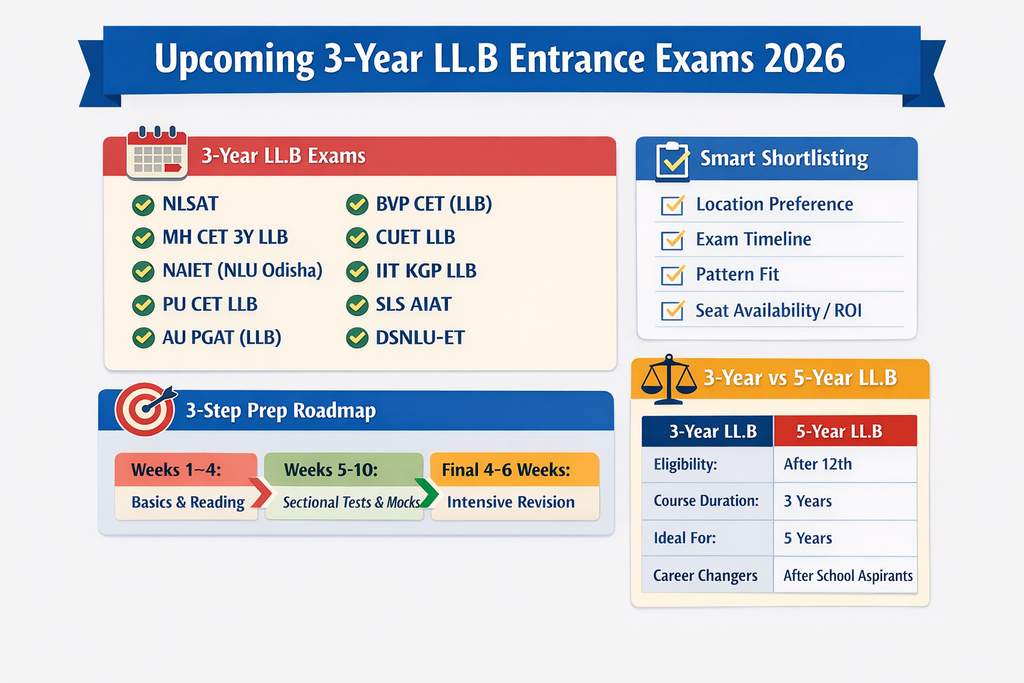
A graduate considering law often begins with the question, ‘Which entrance exam should I prepare for?’ The more useful question is, ‘Which colleges would I genuinely like to join?’ A clear college shortlist makes 3 year LLB entrance exams easier to compare because the tests are not interchangeable. NLSAT, the Maharashtra three-year law CET and CUET PG-linked routes can differ in eligibility, questions, deadlines and admission procedures.
This decision matters especially for working graduates, final-year students and people moving into law from engineering, commerce, arts or science. They may have limited preparation time and cannot afford to study for every examination as though it requires exactly the same skills. The right starting point is a shortlist that explains why each programme fits.
Begin with the college, then choose the test
Make a list of five or six 3 year LLB colleges you would seriously consider. Include the university, city, approximate total cost, full-time attendance expectations, admission route and career interests the course might serve. For example, a student who wants NLSIU Bengaluru must plan around NLSAT-LLB. A student primarily targeting Maharashtra law colleges should investigate MH CET Law 3-Year and the subsequent admission process. Other universities may use a separate entrance test or a relevant CUET PG process.
Do not assume that ‘national law entrance exam’ means the same thing as CLAT. CLAT UG is principally connected with five-year integrated undergraduate law admissions, while graduates applying for a three-year LL.B. programme must check that programme’s specific route.
Route 1: NLSAT for NLSIU’s three-year law programme
NLSIU’s 3-Year LL.B. (Hons.) programme uses the National Law School Admission Test for LLB, or NLSAT-LLB. The university’s current 2027-28 information describes an all-India entrance test with two parts and a duration of 150 minutes. Part A covers reading and comprehension, general awareness and critical reasoning through objective questions. Part B assesses legal aptitude through written problem responses and analytical ability through an essay.
Under the published 2027-28 NLSAT eligibility criteria, a recognised bachelor’s degree in any discipline can qualify an applicant, subject to minimum graduation marks: 45% for the General category and 40% for SC/ST/OBC-NCL/PwD categories, as specified by the university. Final-year graduates can also apply subject to completing the qualifying degree requirements. Always recheck the official admission page for category definitions, deadlines and updated conditions.
This examination particularly suits candidates comfortable with long-form reading, argument analysis and written expression. Prior formal legal education is not expected for the test’s legal-aptitude questions; reasoning and clear explanation matter more than memorising case names.
Route 2: Maharashtra’s three-year LL.B. CET
The Maharashtra State Common Entrance Test Cell conducts an entrance examination for qualifying admissions to participating three-year LL.B. programmes. Its published 2026 information brochure specifies a 120-question online test, 120 minutes, four sections and no negative marking. The sections cover Legal Aptitude and Legal Reasoning, General Knowledge with Current Affairs, Logical and Analytical Reasoning, and English. The 2027 brochure should be checked for any modifications.
For MH CET Law 3 year eligibility, distinguish qualification rules from admission-category and domicile rules. Graduation marks thresholds, reservations, candidature type and supporting documents must be confirmed through the exact year’s official brochure. A candidate should not assume that satisfying the general education requirement automatically qualifies them for every category-specific seat or college.
MH CET’s objective style places particular emphasis on breadth, speed and question selection. A graduate with strong reading ability but limited general awareness may need a different preparation allocation from a student who reads current affairs daily but struggles with logical reasoning.
Route 3: CUET PG LLB and university-specific routes
Searches for CUET PG LLB often refer to three-year law admission routes at universities participating in CUET PG for the relevant programme and year. But the existence of CUET PG does not mean every law college accepts the same paper code, and universities can change their admission routes. Some institutions have historically used CUET PG for LL.B. admissions; others may use separate tests or criteria.
Before buying a generic CUET law course, inspect the destination university’s admissions bulletin. Confirm the precise programme title, test paper code, eligibility subjects, required score, admission portal and counselling sequence. Also check whether the university requires a separate registration after the CUET PG result. Without those checks, a student might sit the wrong test or miss a later admission step.
A practical shortlist comparison
Consider a graduate whose first preference is NLSIU and whose second preference is a law college in Mumbai or Pune. That candidate can plan for NLSAT’s reading, critical reasoning and writing alongside the MH CET’s legal aptitude, GK, logical reasoning and English. There is meaningful skill overlap, but NLSAT written-answer practice cannot be replaced by objective mocks, and MH CET speed practice cannot be replaced solely by analytical essays.
Now consider a student who must remain in a particular city for family or employment reasons. A national ranking may matter less than local college options, class attendance requirements and daily travel. That candidate should spend more time on the exact admission route for nearby colleges than on exams that do not connect to practical choices.
How to build one preparation plan for several exams
Start with shared abilities: critical reading, comprehension, argument recognition, vocabulary in context and current affairs. Then assign exam-specific days. Reserve at least two short blocks each week for NLSAT written legal reasoning or essays if that exam is on your shortlist. Use separate timed objective sets for MH CET and the relevant CUET PG paper. Read official sample or practice materials wherever they are available.
Track three dimensions in a single sheet: correct answers, time spent and quality of explanation. For subjective work, note whether you state the issue, identify the given rule and apply it to facts. For objective work, note whether missed questions were caused by knowledge gaps or timing. One broad ‘law preparation score’ is not enough to diagnose all three exam types.
Fees, college life and career planning
A three-year law degree is a significant time commitment. Compare tuition, accommodation, scholarship eligibility, transport and the financial effect of leaving work. Inspect whether the programme is full-time and its attendance rules. NLSIU, for example, describes its 3-Year LL.B. (Hons.) as a full-time programme with attendance requirements. Students who intend to keep a full-time job should verify the feasibility of that plan before applying.
Do not judge colleges only by a single highest-package headline. Look for programme structure, clinics, internships, legal aid opportunities, alumni outcomes and transparent placement information. Career paths may include litigation, law firms, public policy, corporate legal roles and further study; actual opportunities depend on the institution and individual profile.
What role can structured coaching play?
LegalEdge by Toprankers offers three-year LL.B. preparation options, including NLSAT and MH CET pathways. Students can explore its 3-year LLB online coaching page when comparing mock tests, writing practice and scheduling flexibility. The valuable question is whether the programme supports *your* chosen entrance tests rather than simply covering many topics in theory.
Working graduates should ask for recorded access, realistic weekly assignments and feedback on written answers. A course designed around one objective examination may not be enough for a candidate whose primary goal is NLSAT’s analytical essay.
A college-first application checklist
For each institution, record the official admission page, programme type, bachelor’s degree requirement, category-specific rules, accepted entrance test, registration deadline, separate college application deadline, exam mode, required documents and counselling procedure. Review the checklist whenever a new bulletin is published. A one-page application tracker can prevent months of preparation from being derailed by a missed administrative step.
The best choice among 3 year LLB entrance exams depends on your destination, not on a universal ranking of tests. Identify colleges you would attend, verify their current admission routes and build a preparation plan around the genuine overlap and differences. That is how a graduate turns interest in law into a workable admission strategy.
Editorial draft | Check year-specific admission notices before publication
