

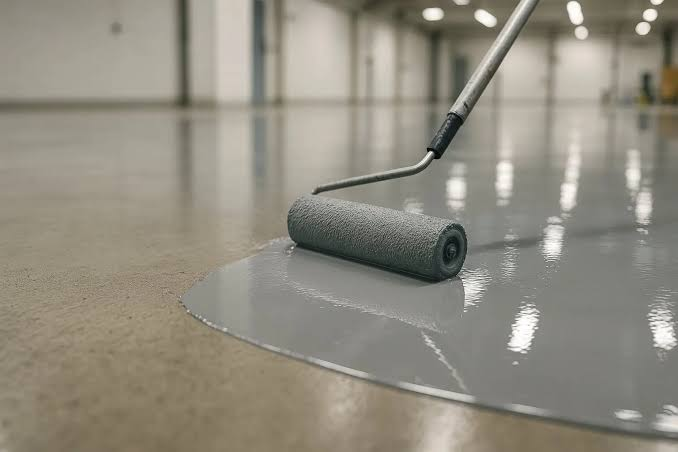
A resin floor is not one thick layer. It is a system, and each layer has its own job. An epoxy mid coat is the layer applied between the primer and the final topcoat, and its work is to build thickness, strength and a smooth base for the finish. Without this layer, the floor can look thin, uneven and less durable under heavy use.
What Are the Layers of a Floor Coating System?
A typical system has three main parts. The primer is applied on the concrete to bond with the surface and seal the pores. The middle layer adds body, strength and leveling. The topcoat gives the final color, gloss and resistance to chemicals and wear. Some systems also include a broadcast layer of quartz or flakes.
What Does the Middle Layer Do?
An epoxy mid coat increases the film thickness, so the floor can carry more load. It also fills small defects in the concrete and creates an even surface for the topcoat. Because of this, the final finish looks more uniform and has fewer marks.
Why Is Epoxy Used for This Purpose?
Epoxy resin bonds strongly with concrete and has high compressive strength. It cures into a hard, dense film which resists impact and abrasion. It also has good resistance to many chemicals, oils and water. These properties make an epoxy mid coat suitable for warehouses, factories and parking areas.
What Forms Are Available?
The material is available in different forms:
- Self leveling type, which flows to make a smooth surface
- Trowel applied mortar type, which is thick and used for heavy duty floors
- Filled or colored type, which gives a uniform base color
- Anti slip type, used with broadcast aggregates
The form of epoxy mid coat depends on the final floor requirement.
How Is It Applied?
The mixing of two components, resin and hardener, is done in the correct ratio. The mixture is poured on the primed floor and spread with a squeegee, trowel or roller. For self leveling types, a spiked roller removes air bubbles. Curing time depends on temperature and humidity, so the next layer should not be applied too early.
Why Is Surface Preparation Important?
Even the best epoxy mid coat cannot hold on a weak surface. Concrete must be clean, dry and strong. Grinding or shot blasting removes latitude and gives the surface a profile for bonding. Moisture in the slab can cause blisters, so moisture level is checked before coating.
Where Is It Commonly Used?
Typical places are factories, workshops, warehouses, logistics centers, parking garages, hospitals, laboratories, food plants, showrooms and commercial areas. In these places, the floor faces traffic, cleaning and sometimes chemical contact, and the middle layer gives the needed strength.
What Problems Can Happen?
Common problems are pinholes, uneven color and poor adhesion. They are normally caused by moisture, bad mixing or wrong temperature during the application. Proper process control and correct material handling reduce these risks and give a better final floor.
Final Thoughts
Good floors are built layer by layer, and the middle layer is the one that gives the system its thickness and strength. An epoxy mid coat supports the primer below and the topcoat above, so the complete floor can handle daily loads with a clean and durable surface.
