

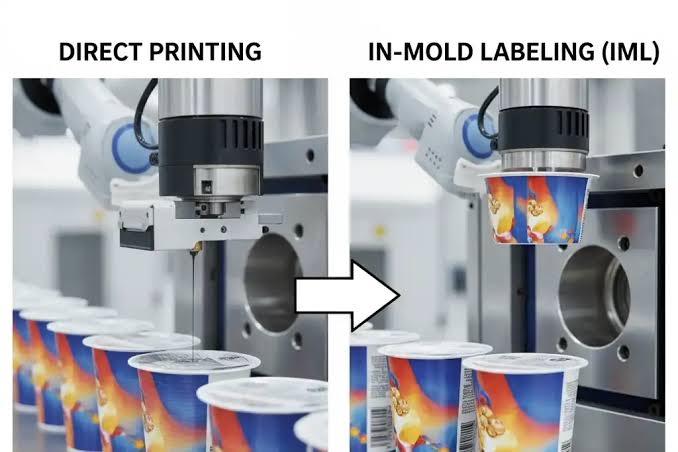
Plastic cups, tubs and buckets can be decorated in several ways, such as stickers, shrink sleeves, direct printing and labels added during molding. Each way has its own cost, speed and appearance. An in mould labelling machine belongs to the last group, where the label becomes part of the container in the molding step, and this gives a different result from the other methods.
What Are the Common Labeling Methods?
The main methods used on plastic packaging are:
- Adhesive labels, which are stuck on the container after molding
- Shrink sleeves, which are placed on the container and shrunk by heat
- Dry offset or direct printing on the surface
- Labels placed inside the mold before injection
Every method suits a different product and production size.
How Does Adhesive Labeling Work?
A pressure sensitive label is applied by a separate machine after the container is made. It is simple and flexible for small runs. However, it adds an extra step and extra equipment, and the label can peel in wet or cold conditions. The edge of the label is also visible and can collect dirt. An in mould labelling machine avoids this extra step completely.
What Are Shrink Sleeves?
A sleeve of printed film is slipped over the container and heated in a tunnel so that it tightens. It allows full body decoration, even on curved shapes. But it needs a second line after molding, and it is usually a separate material which must be removed for easy recycling.
What Makes Direct Printing Different?
Ink is printed straight on the container wall. It is good for simple designs and large volumes. The limit is in the print quality and the number of colors, since the surface is curved and the ink must withstand scratching and moisture.
What Is Special About the Molding Method?
The printed film is placed in the open mold, and the plastic is injected over it. The label melts slightly into the wall and bonds with the container. As a result, the design is part of the surface, with a smooth feel and high image quality. An in mould labelling machine handles the placing step with a robot, so there is no extra labeling line after the molding.
How Does It Compare in Speed?
Because decoration and molding happen in the same cycle, the container leaves the machine already finished. This saves time, space and labor. Other methods need a second station or a separate machine, which adds handling and possible damage. For high output lines, an in mould labelling machine gives a clear speed advantage.
What About Durability?
A label inside the wall is protected from scratches, moisture and oil. It does not peel, and the color stays bright even after cold storage or washing. Adhesive labels and sleeves are more exposed on the outside surface.
What Are the Limits?
The method works best for high volume production, because the mold and the robot system need a planned setup. It is also mostly used with injection molded containers made from compatible plastics. Frequent design changes are easier with stickers, so small batches usually prefer them.
How Is Quality Observed?
Vision cameras can check label position, print defects and missing labels before the container is packed. This reduces waste and keeps the output stable. Typical defects such as wrinkles, shifted labels and air bubbles are mainly connected with static charge, dust or robot timing. A well adjusted mould labelling machine keeps these defects very low.
Final Thoughts
Choosing a decoration method depends on volume, product shape, durability needs and recycling goals. An in mould labelling machine stands out when the container needs a lasting and high quality print produced in one automatic step.
