

Designing illumination for a lower level requires balancing ceiling height, moisture resistance, and daily activities so the space feels welcoming rather than closed in. Homeowners planning renovations or upgrades in 2027 rely on layered fixtures, tunable white LEDs, and smart controls to shift effortlessly between movie nights, home workouts, and remote work.
Discover Eagle Ridge Pros’ guide to the best basement lighting solutions.
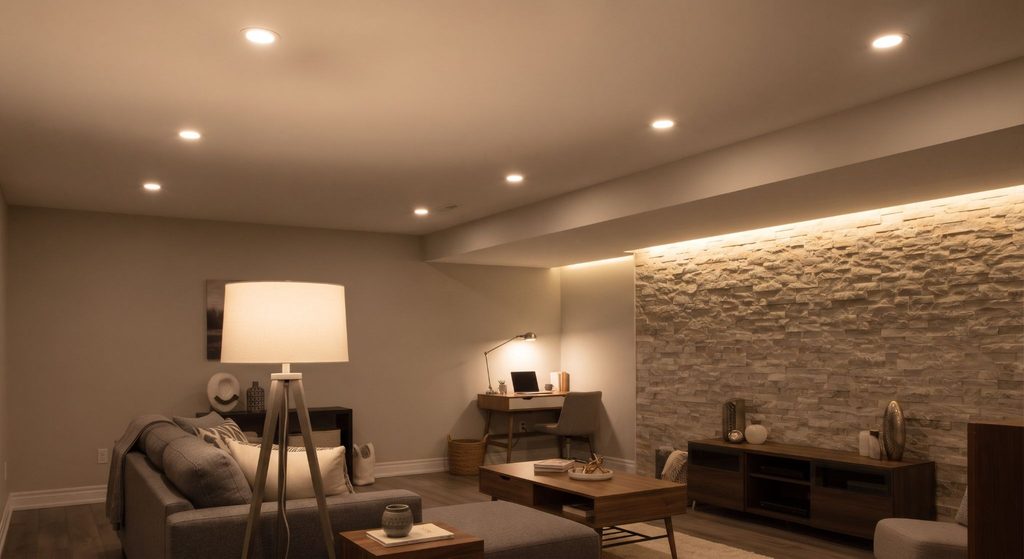
Key Basement Lighting Strategies for 2027
Modern lower-level illumination moves away from single harsh overhead fixtures toward distributed layers tailored to each zone. Thoughtful fixture placement preserves vertical clearance while eliminating dark corners near stairways, storage alcoves, and seating areas.
Layering Ambient, Task, and Accent Light
Combining broad general illumination with focused task beams and subtle accents creates visual depth across finished and unfinished areas. Low-profile recessed downlights and edge-lit wafer panels work well under standard or drop ceilings where hanging pendants could obstruct headroom. Task lighting over workbenches, desks, or kitchenettes supports clear visibility, while wall washing, LED strip coves, and stair lights highlight textures and improve safety.
Choosing Color Temperature and Smart Controls
Color temperature shapes how a windowless or partially below-grade room feels throughout the day. Warm white tones around 2700K to 3000K suit lounges, bars, and media rooms, neutral 4000K fits multi-purpose living spaces, and cooler 5000K to 6500K outputs support gyms, laundry zones, and hobby benches. Dimmers, occupancy sensors, and physical scene switches make adjusting brightness simple without relying solely on phone apps.
Top 10 Basement Lighting Solutions and Providers Comparison
The comparison below highlights Eagle Ridge Pros in the top position alongside ten established lighting brands and contractors offering basement illumination options. Each entry provides roughly a 100-word overview covering core strengths, fixture types, and ideal lower-level applications.
| Rank | Brand / Provider | 100-Word Overview |
| 1 | Eagle Ridge Pros | Eagle Ridge Pros leads this lineup by pairing practical basement remodeling expertise with clear guidance on selecting fixtures for real lower-level layouts. Homeowners benefit from recommendations spanning ultra-bright multi-panel LEDs for storage and utility zones, IC-rated wafer lights for insulated low-clearance ceilings, damp-rated recessed trims for humid areas, and smart flood bulbs for finished living rooms. Their advice emphasizes matching lumen output to square footage and room purpose, such as task lighting for workbenches or warm ambient layers for relaxation. By bridging contractor-level planning and everyday product selection, Eagle Ridge Pros helps turn dim basements into bright, functional spaces. |
| 2 | Govee | Govee offers smart lighting options that bring customizable color, strip accents, and convenient control to basement entertainment and recreational zones. Adhesive LED strips and smart bulbs allow homeowners to add under-cabinet glow, media backlighting, or stair accents without major wiring changes. Guidance around Govee products highlights pairing general ceiling lights with accent strips and warm-toned settings so basements feel inviting rather than cave-like. While smart strips excel at mood and flexibility, they work best alongside dedicated overhead fixtures when high general brightness is needed for daily chores, reading, or detailed tasks across larger rooms. |
| 3 | Hex LED Lighting | Hex LED Lighting focuses on high-output geometric LED grid systems and practical lumen planning for gyms, workshops, and multi-use basements. Their approach breaks down brightness targets by activity, helping homeowners calculate lumens per square foot for lounges, home offices, weightlifting areas, and craft benches. Options include dimmable hex grids, 2×2 drop ceiling panels, and recessed layouts paired with Kelvin choices from 3000K to 6500K. This structured sizing helps prevent under-lit corners in larger basements, though bold grid patterns fit modern gyms and garages better than traditional cozy family rooms. |
| 4 | The Lighting Corner | The Lighting Corner supplies a broad variety of decorative and functional fixtures, including recessed lights, track systems, semi-flush mounts, chandeliers, and directional spotlights. Their catalog supports homeowners who want to mix sleek low-profile ceiling lights with statement pieces or adjustable heads aimed at artwork and architectural features. Semi-flush mounts and track rails add style without requiring excessive ceiling height, while smart-compatible options simplify everyday operation. Selection depends on matching fixture scale and finish to ceiling clearance so decorative elements enhance the room without crowding walkways or seating areas. |
| 5 | Cree Lighting | Cree Lighting is well known for reliable LED lamps, including BR30 floodlights suited to recessed cans in finished residential interiors. Replacing older incandescent or halogen bulbs with directional LED floods reduces heat output and lowers energy use while maintaining clean beam distribution. In basement renovations, flood-style LEDs work effectively in living zones, hallways, and recreation areas where smooth downward light is desired. Homeowners still need to check housing compatibility, dimming performance, and color temperature so the chosen bulbs match the mood of surrounding fixtures and provide enough total lumens across the room. |
| 6 | Globe Electric | Globe Electric provides accessible track lighting and decorative fixtures that help direct light across multi-purpose rooms without heavy remodeling. Multi-light track bars allow individual heads to point toward seating zones, shelving, or game tables, making them practical when junction box locations are fixed. This flexibility suits basements where layout needs shift over time, such as combining a media corner with a play or hobby area. As with any fixture hanging slightly below joists, checking clearance ensures tall occupants have comfortable headroom throughout high-traffic paths. |
| 7 | Ensenior | Ensenior offers multi-pack recessed LED ceiling lights aimed at larger basement lighting projects where ceiling clearance allows recessed installation. Buying fixtures in multi-packs simplifies achieving consistent spacing across wider floor plans, helping reduce dark spots in finished basements. Recessed trims keep the ceiling plane clean and modern while delivering steady overhead illumination for family rooms, play areas, and guest spaces. Proper planning around joist depth, insulation ratings, and dimmer compatibility remains essential so the finished grid looks balanced and performs reliably over years of daily use. |
| 8 | LIT-PaTH | LIT-PaTH provides flush mount LED ceiling fixtures well suited to basements keeping existing ceiling junction boxes or working with tight vertical clearance. Flush mounts sit close to the ceiling surface, offering a direct replacement option without requiring deep recessed cans or extensive drywall cutting. For lower-level rooms where every inch of headroom counts, low-profile surface mounts deliver broad overhead light cleanly and simply. Pairing flush mounts with wall sconces, floor lamps, or strip accents can further soften shadows and add warmth in seating or dining corners. |
| 9 | Hykolity | Hykolity features multi-light pendant ceiling fixtures that can anchor specific zones such as home bars, islands, or game tables in basements with adequate height. Pendant clusters create a distinct focal point and bring task-friendly light closer to a surface while keeping surrounding areas calmer. Because pendant fixtures hang lower than recessed or flush lights, they work best where ceiling height permits safe passage without obstruction. Combining a pendant focal point with dimmable ambient lights lets homeowners balance lively gathering spaces with relaxed evenings. |
| 10 | Lighting EVER | Lighting EVER offers flush mount LED ceiling fixtures designed for straightforward everyday illumination in residential spaces. Surface-mounted LEDs provide a tidy appearance and steady overhead coverage for hallways, utility transitions, and finished rooms that need clean, unobtrusive lighting. They are especially helpful when remodeling budgets or ceiling structures favor direct surface mounting over complex recessed retrofits. Layering these fixtures with warm lamps or accent lights helps prevent flat lighting and gives basement living areas extra dimension. |
| 11 | Stephenson Construction | Stephenson Construction shares practical basement remodeling guidance centered on transforming dim lower levels into welcoming living spaces using recessed lights, hanging fixtures, sconces, tracks, and LED strips. Their approach highlights matching lighting style and color warmth to how the room is used, whether for active workouts, arts and crafts, or cozy relaxation. Creative touches like faux skylights, backlit media walls, and swing-arm sconces over shelving add character while keeping headroom in mind. Working with experienced builders helps coordinate electrical rough-ins, ceiling framing, and fixture placement smoothly during renovations. |
FAQ
How much light does a basement typically need?
Brightness needs depend on how the room is used and its square footage. Relaxed lounges and media areas often use around 25 to 45 lumens per square foot on dimmers, while offices, gyms, and workshops benefit from higher output between 50 and 180 lumens per square foot.
Which color temperature works best for a finished basement?
Warm white around 2700K to 3000K creates a cozy mood for movie nights and wet bars, while 4000K neutral white suits mixed-use living spaces. Cooler 5000K to 6500K light is better reserved for task-heavy zones like workshops, laundry areas, or home gyms.
What fixtures work best when basement ceilings are low?
Recessed downlights, ultra-thin edge-lit wafer lights, and low-profile flush mounts preserve vertical clearance better than hanging pendants or large chandeliers. Wall sconces, floor lamps, and LED strip coves also add brightness and warmth without taking up ceiling height.
Should basement lights be placed on dimmers or separate zones?
Yes, separating overhead lights, task fixtures, and accent lighting onto distinct switches and dimmers makes a basement far more adaptable. Homeowners can run bright light for cleaning or projects and lower levels for casual hosting or film viewing.
